Sigma has always been known as a leader in analytics, with its cloud-built platform designed to support today's massive data scale challenges.
Sigma has been extended to enable customers to build rich, interactive applications, automate workflows, and take action customized to their team's needs—all without writing any code.
This QuickStart demonstrates how to use Sigma to build an AI Application (app) entirely within the Sigma UI. The data used will come from, and be stored in, Snowflake. During this demonstration, we will build a fully functional project tracking AI App that, in the past, may have taken significant time to get up and running.
Prefer to watch first? Watch the short summary video to see how the app is built with input tables, modals, controls, and actions.
This QuickStart is a bit longer than usual, and we understand that people can be pressed for time. While it is well worth the investment, if you can't spare the time, you can instead watch this 5-minute video to see how impactful Sigma AI apps can be for your organization.
What we will build
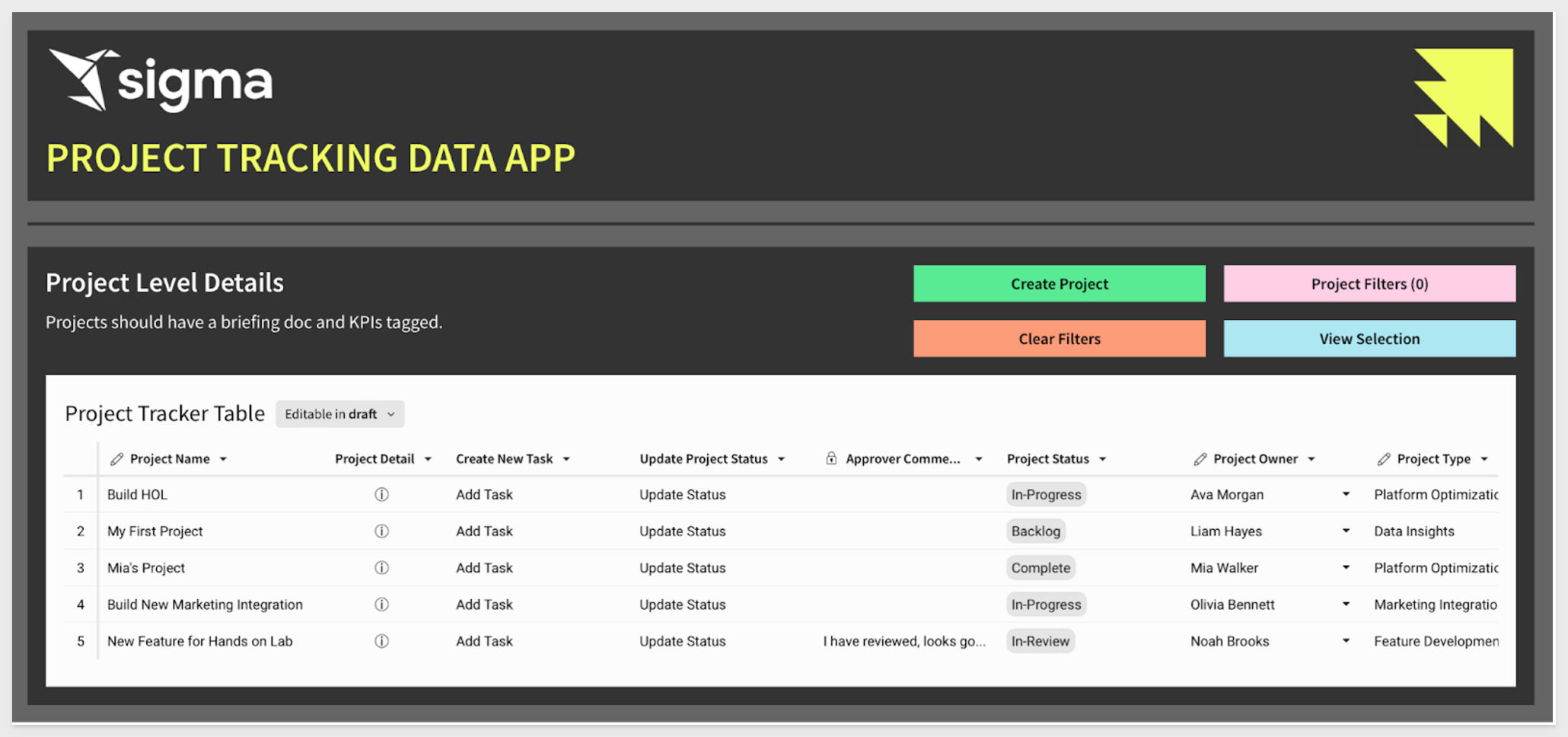
After completing this QuickStart, we will have built a fully functional AI App based on a project management use case.
The finished product can look something like this (depending on your styling choices!):
If something isn't working as expected, here's how to contact Sigma support
For more information on Sigma's product release strategy, see Sigma product releases
Target Audience
Sigma builders interested in leveraging the advanced capabilities to create fully functioning AI Apps.
Prerequisites
- A computer with a current browser. It does not matter which browser you want to use.
- Access to your Sigma environment.
- Some familiarity with Sigma is assumed. Not all steps will be shown as the basics are assumed to be understood.

Teams managing work across initiatives, customer rollouts, and internal programs need a way to see what's in flight, what's blocked, who owns each task, and whether the work has been approved. Spreadsheets get messy; standalone project tools mean another login, another data silo, and integration work to get the numbers back into your analytics.
The Project Tracker built in this QuickStart keeps the entire app inside a Sigma workbook, backed by your warehouse. Project records, task hierarchy, status history, approval state, and the UI to manage all of it land in one place — no separate database, no hand-built forms, no custom approval routing.
The app supports the following capabilities:
Category | Description |
Projects | Top level reporting. |
Tasks | Tasks are children of projects. Each project may have one or more tasks. |
Status | Project status changes over time. The app tracks status history while displaying only the latest status for each project. |
Approvals | All projects must be reviewed and approved before being marked complete. |
UI | All project details visible in one place. |
Throughout the build, we'll exercise these core Sigma areas:
- Input Tables:
- Data validation
- Input tables + Actions
- Overlays / Modals:
- Forms
- Filters
- Controls:
- Building a control panel
- Interaction of controls and actions
- Building the application interface
- Approval workflow
- Themes
The following is a guideline for the different parts of the Sigma interface so that we are oriented to the terms that will be used throughout this QuickStart. Not every item is called out, but the most used ones are.
Workbook page - published version
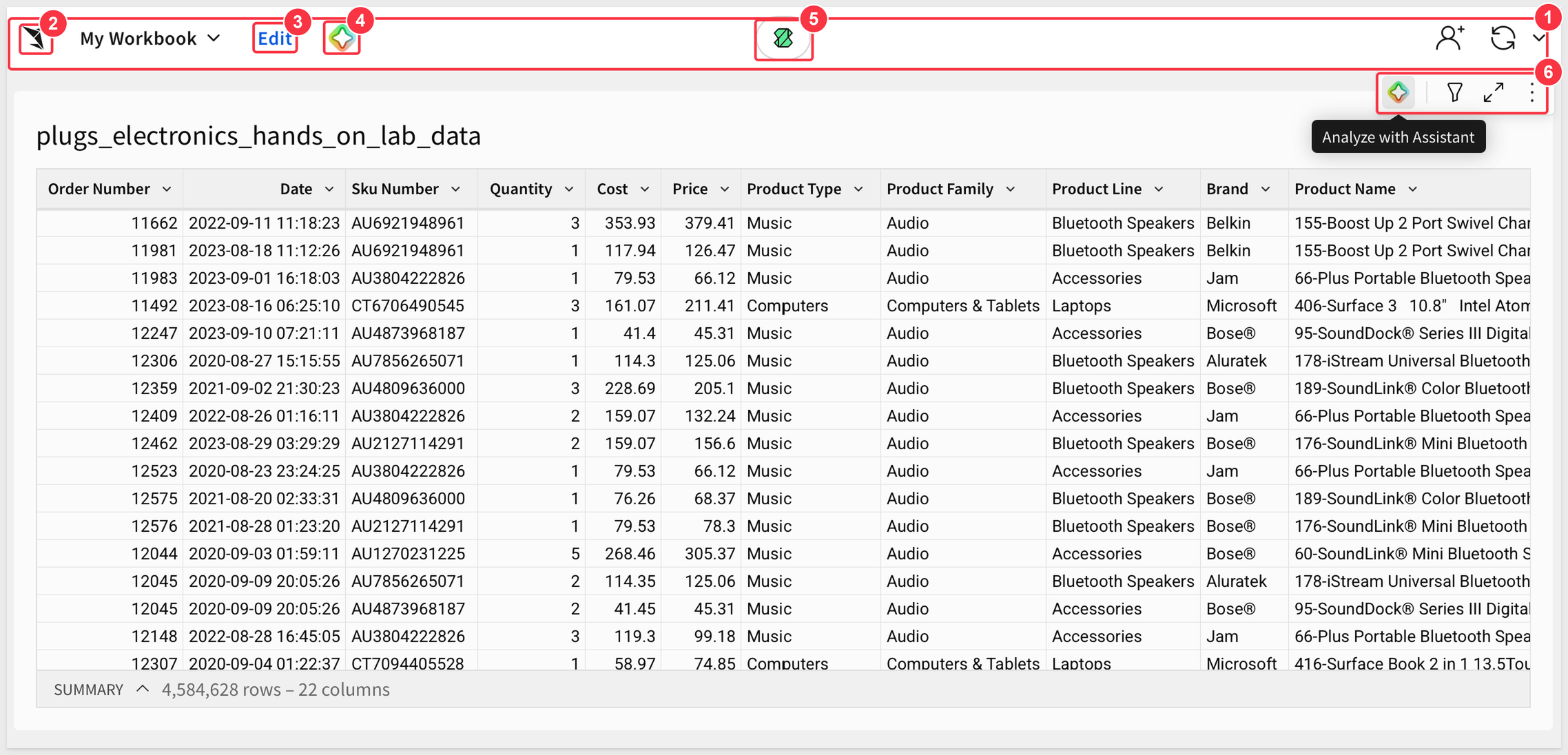
The numbered areas are:
- (1)
Workbook header - (2)
Sigma home: returns to Sigma Home. - (3)
Edit: opens the workbook in edit mode. - (4)
Assistant: opens Sigma Assistant. - (5)
Customize workbook - (6)
Customize selected element: the element toolbar, shown above the selected element.
Workbook menu - published version
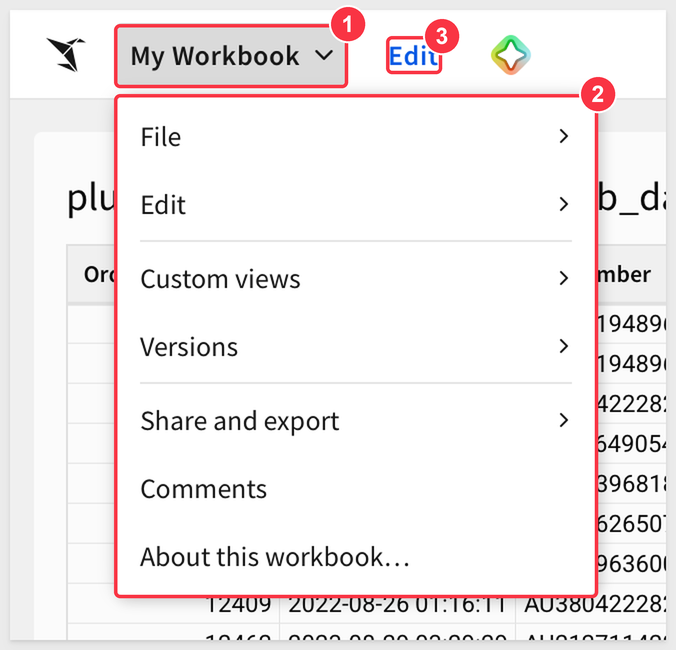
The numbered areas are:
- (1)
My Workbook: opens the workbook menu. - (2) The workbook menu:
File,Edit,Custom views,Versions,Share and export,Comments, andAbout this workbook.... - (3)
Edit: opens the workbook in edit mode.
Workbook page - edit mode
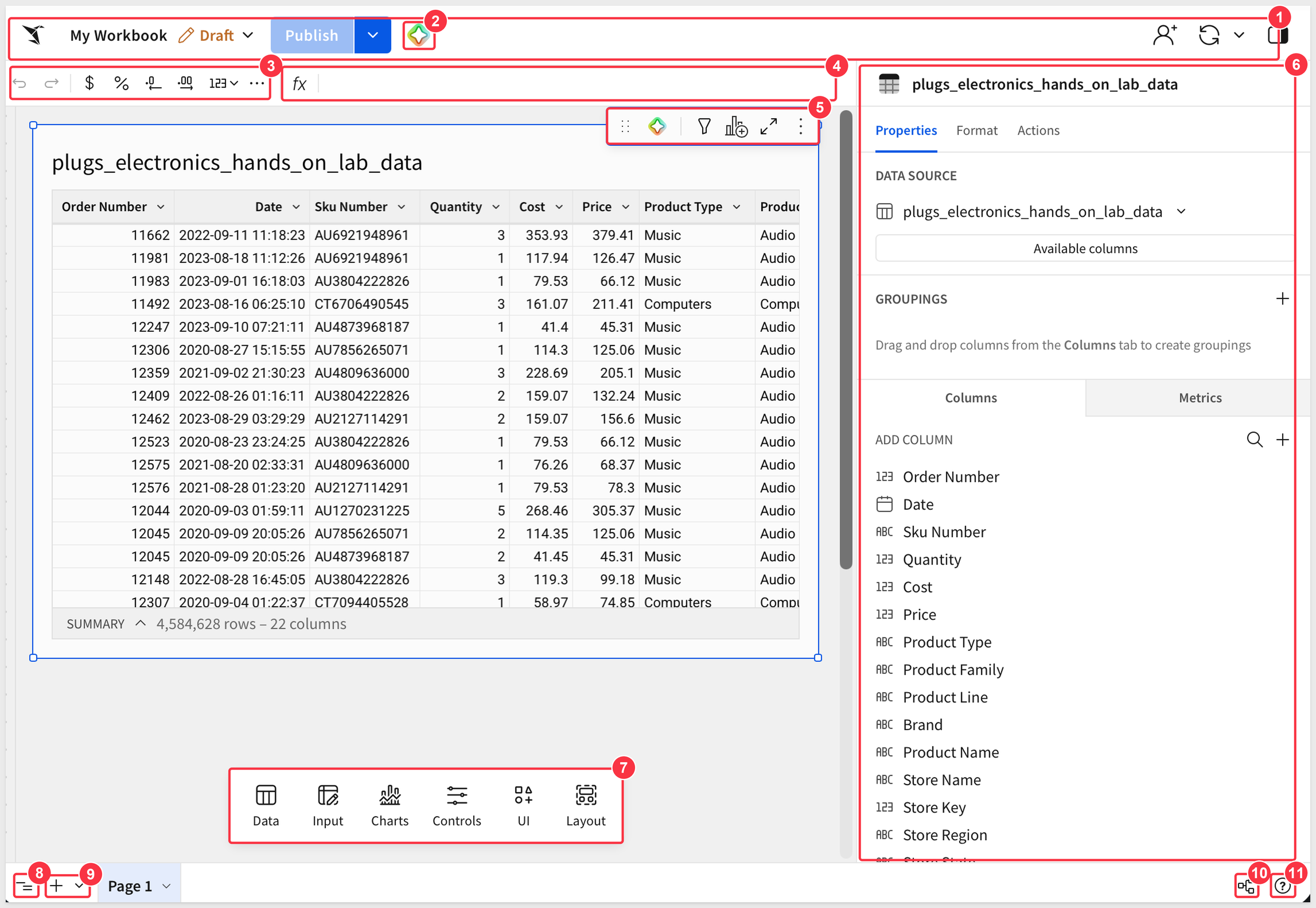
The numbered areas are:
- (1)
Workbook header: the workbook name and draft status,Publish, and workbook-level controls. - (2)
Assistant: opens Sigma Assistant. - (3)
Toolbar: undo, redo, and formatting for the selected column or element. - (4)
Formula bar: view and edit the formula for the selected column. - (5)
Element toolbar: appears above the selected element. - (6)
Element panel: the right-hand sidebar for configuring the selected element, withProperties,Format, andActions. - (7)
Element bar: adds new elements to the page:Data,Input,Charts,Controls,UI, andLayout. - (8)
Page overview: lists the pages and elements in the workbook. - (9)
Add page: adds a new page. - (10)
Workbook lineage: shows where the workbook's data comes from. - (11)
Help: help options.
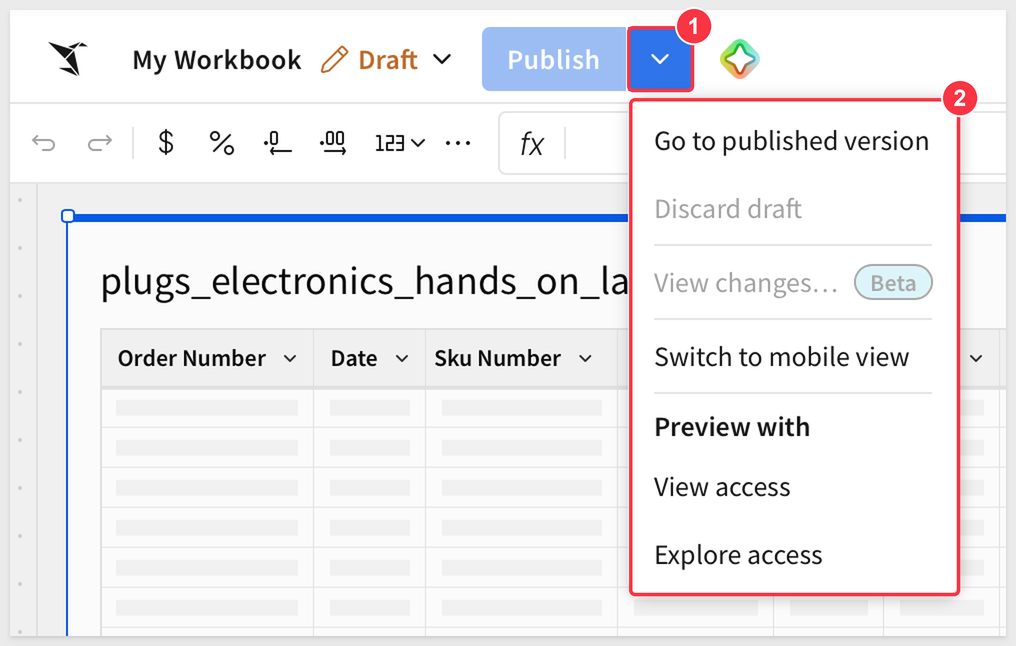
Publish menu - edit mode
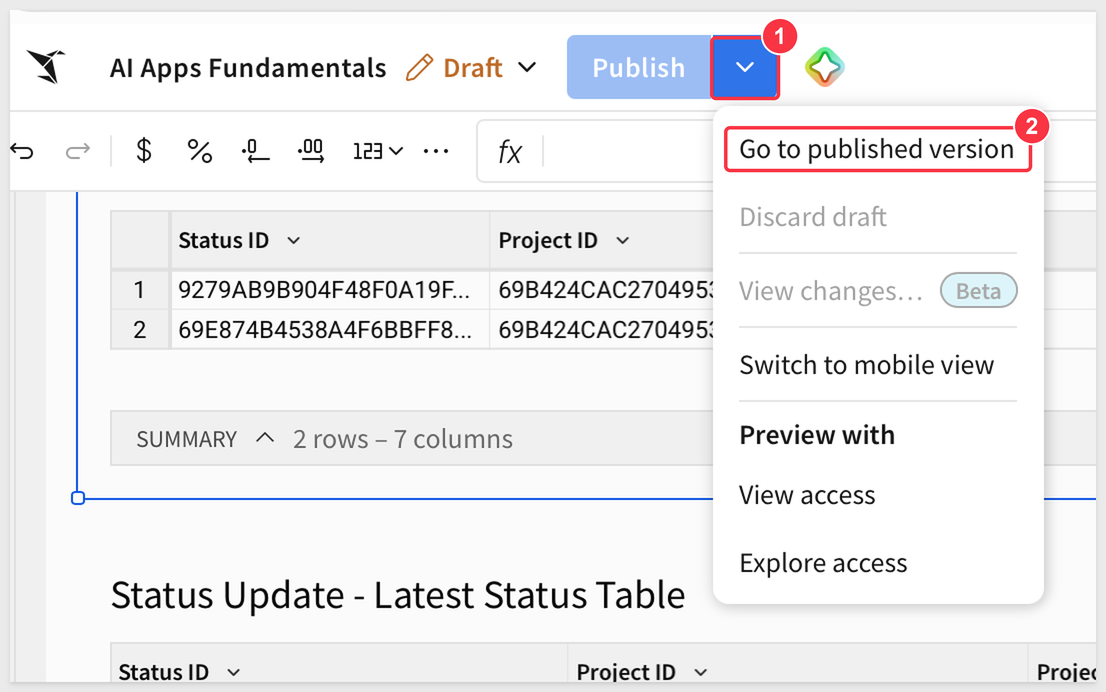
Open the arrow next to Publish (1) to go to the published version, discard the draft, switch to mobile view, or preview the workbook with View access or Explore access (2).
For more information, see Getting around in Sigma
Input tables are dynamic workbook elements that support structured data entry. They allow you to integrate new data points into your analysis and augment existing data from your data platform to facilitate rapid prototyping, advanced modeling, forecasting, what-if analysis, and more—without overwriting source data.
Use input tables as sources for tables, pivot tables, and visualizations, or incorporate the data using lookups and joins. And when you create warehouse views for input tables, you can reuse the manually entered data across your broader data ecosystem.
There are many options to control how users are permitted to use input tables.
For more information on this topic, see: Input tables overview
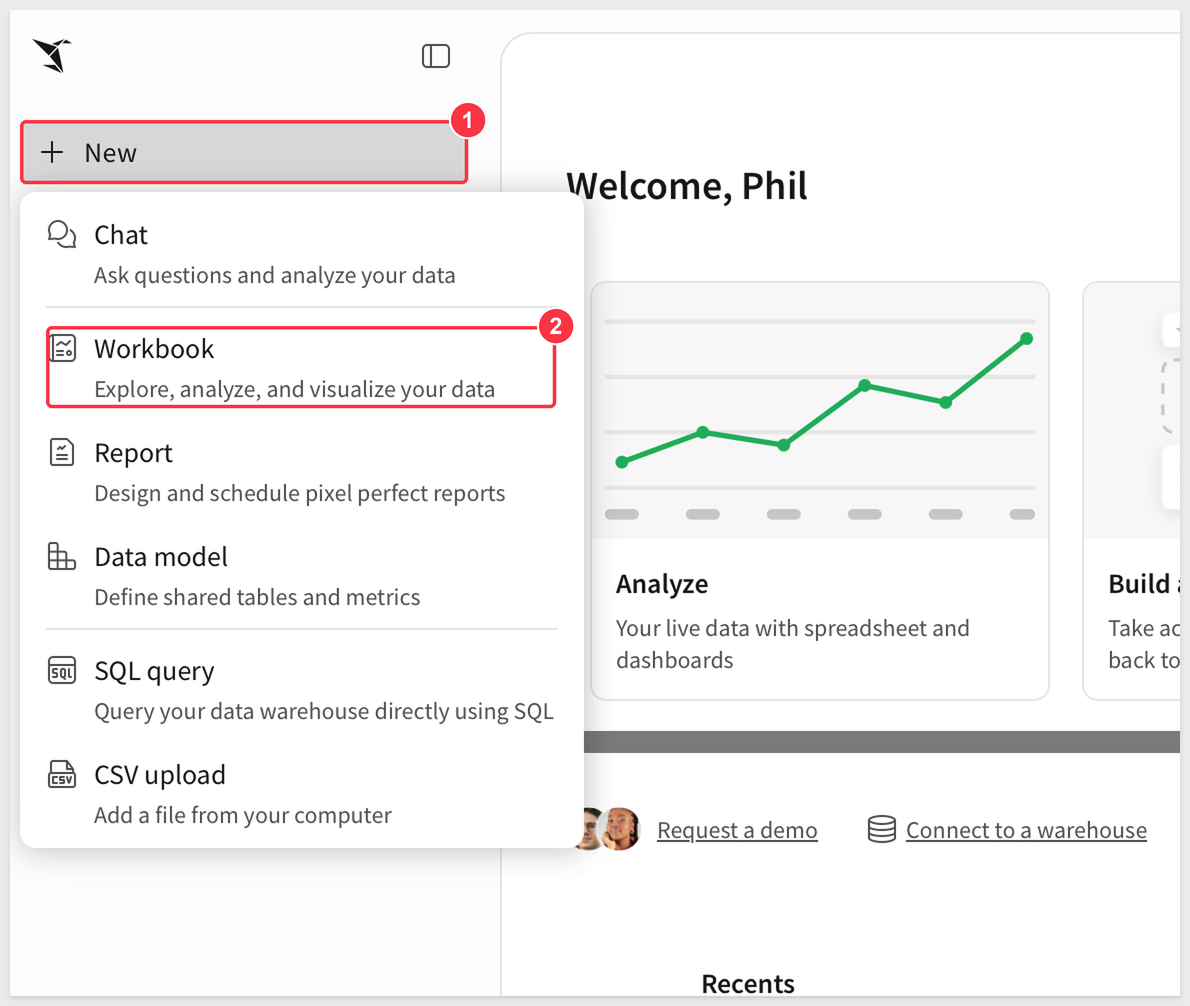
Step 1: Open a blank workbook in Sigma:
Log into Sigma and select + New (1) > Workbook (2) from the homepage:
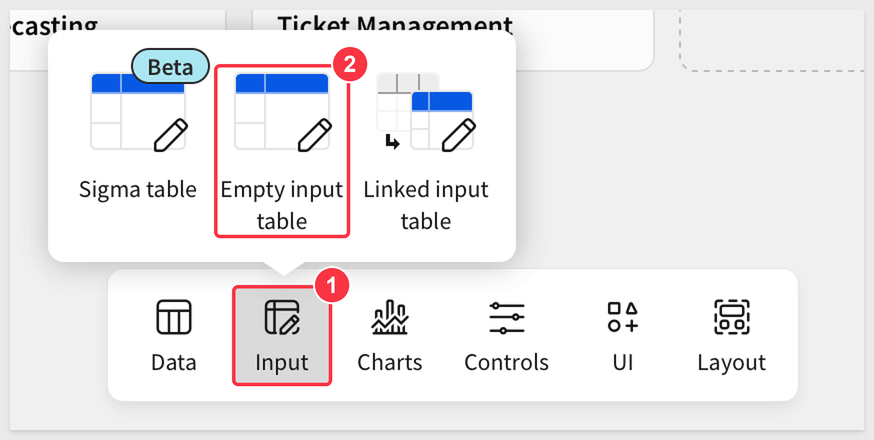
Step 2: Add empty input table:
Create an empty input table on Sigma Sample Database by clicking Input (1) in the element bar and dragging Empty input table (2) onto the page.
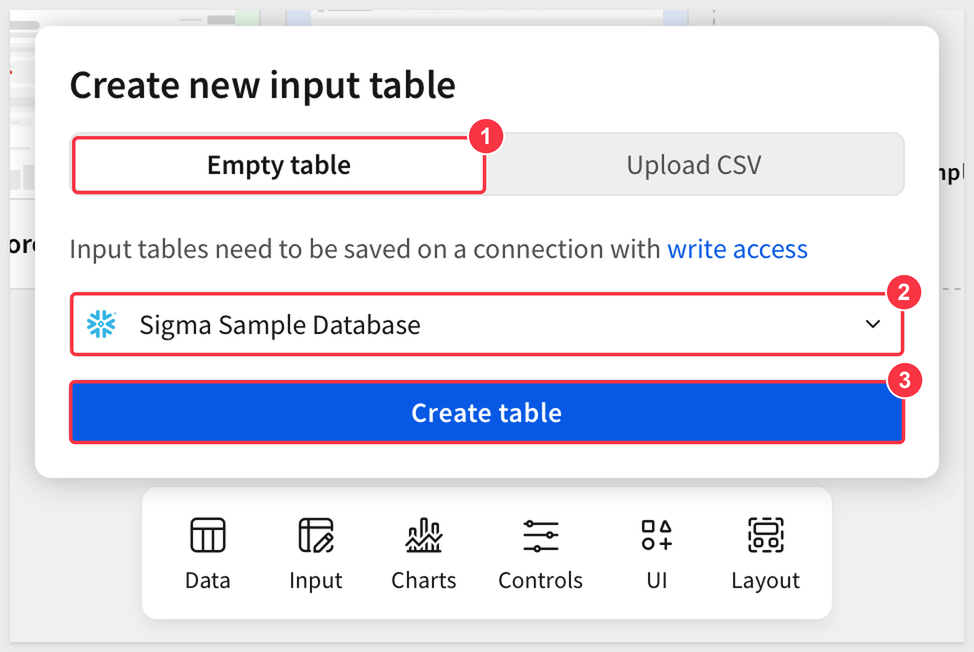
In the Create new input table dialog, leave Empty table selected (1), confirm the connection is Sigma Sample Database (2), and click Create table (3).
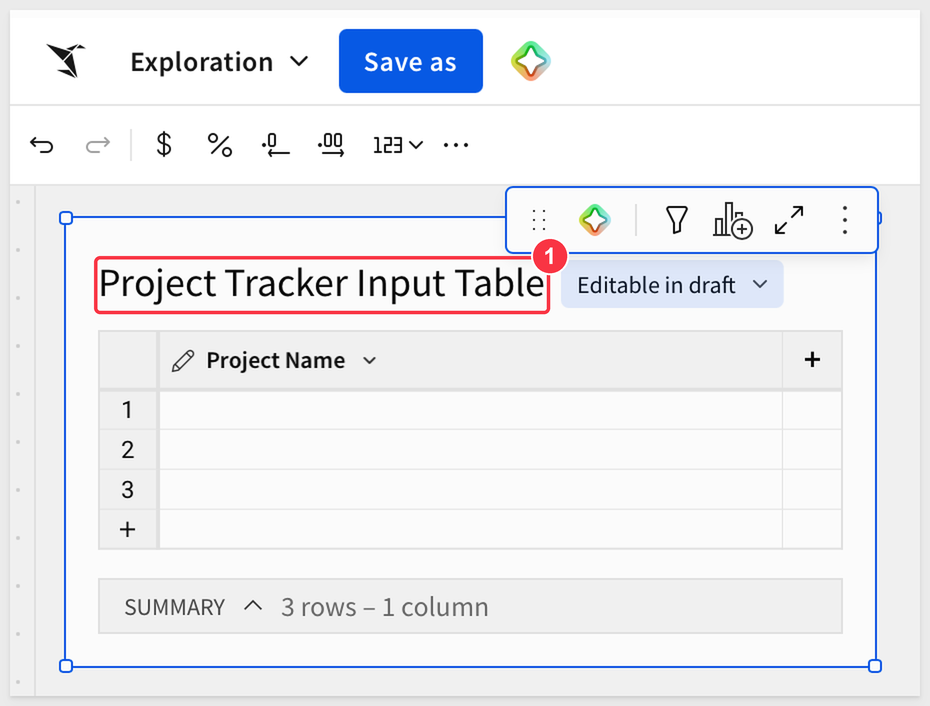
Change the title of the new input table (by double-clicking its current title) to Project Tracker Input Table (1):
Step 3: Add new columns:
In this step, we will create three new columns: two as text and one as date format.
First, rename the existing Text column to Project Name.
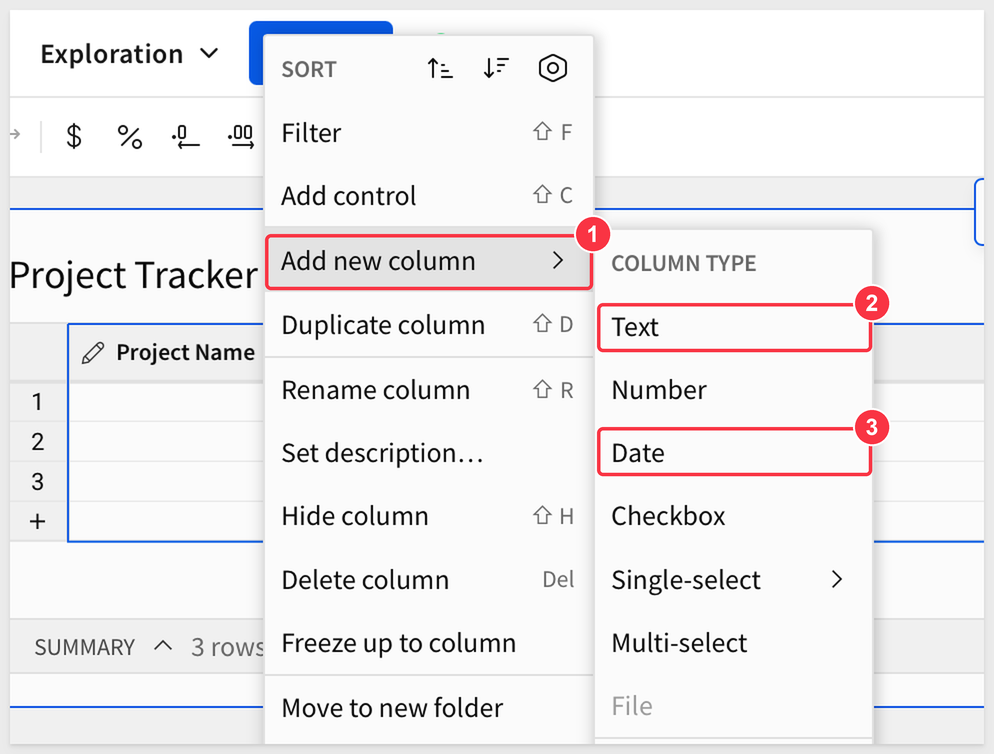
Next, open the menu for the Project Name column and select Add new column (1). Add two Text columns (2) and one Date column (3):
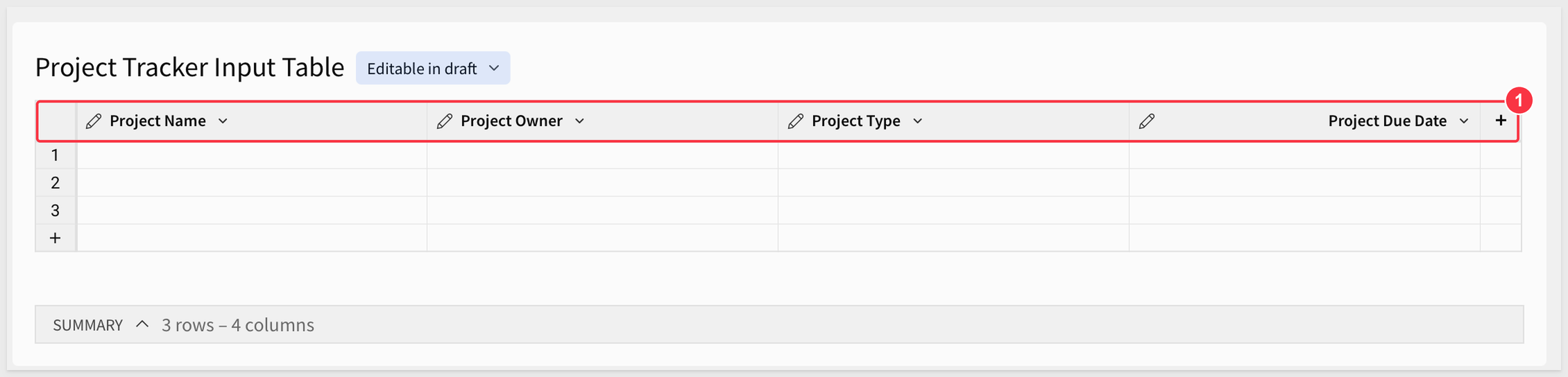
Rename the new columns to Project Owner, Project Type, and Project Due Date respectively (1):
Step 4: Rename the page
Rename the workbook page to Project Tracker (1) and add a new page, by clicking the + icon (2) in the footer. Rename it to Data Validation (3):

Step 5: Validation input tables
In this step we will create three additional input tables, reloading them with data from csv files.
Click the button below to download the files (in zip format). Extract them to a known location to make them easy to find.
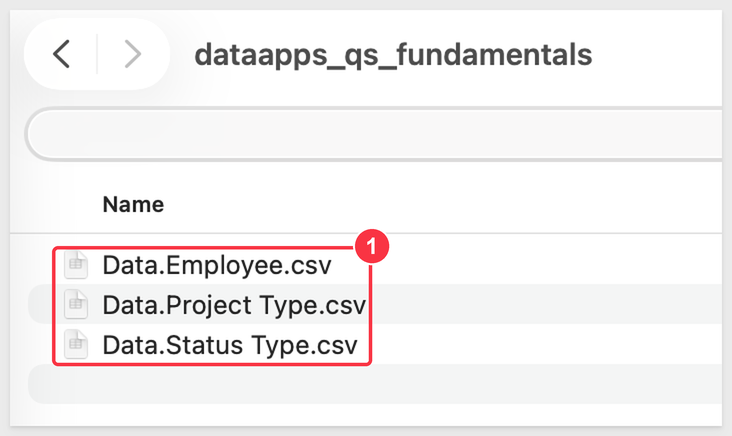
The download will contain three csv files once extracted (1):
Now that we have the files, go to the Data Validation page. We will add three CSV input tables there using the element bar as we previously did.
The only different thing in this workflow is we will select Upload CSV from the Input table element bar group:
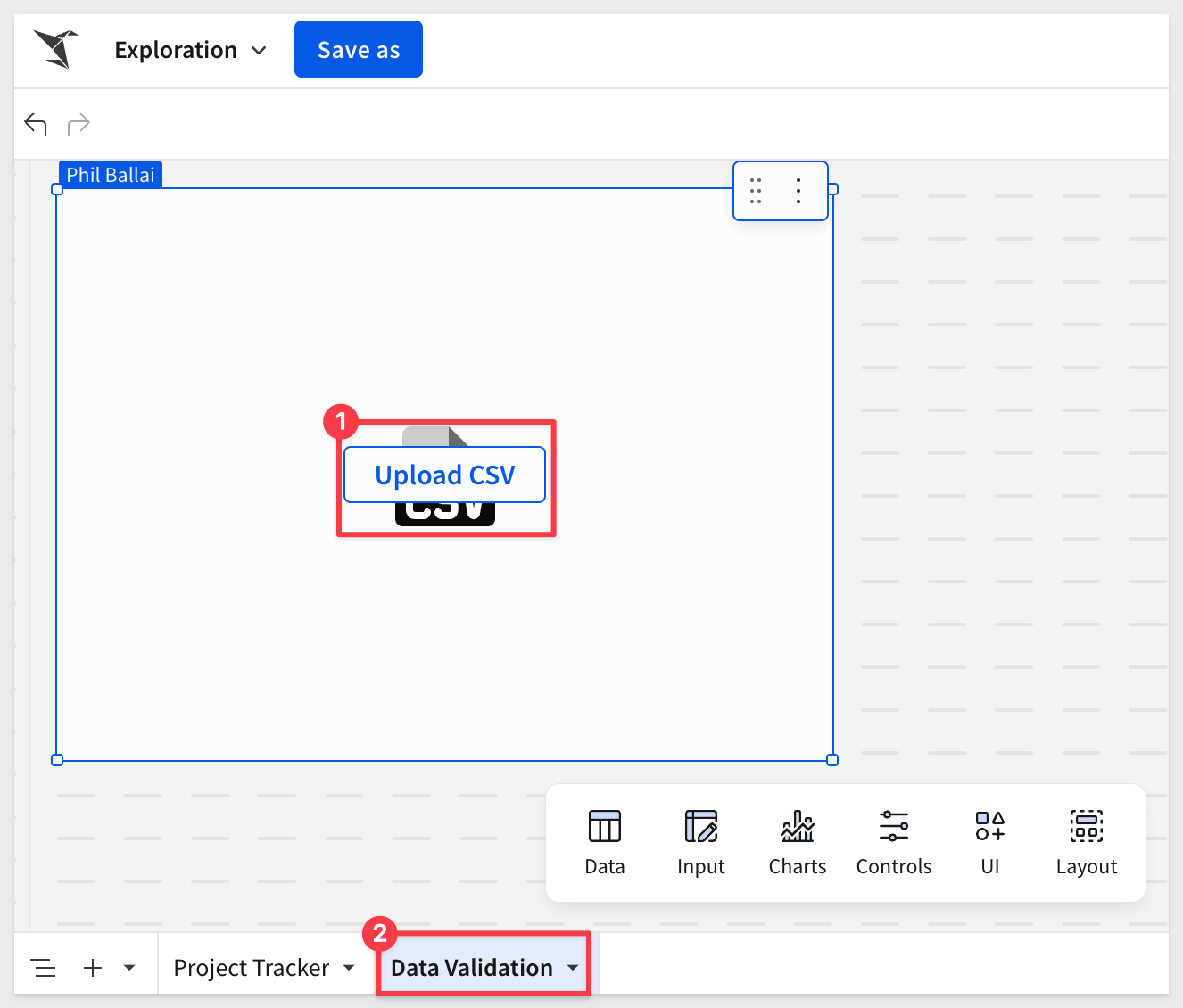
Browse to where the csv files downloaded are stored and select the first one.
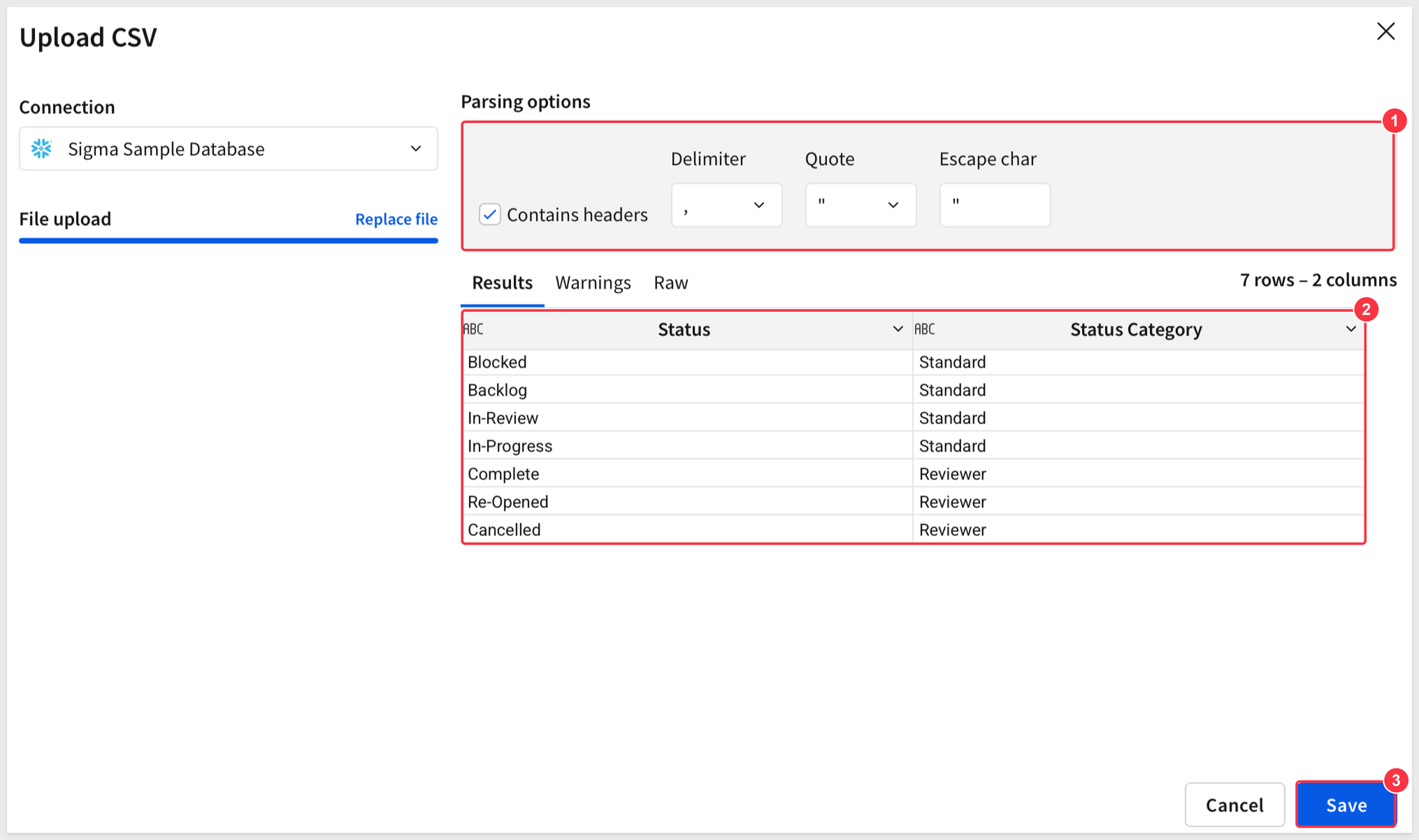
After selecting the first csv file, Sigma allows you to adjust the Parsing options (1) and review the parsed data (2). This ensures the data makes it to the input table as expected. If everything looks correct, click Save (3).
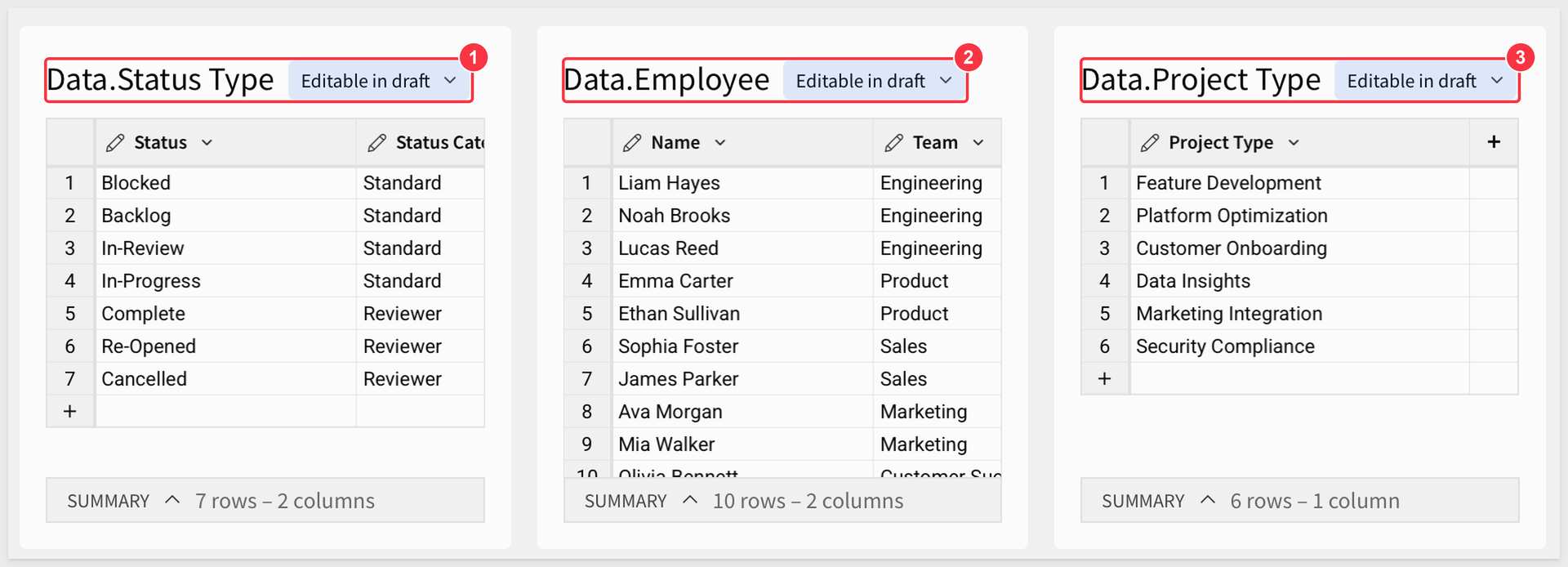
Sigma names each new input table after its csv file. Once all three input tables are added, the Data Validation page has Data.Status Type (1), Data.Employee (2), and Data.Project Type (3):
Step 6:
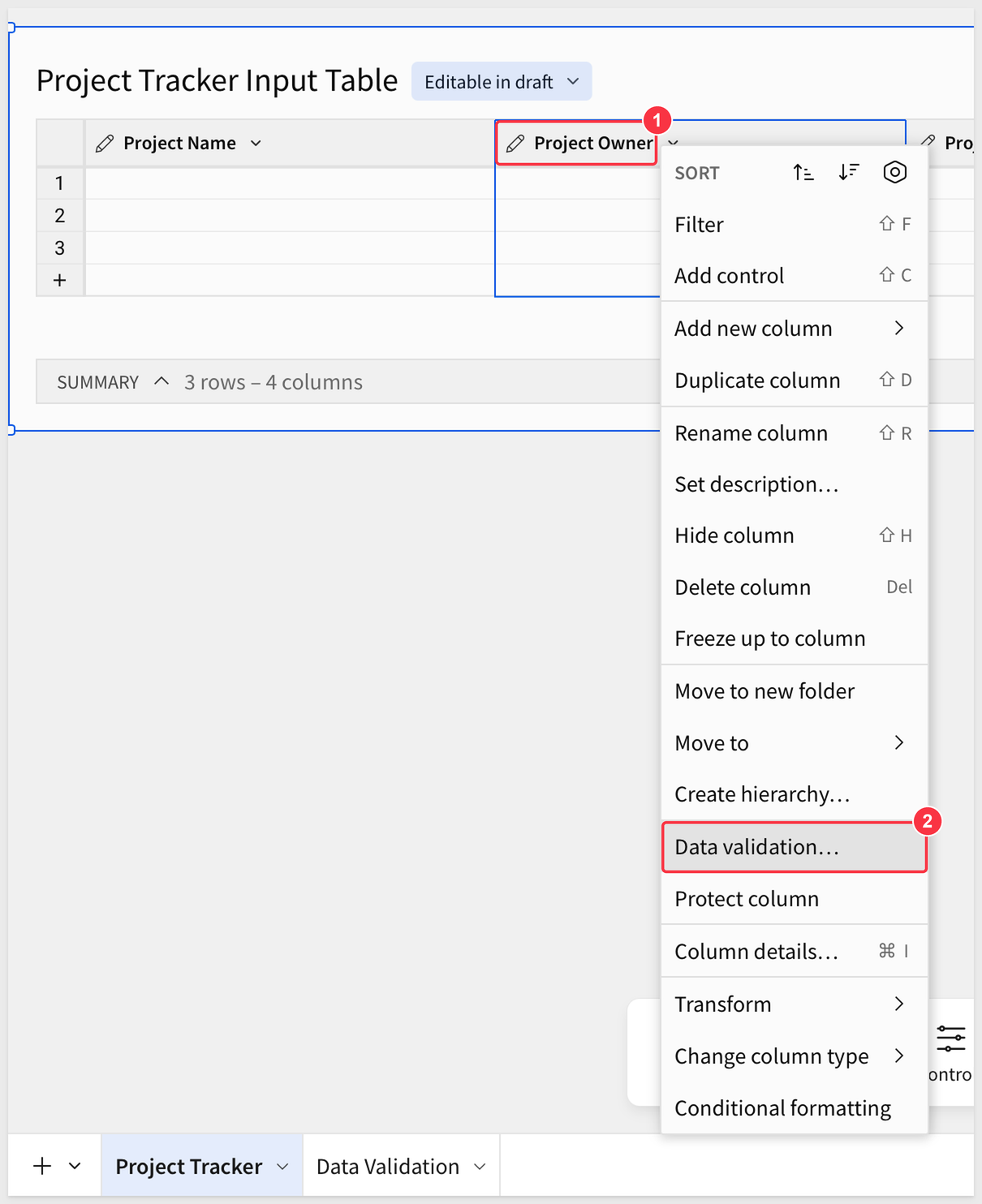
On the Project Tracker page, open the menu for the Project Owner column (1) on the Project Tracker Input Table and select Data validation (2):
For Option source (1), select Data Validation - Data.Employee. The Name column (2) from that table is automatically selected.
Also click Convert (3) to convert this column to a Single-select to take advantage of more styling options. It makes sense that a project would have one Project Owner in our use case:
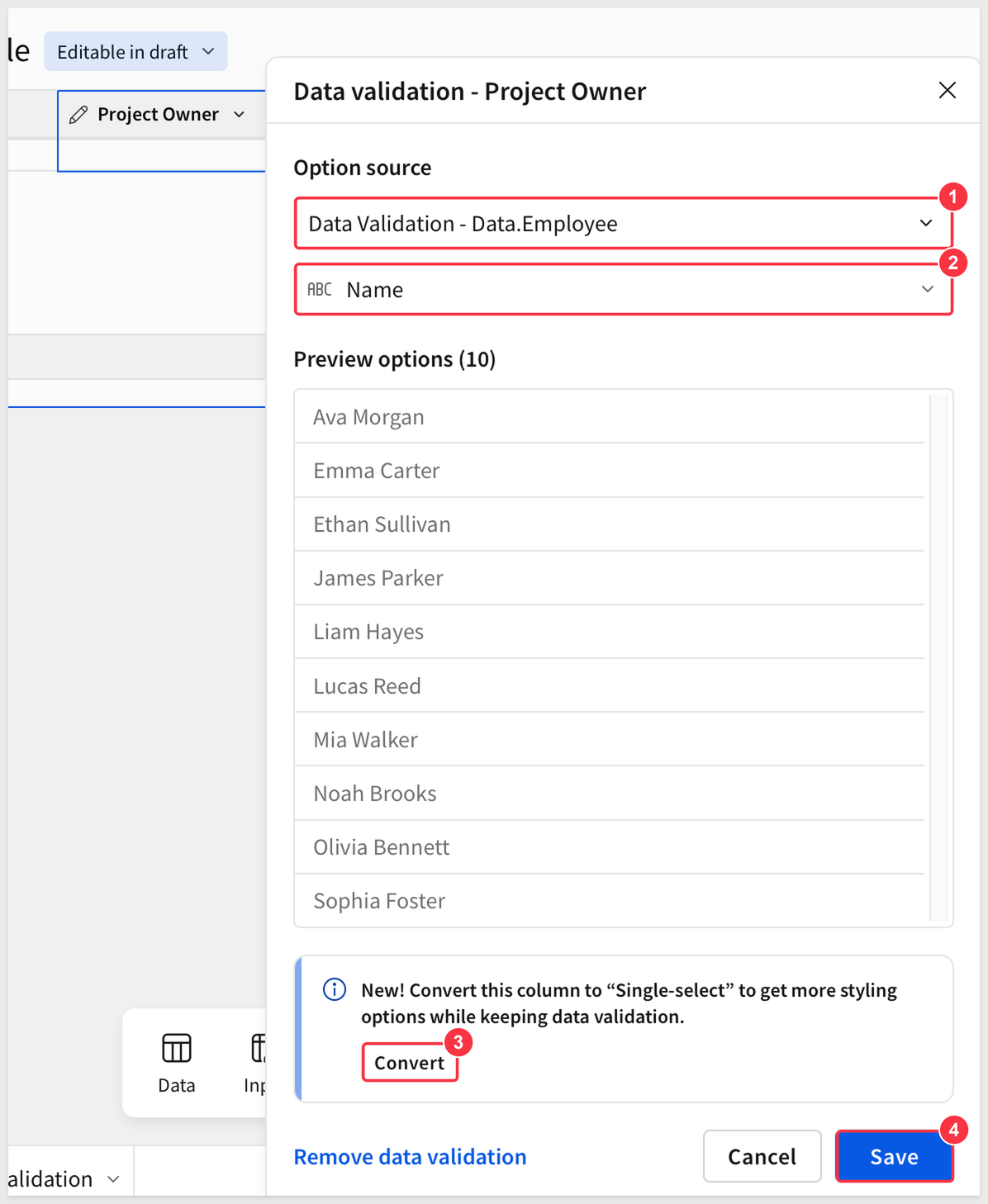
Click Save (4).
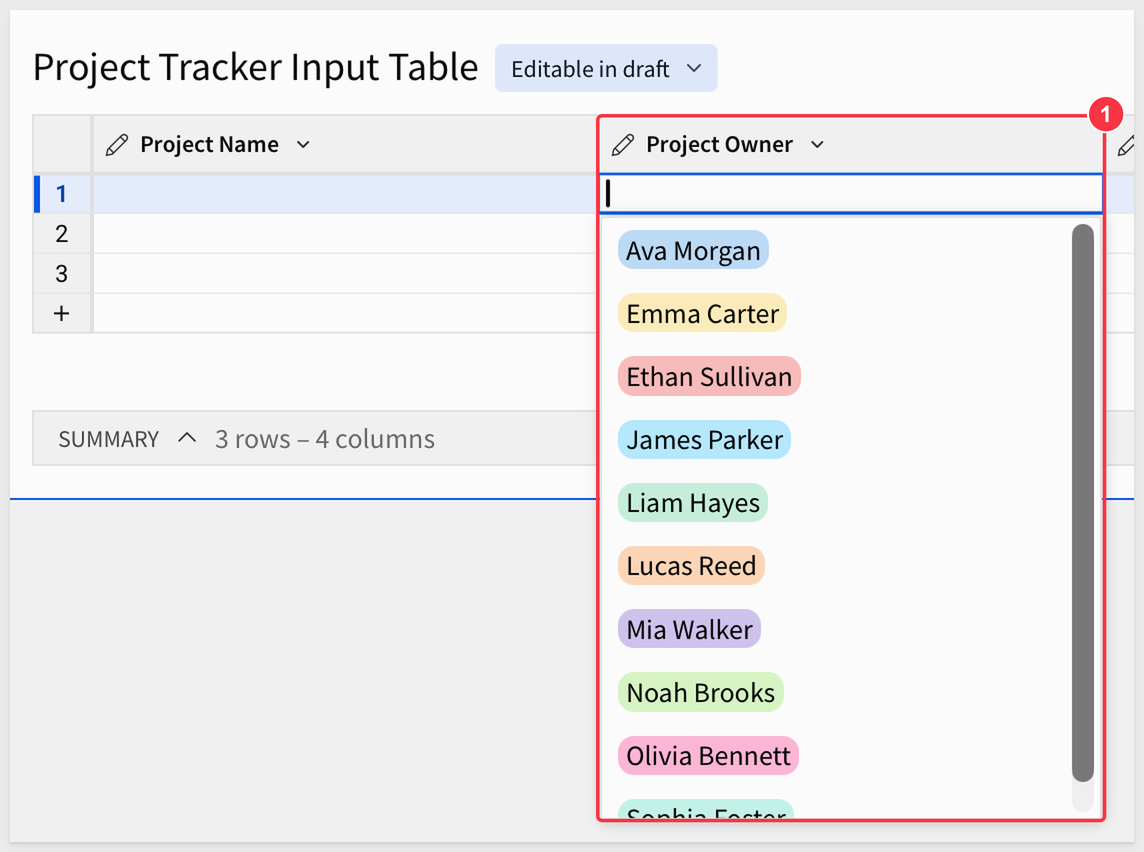
Now the Project Owner column is restricted to the list of employees from the Data.Employee input table (1):
Repeat this step for the Project Type column (1), but this time, open Change column type (2) and select Single-select (Text) (3) to save a step, since we know we want styling and only allow one Project Type to be selected for each project:
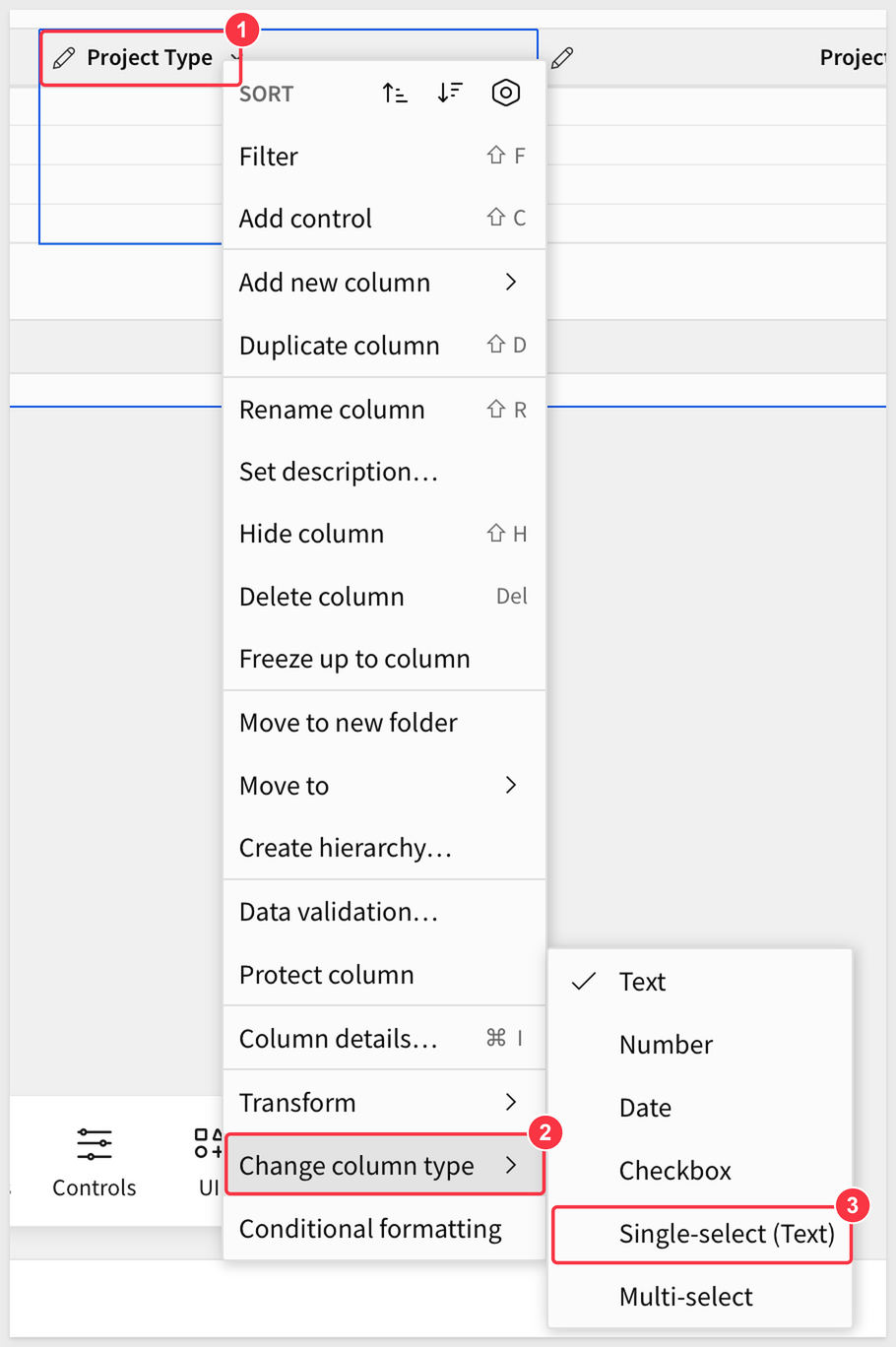
Use the Data.Project Type input table as the source of validation value.
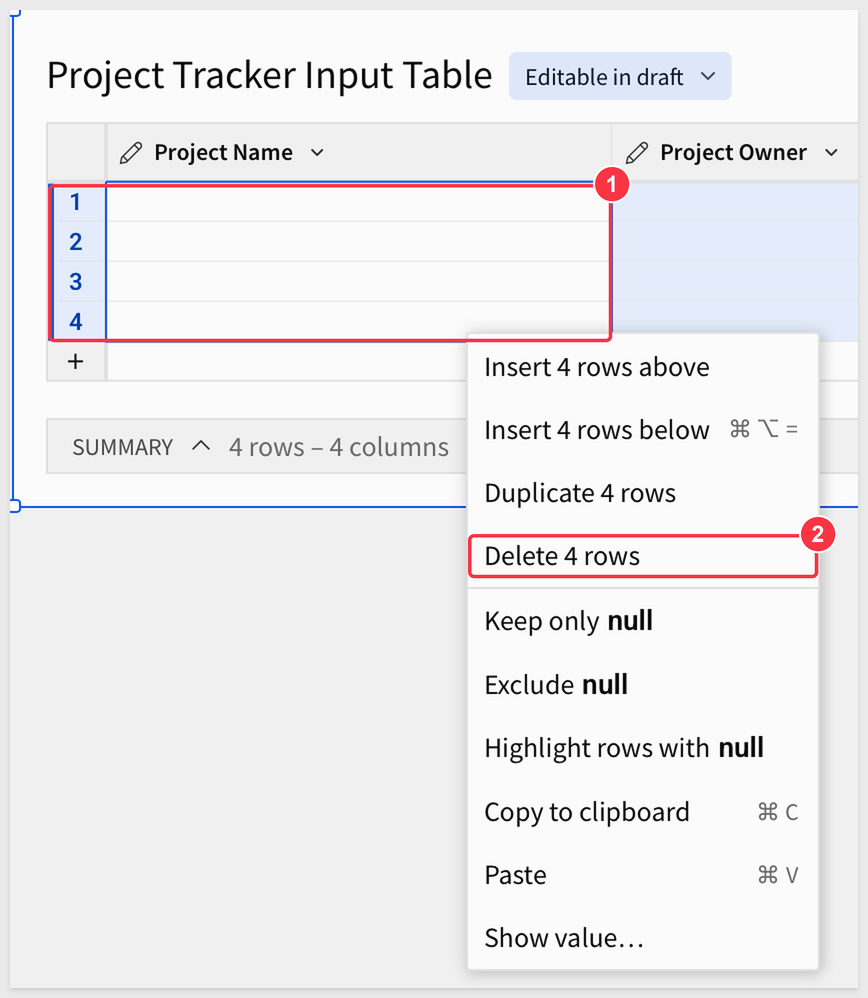
Delete any blank rows that may be present in the Project Tracker Input Table while we were building. Select the rows (1), right-click, and choose Delete 4 rows (2). The number matches how many rows you selected:
Step 7:
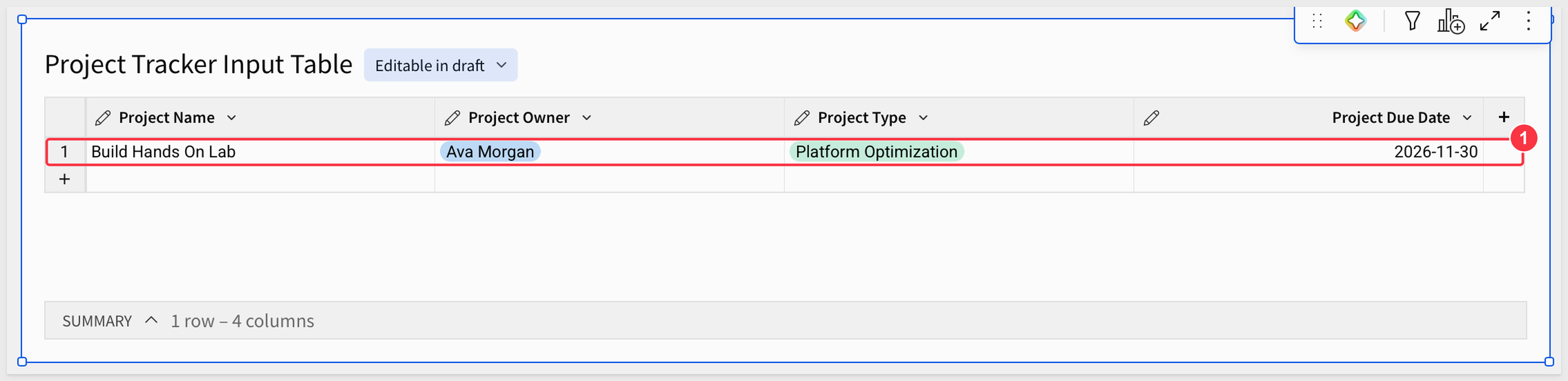
Add the following row of data (1) to the Project Tracker Input Table.
Step 8:
Click the Save as button (1) and name the workbook AI Apps Fundamentals.

Step 9:
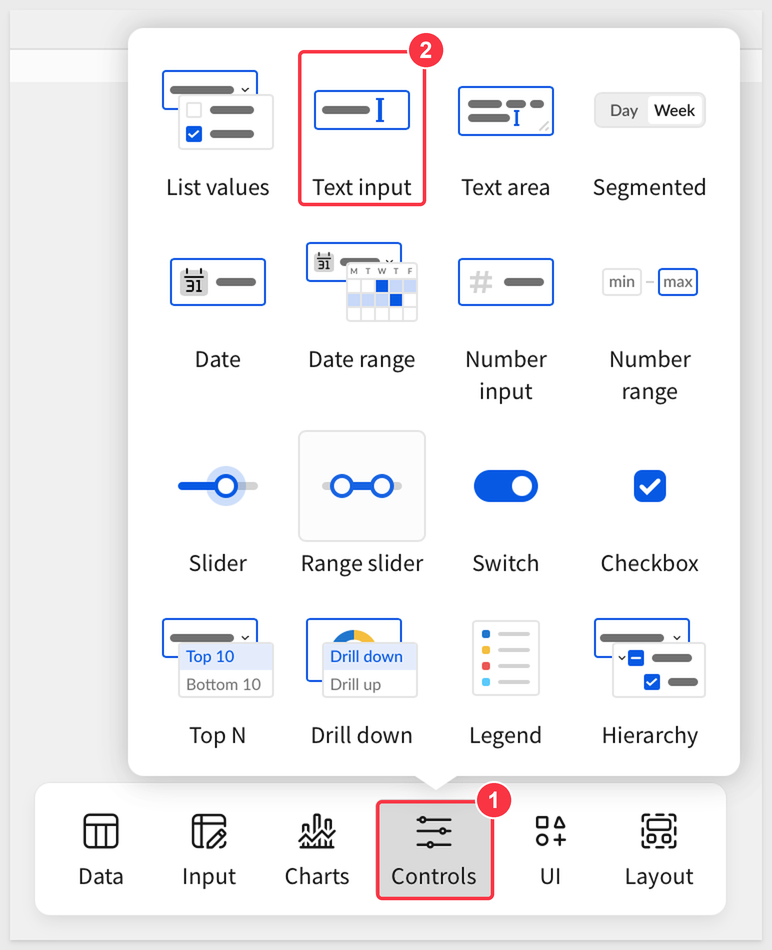
Using the element bar, in the Controls group (1), add a Text input control (2) and drag it above the input table:
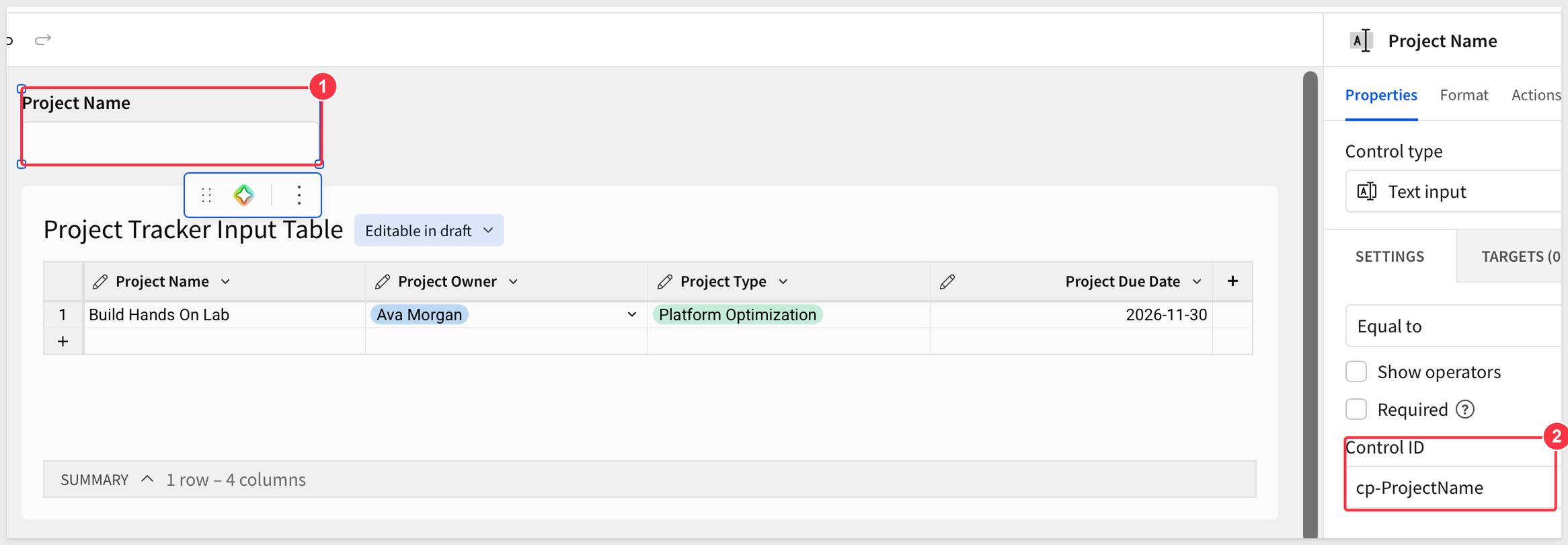
Rename it Project Name (1).
With the Project Name control selected, change the Control ID (2) to cp-ProjectName in the element panel:
Step 10:
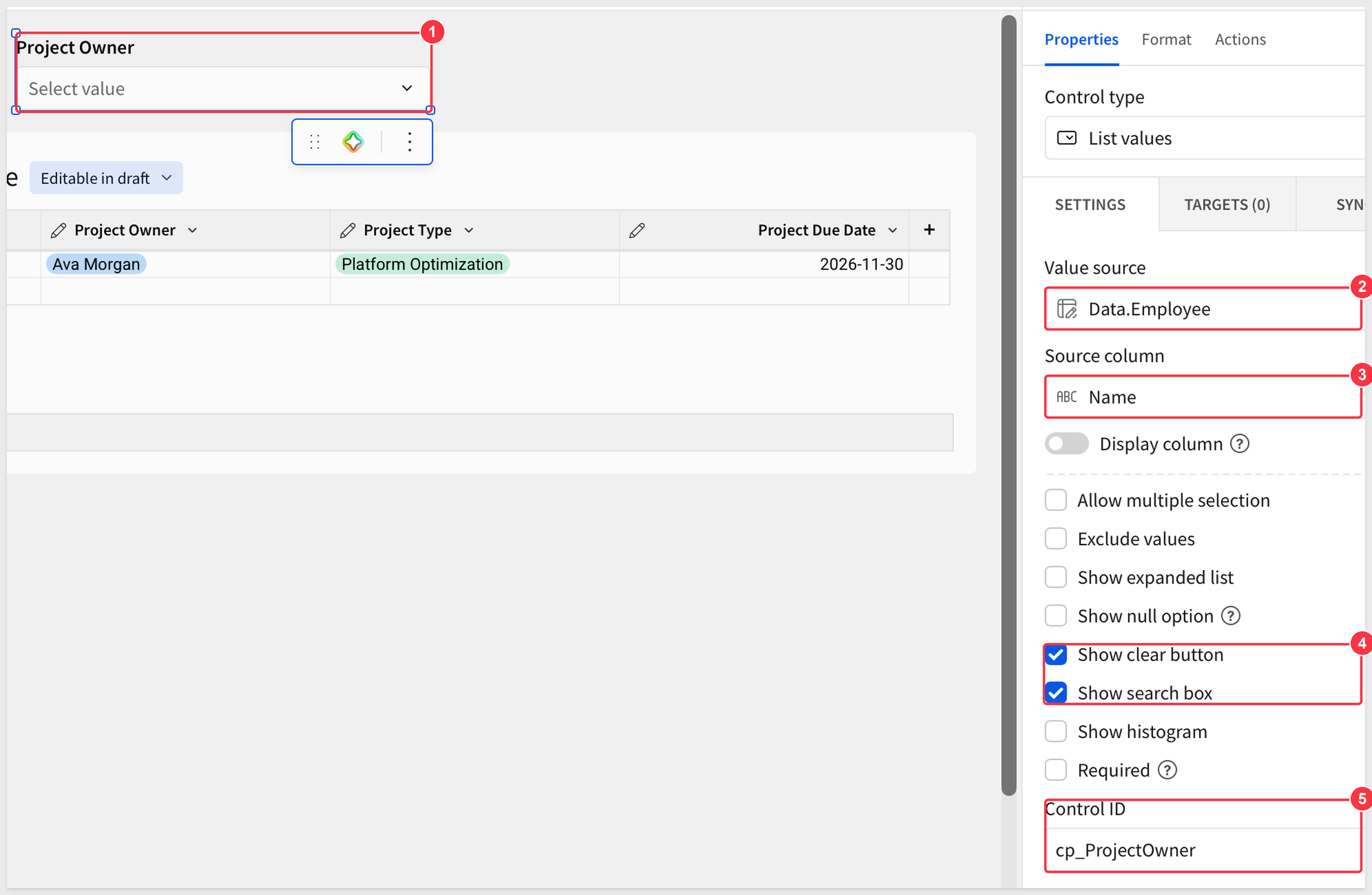
Add a List values control element and name it Project Owner (1).
In the element panel under Value source (2), select Data Validation > Data.Employee and set the Source column (3) to Name.
Ensure that only Show clear button and Show search box (4) are selected.
Rename the Control ID (5) to cp_ProjectOwner:
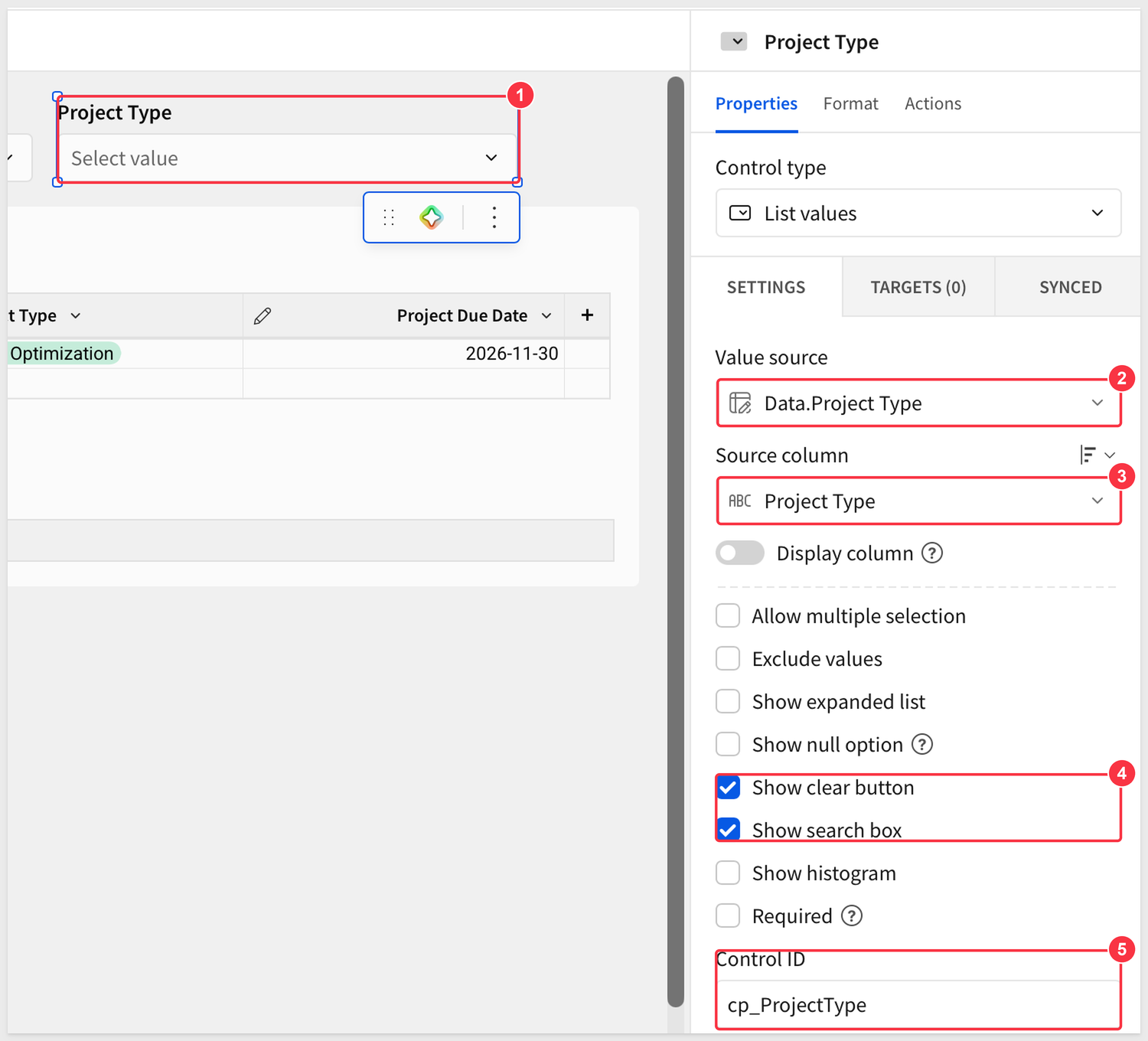
Step 11:
Repeat step 10 for Project Type (1).
In the element panel under Value source (2), select Data Validation > Data.Project Type and set the Source column (3) to Project Type. Keep only Show clear button and Show search box (4) selected.
Rename the Control ID (5) to cp_ProjectType:
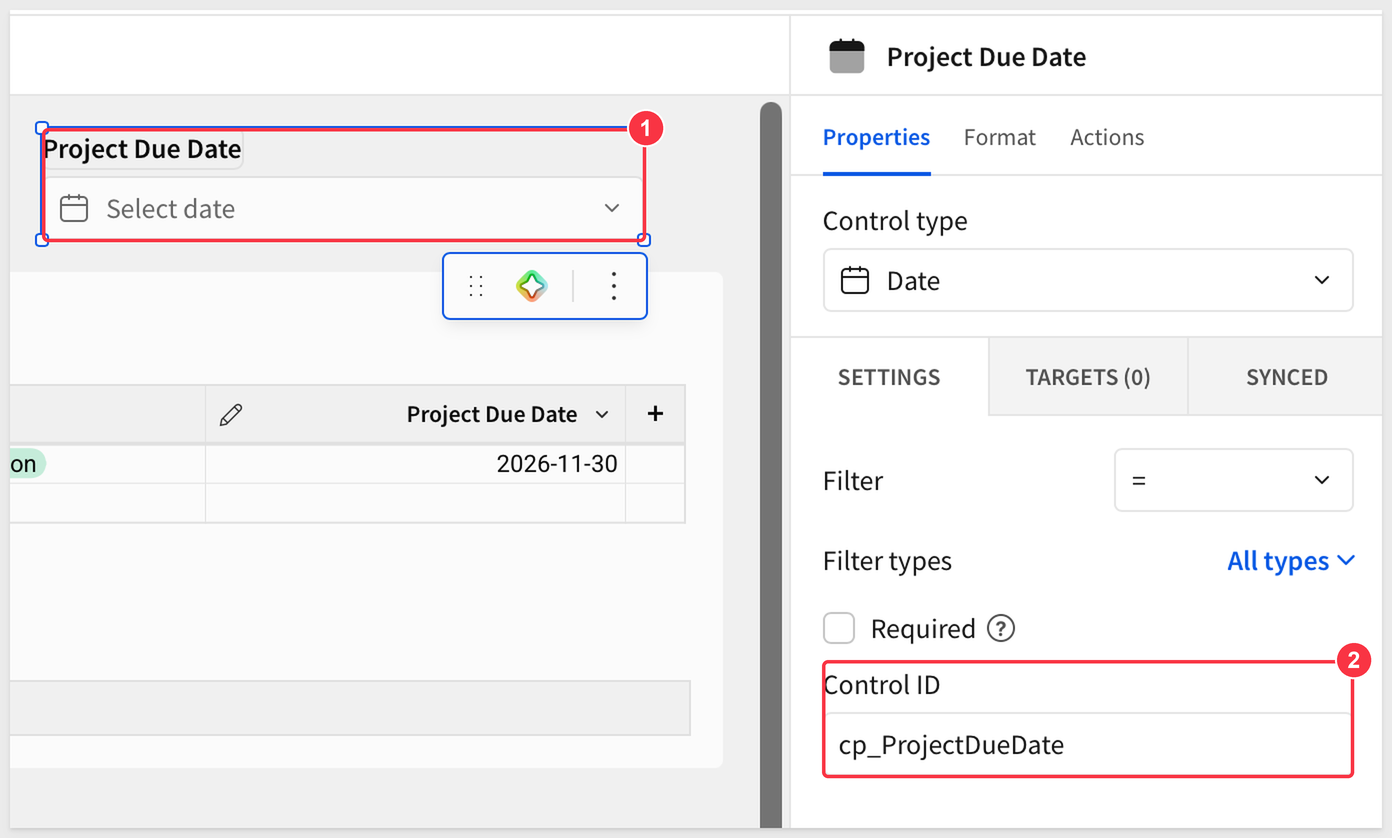
Step 12:
Add a Date control titled Project Due Date (1) with a Control ID (2) of cp_ProjectDueDate:
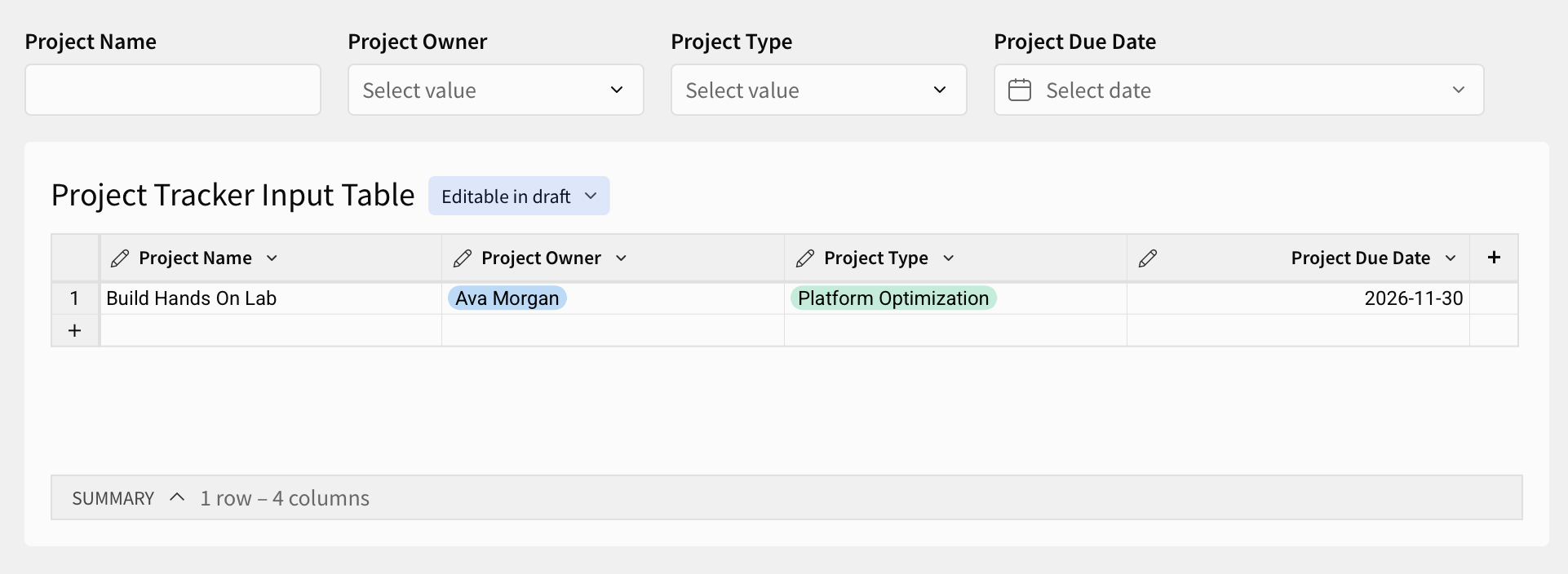
The page should look like this now:
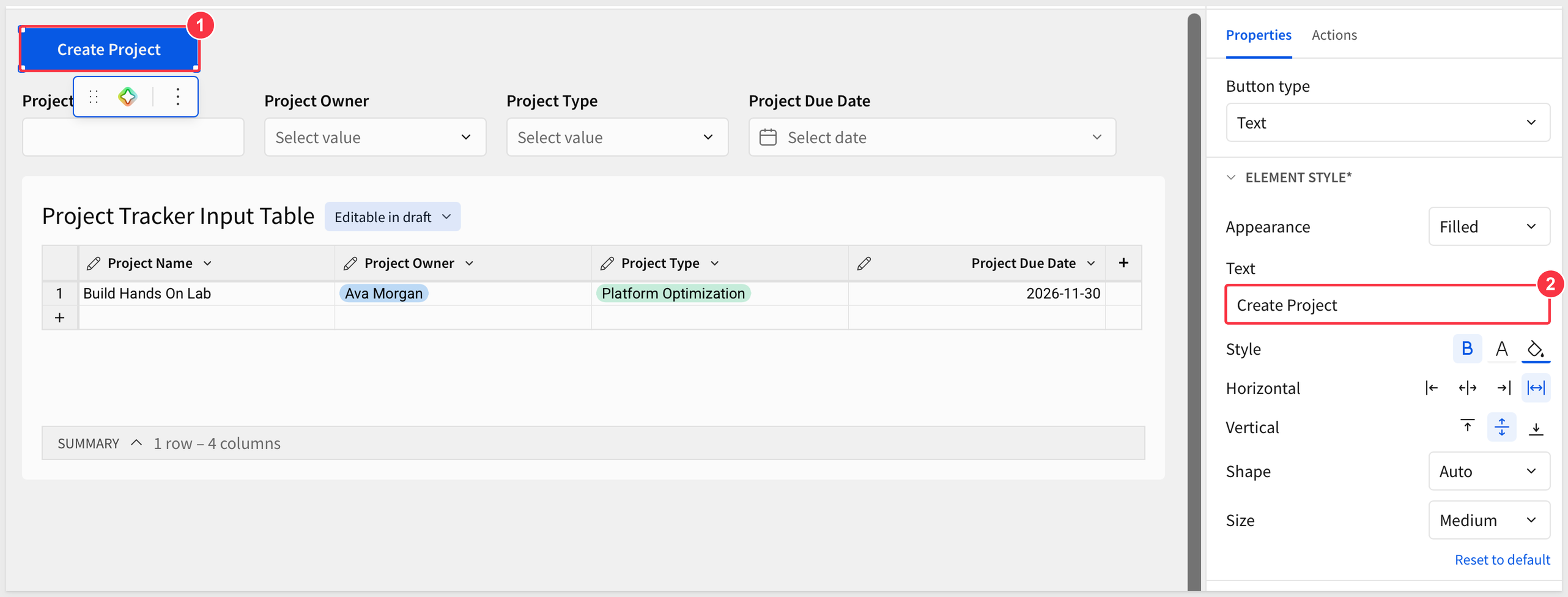
Step 13:
Add a Button (1) from the element bar, UI group to the page and set its Text (2) to Create Project:
Step 14:
On the Actions panel of the Create Project button, add a new action (1) and select Insert row.
Ensure the values align for each control to the Project Tracker Input Table (2):
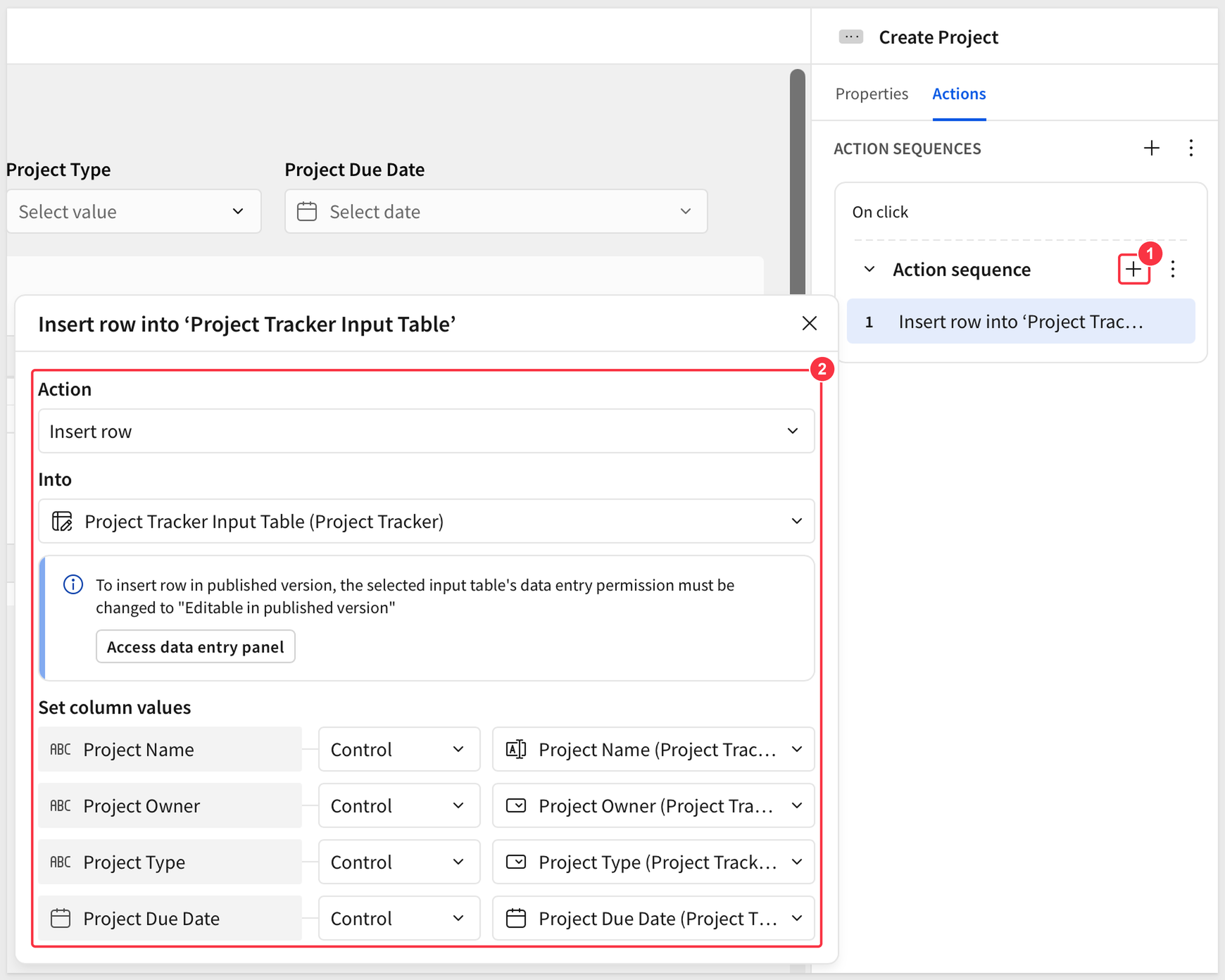
For more information on this topic, see: Create actions that modify input table data
What this action does is add a new row to the input table, containing whatever values are set in the four controls on our page.
If you click the button with no values provided, an empty row is added to the input table. Right click that empty row and select Delete 1 row if needed.
Click Publish.
Step 15:
Now let's create some projects. It does not really matter what you decide to use for the control, it is test data anyway.
For more information on this topic, see: Input tables overview
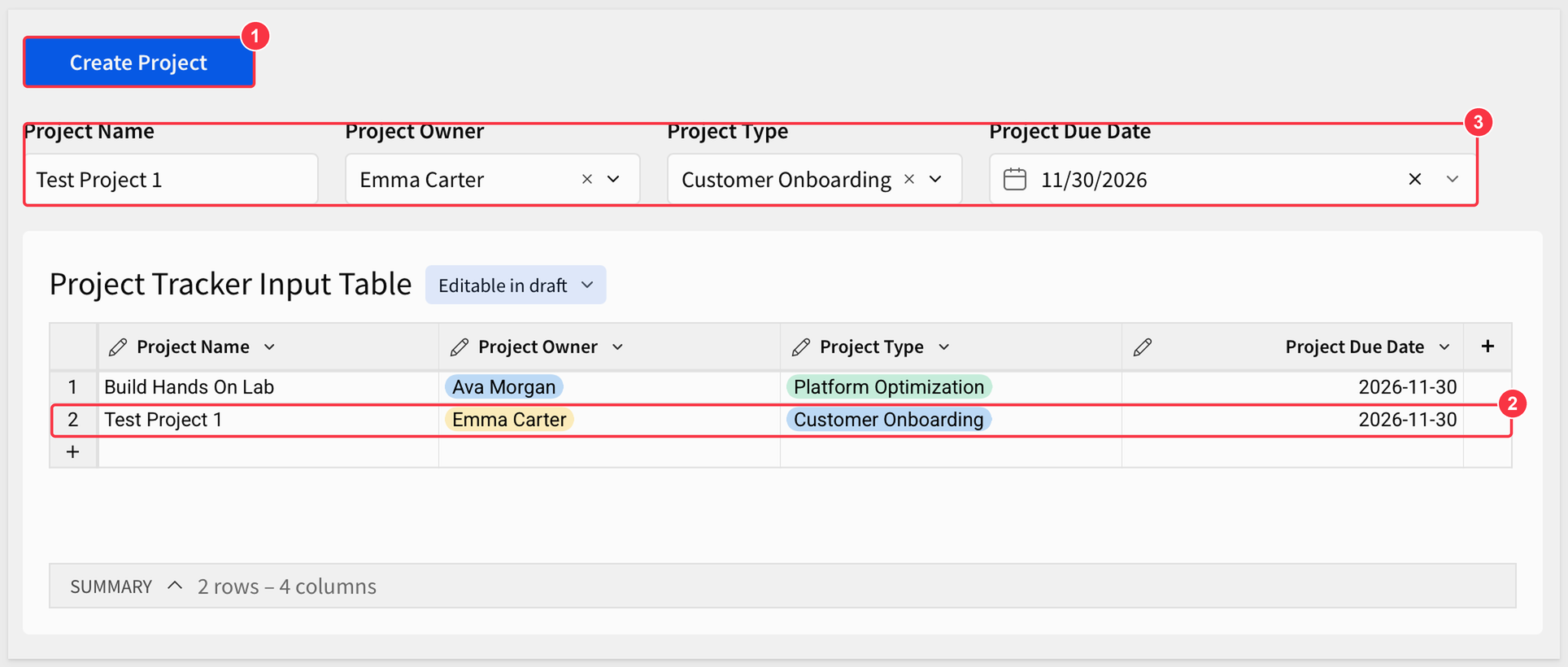
Adjust the controls for a new project:

Click Create Project (1) to test if everything was set up correctly. A new row appears in the input table (2):
Step 16:
Select each control (shift+click) and the Create Project button.
At the top right, choose the Create container option (1) from the selected elements menu:

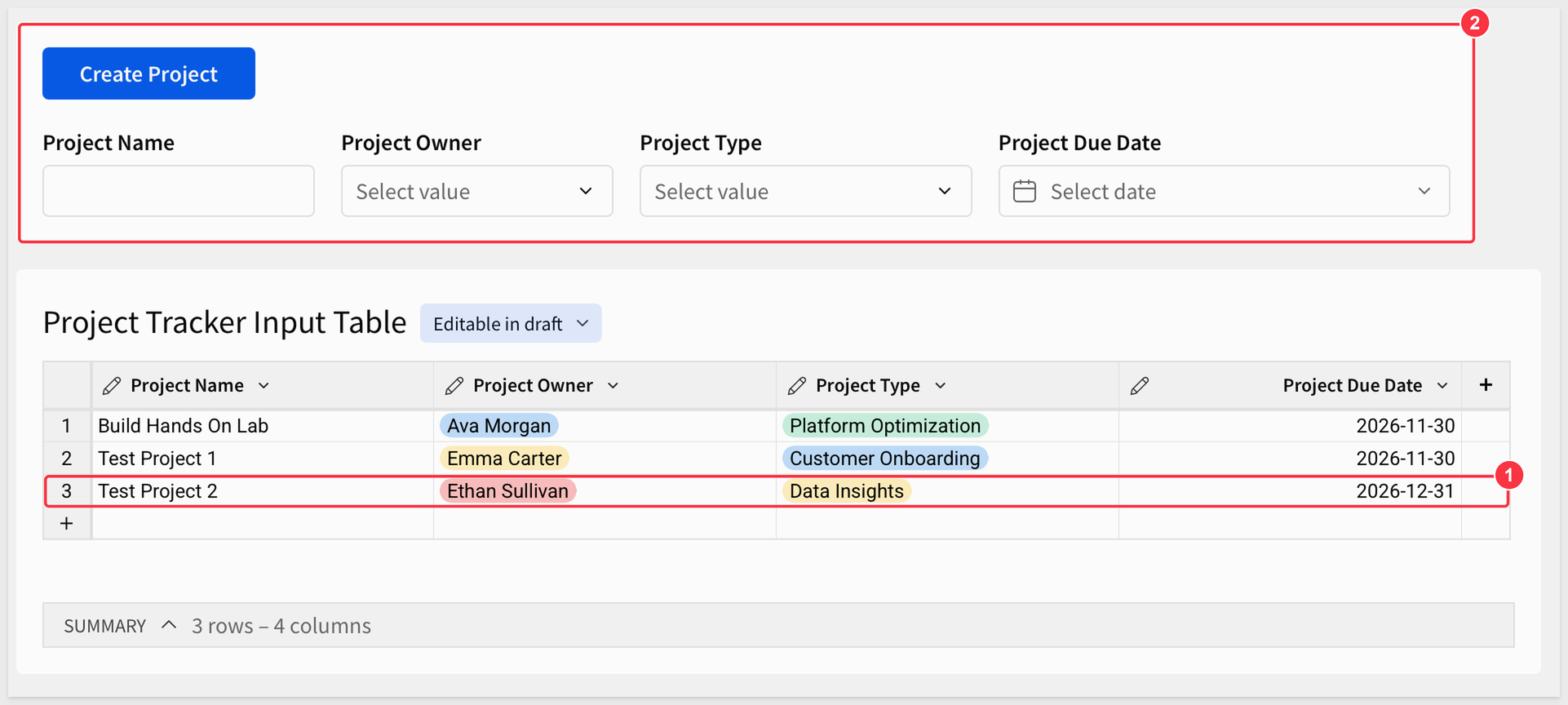
Step 17:
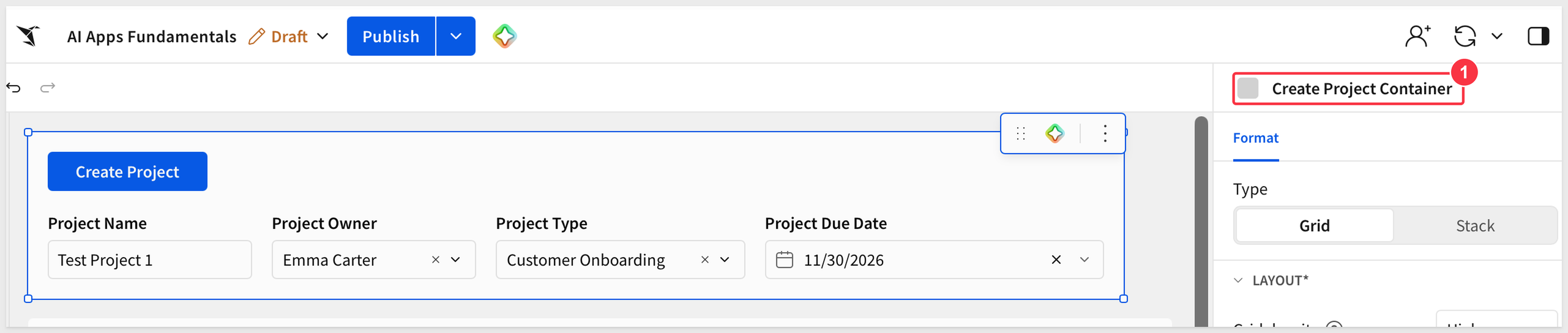
Rename the container Create Project Container (1):
Step 18:
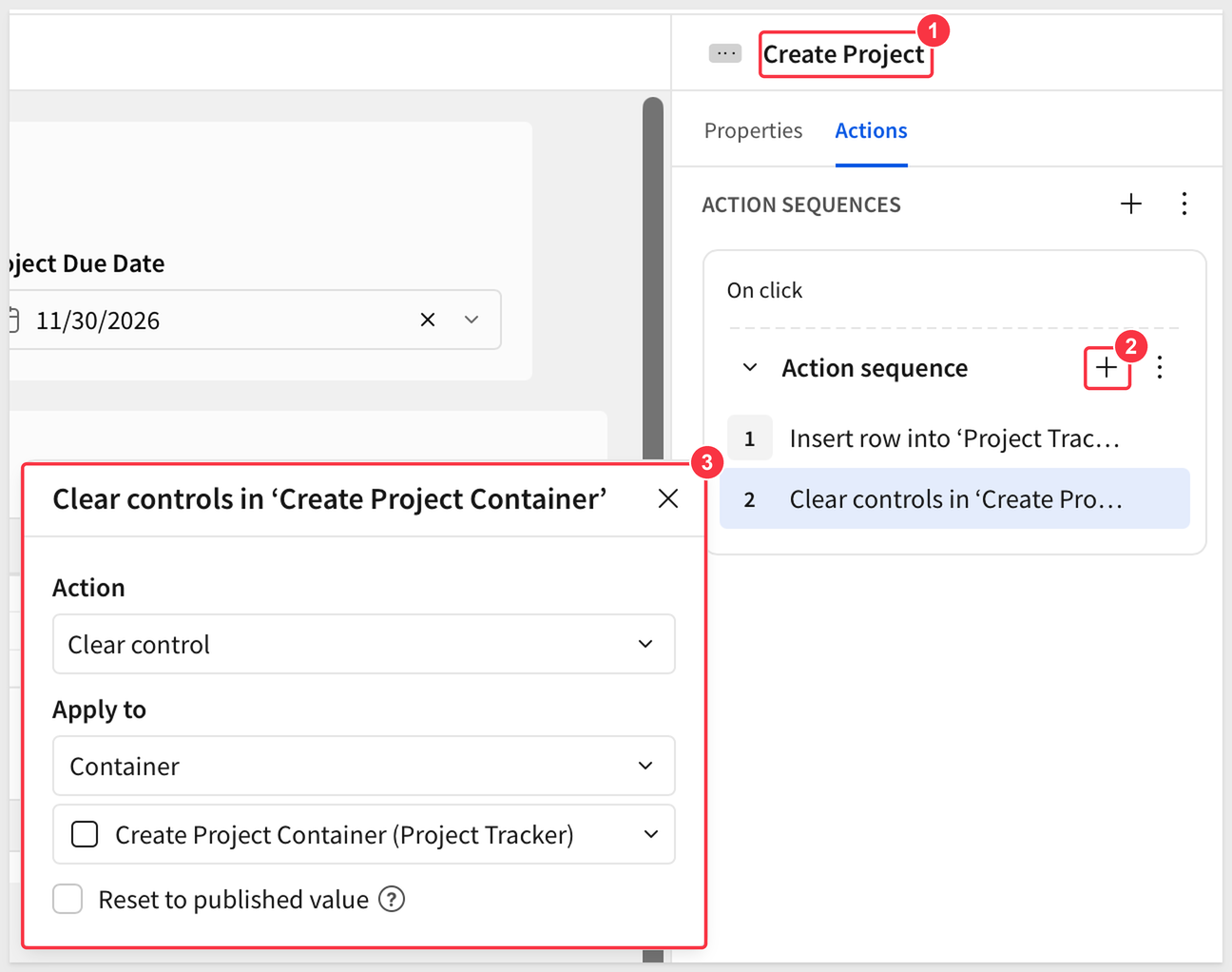
Select the Create Project button (1), and go to Actions.
Add a second action (2) set to Clear control applied to Container with our newly created Create Project Container (3). This will set the action to automatically target all four control elements:
Step 19:
Add an additional row of data to test the clear action on each control element within the container.
The updated Project Tracker should look as follows, with a new row of data (1) and the controls cleared (2) once the Create Project button is clicked:
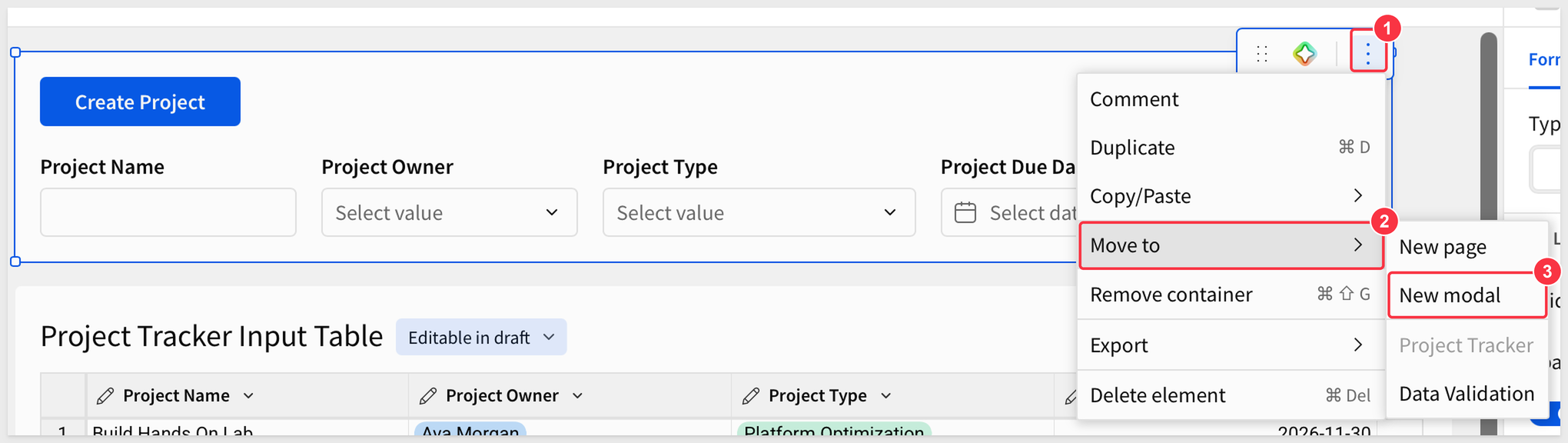
Step 1: Add a modal
Click on the Create Project container, and then click the  icon (1) at the top right of the container.
Select the Move to (2) > New modal (3) option.
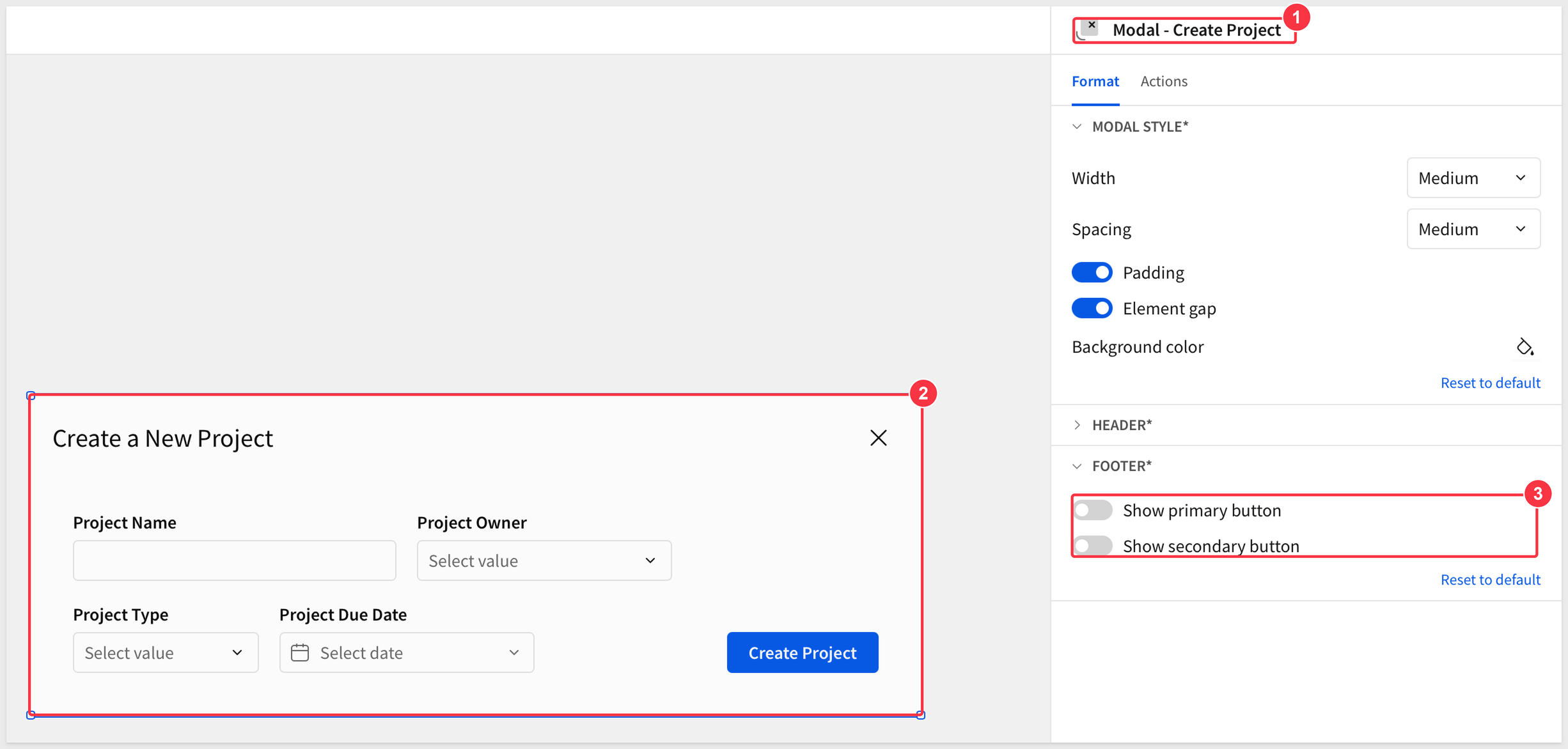
Step 2:
Name the modal tab Modal - Create Project (1) by changing the workbook page name.
By now, we assume you are familiar with where elements are accessed and configured in Sigma, so we may not show all steps.
Rename the title from New modal to Create a New Project (2).
Turn off both Show primary button and Show secondary button (3) under Footer in the element panel.
Move the various elements around and resize everything to suit. Trim any unnecessary space:
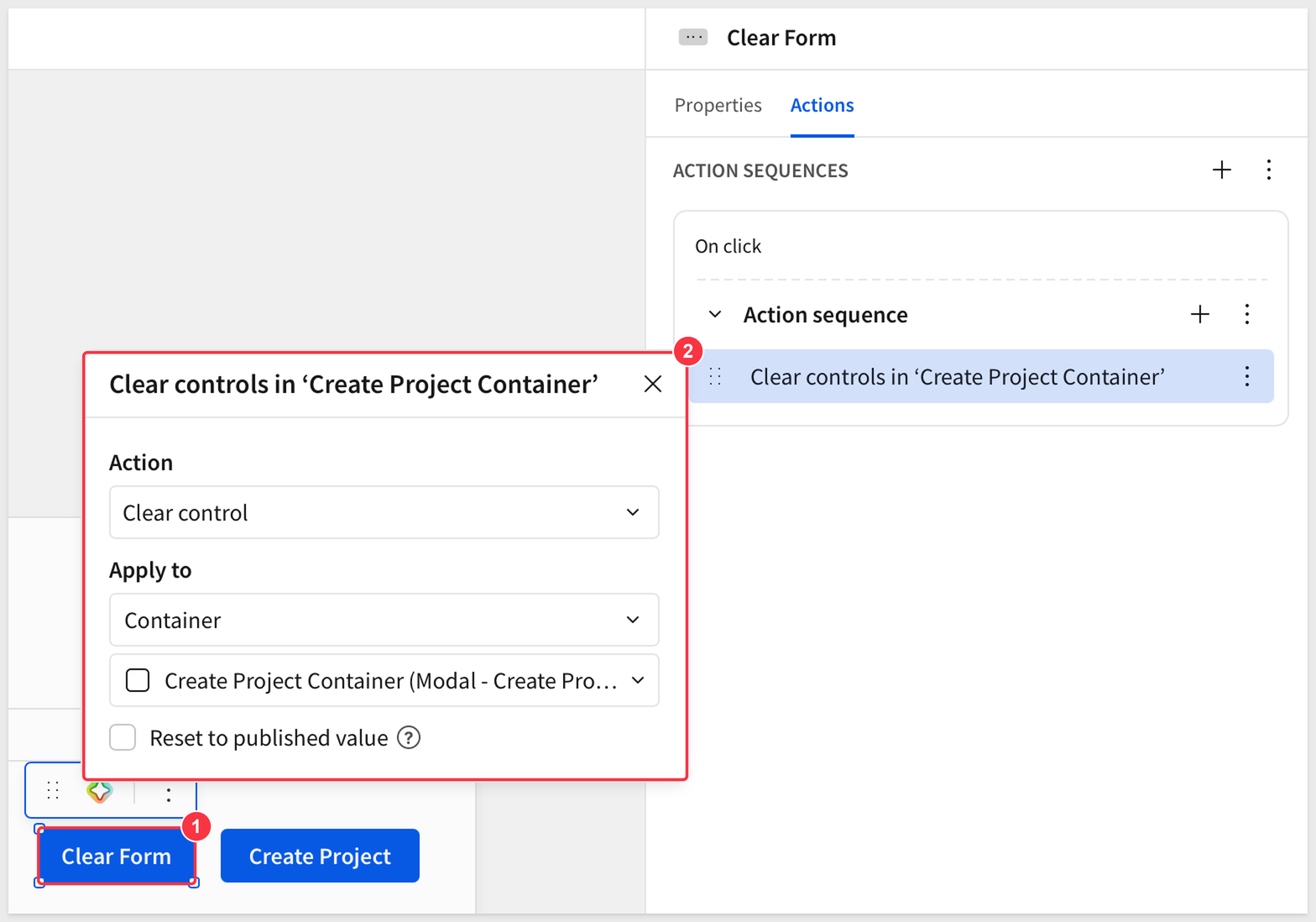
Step 3:
Create a new button and rename it to Clear Form (1).
In the actions panel, add an action (2) set to Clear control on the Create Project Container. This is a good best practice for improving user experience.
Step 4:
Return to the Project Tracker page and add a button titled Create Project (1).
This button replaces the Create Project button we moved to the modal earlier.
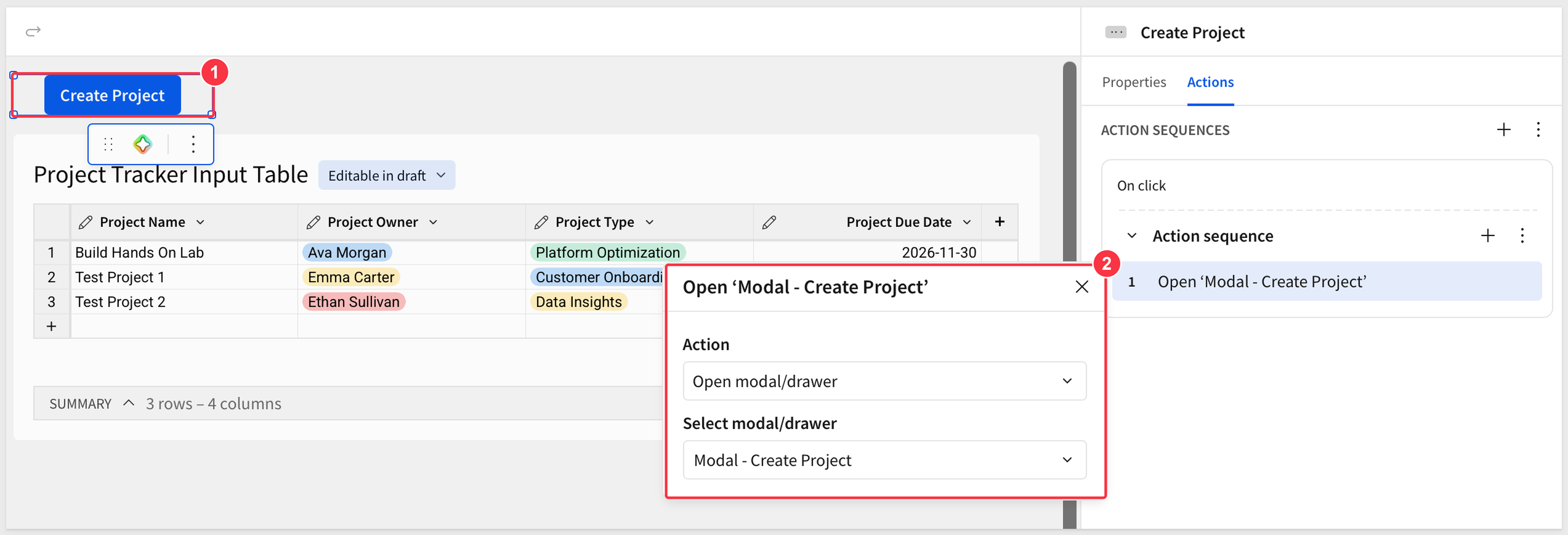
Add an action (2) with Open modal/drawer selected for the Modal - Create Project:
Step 5:
Click the Create Project button to test the action. Modal - Create Project should open. Check that adding a record, clear and create project works to add a new row in the Project Tracker.
Congratulations!
You have now successfully built a form to do controlled data entry.
Considering how easy that was AND data is being written automatically to the cloud data warehouse, that is pretty slick. Let's go further still.
Step 6: Create page controls
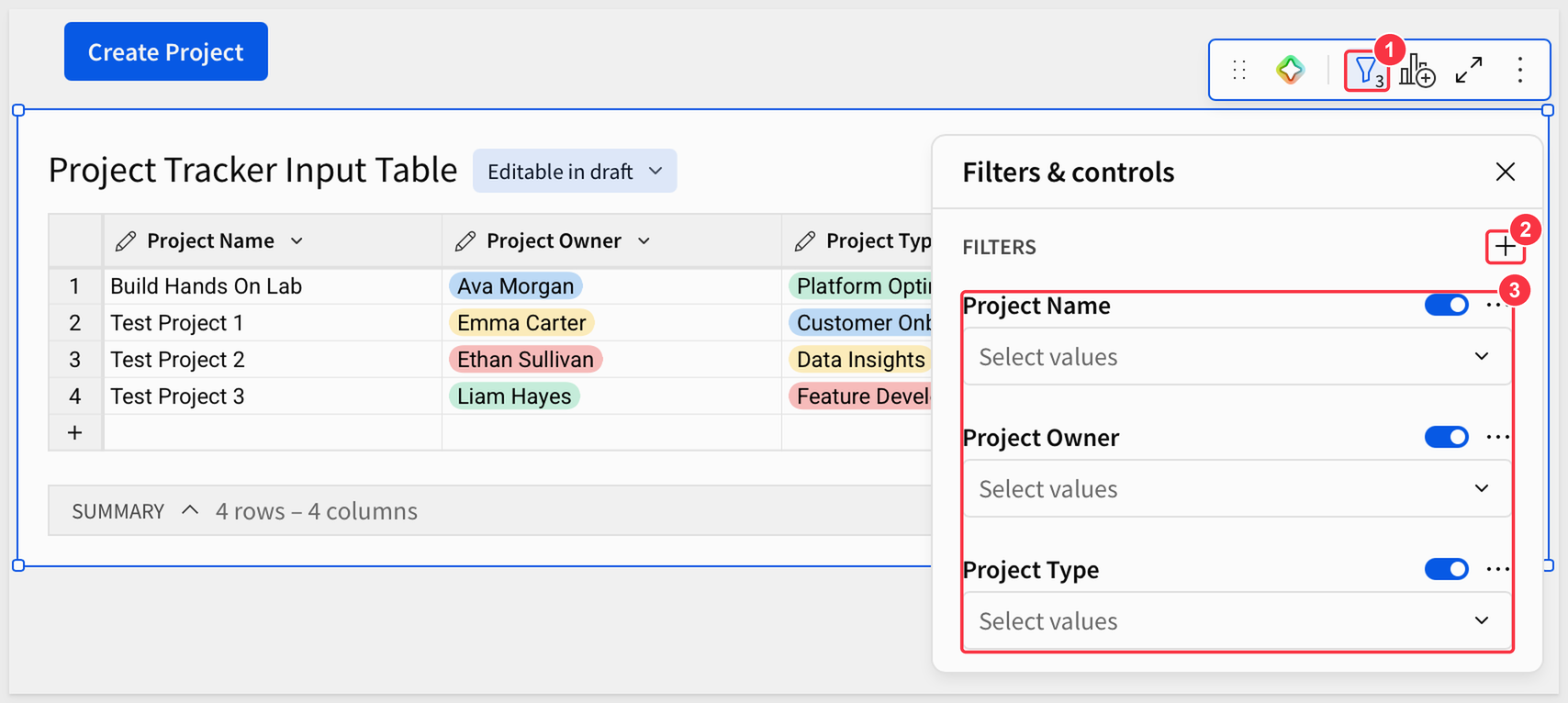
On the Project Tracker Input Table page, open the filters panel (1) and add (2) filters (3) for the Project Name, Project Owner, and Project Type one at a time.
For more information on keyboard shortcuts in Sigma, check out these docs:
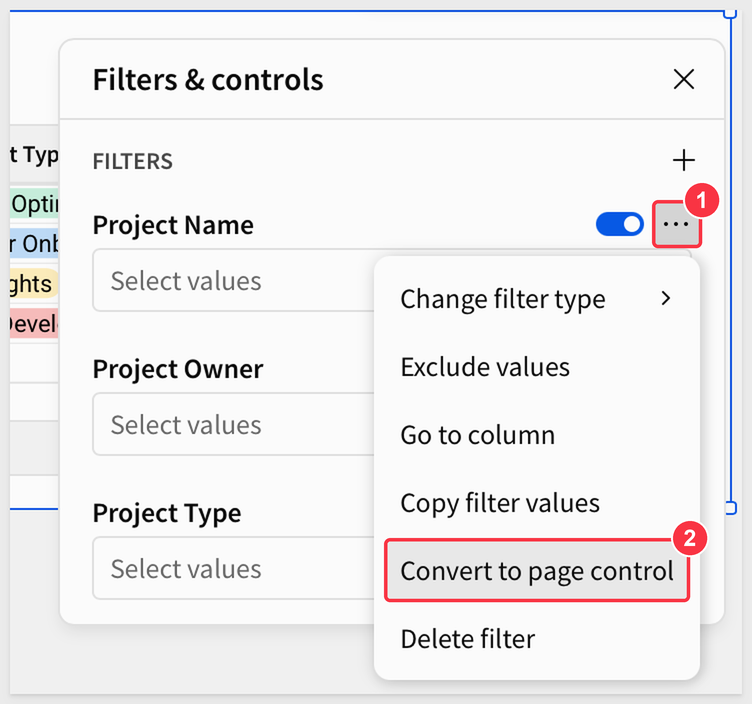
Convert each filter to a page control by selecting the ellipsis (1) and then Convert to page control (2):
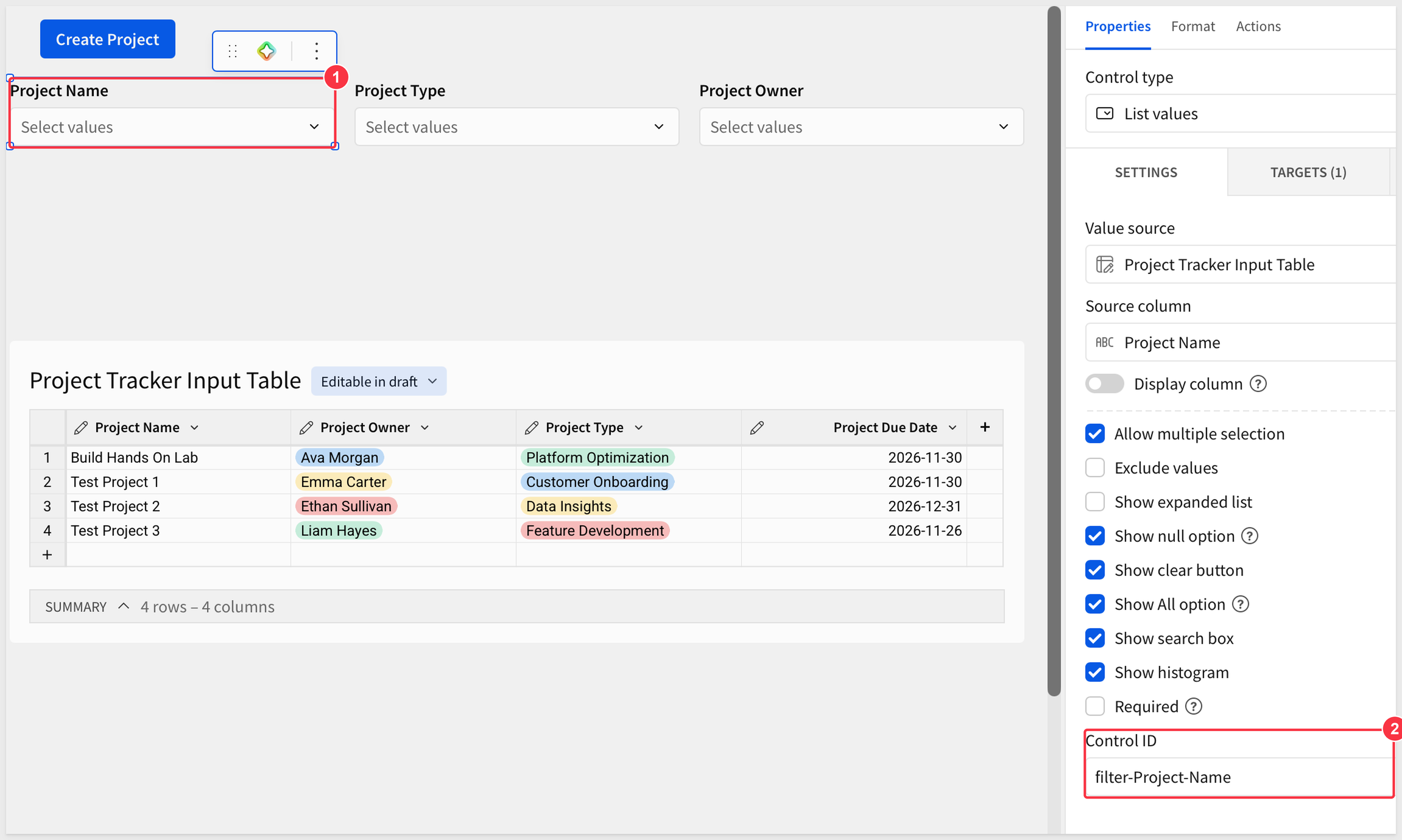
Select each control (1) and rename each of the Control ID values (2) to have filter- prepended, as shown for filter-Project-Name:
Click Publish.
Step 7: Container it
Select the filters and place them into a container titled Filters Container,
Move this container to a new modal titled Modal - Filters.
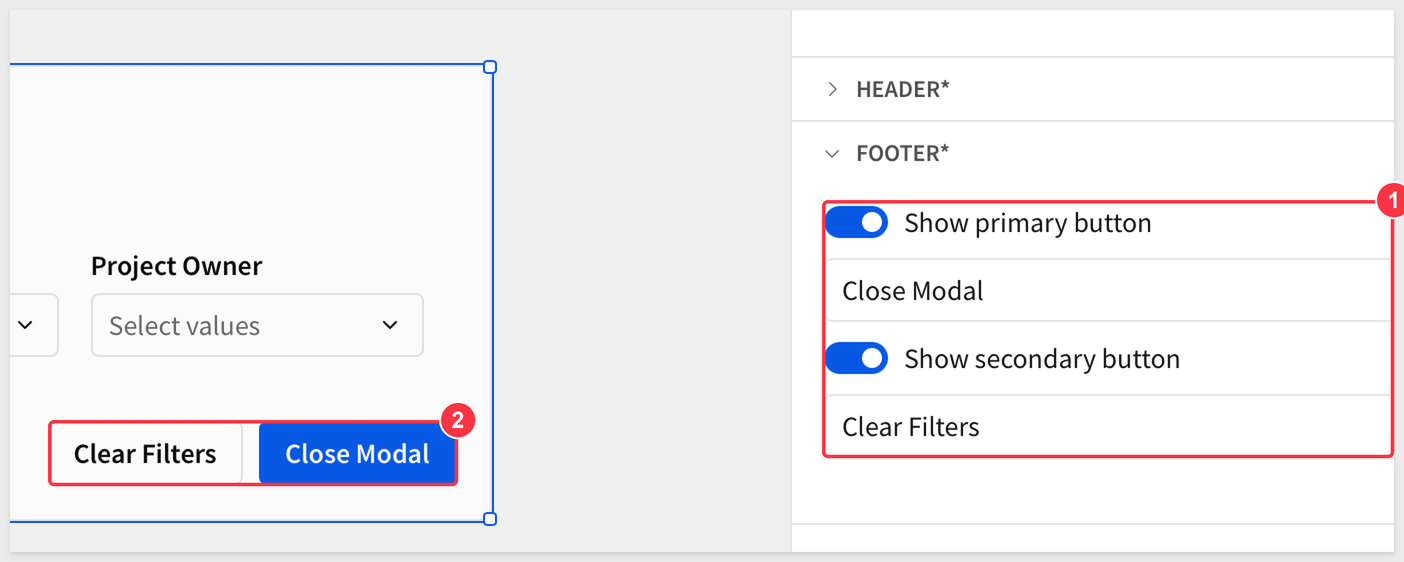
Change the title to Filters and this time keep the footer buttons (1), naming the primary Close Modal and the secondary Clear Filters (2). Turn off Show close icon, since we will have a button to do that.
Step 8:
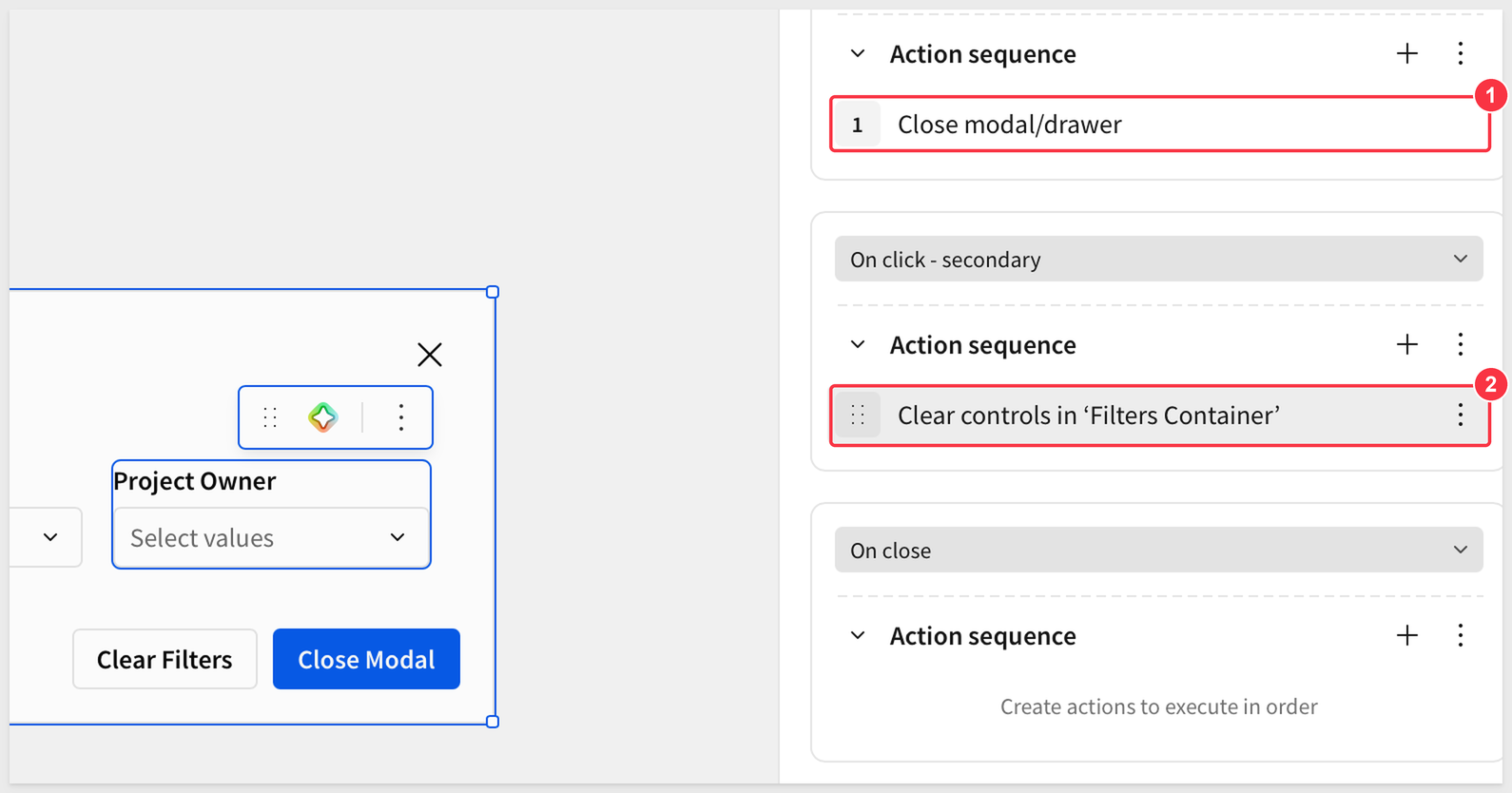
On the actions tab of Modal - Filters configure the Close Modal button to Close modal/drawer (1).
For the secondary button, configure Clear Filters to Clear control on the Filters Container (2):
Step 9:
Back on the Project Tracker page, add another button for Project Filters with an action to Open Modal on Modal - Filters.
Add an additional button named Clear Filters.
Select all three buttons and place those into a container titled Buttons Container.

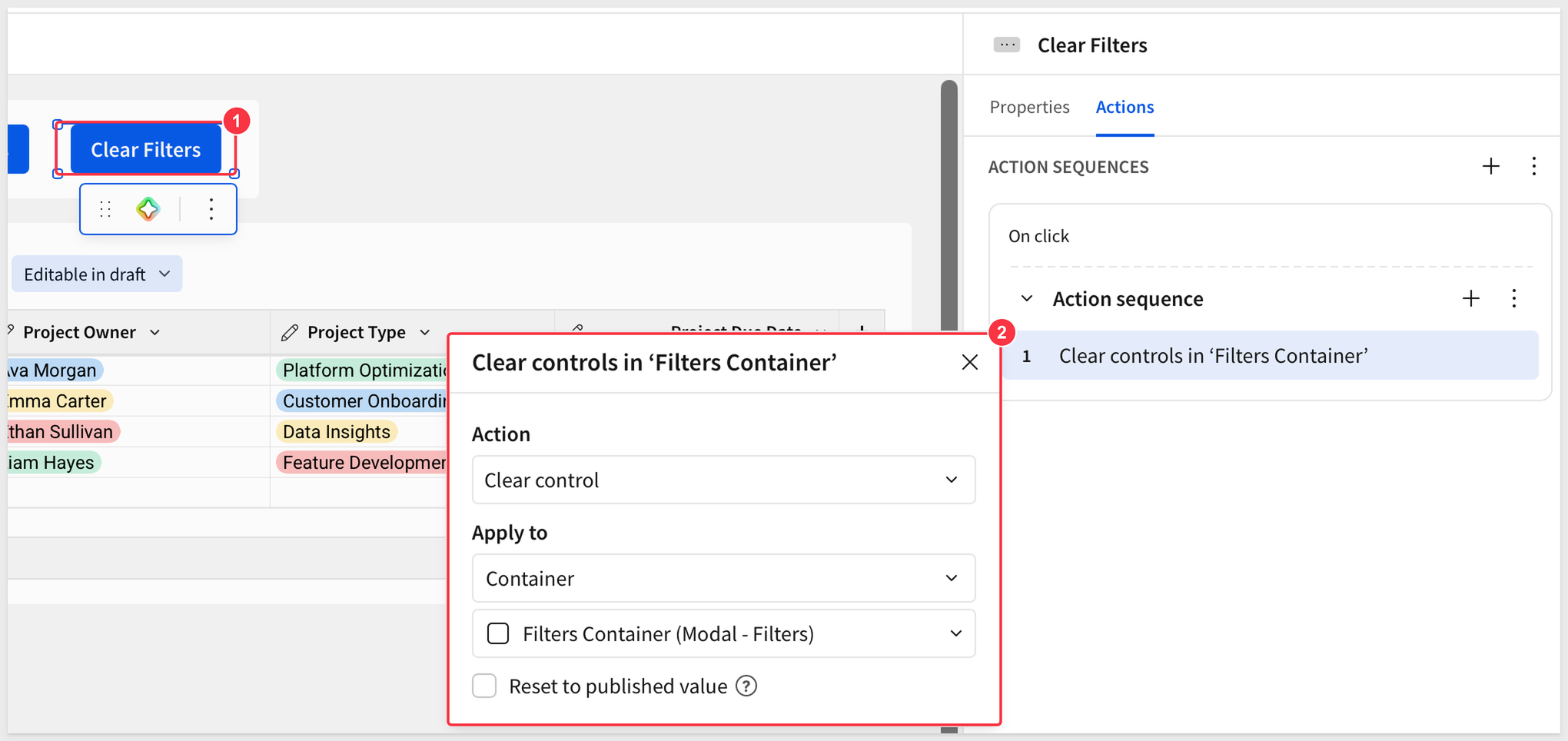
Set the action on the Clear Filters button (1) to Clear control on the Filters Container (Modal - Filters) (2).
Test that the new buttons work as expected.
Our AI App is beginning to take form by mixing and matching Sigma building blocks.
Step 10:
Customize the title for the Project Filters button by adding a ( after the Project Filter text, followed by the = sign, which will open a pop up for you to use a custom formula:
Use the following formula:
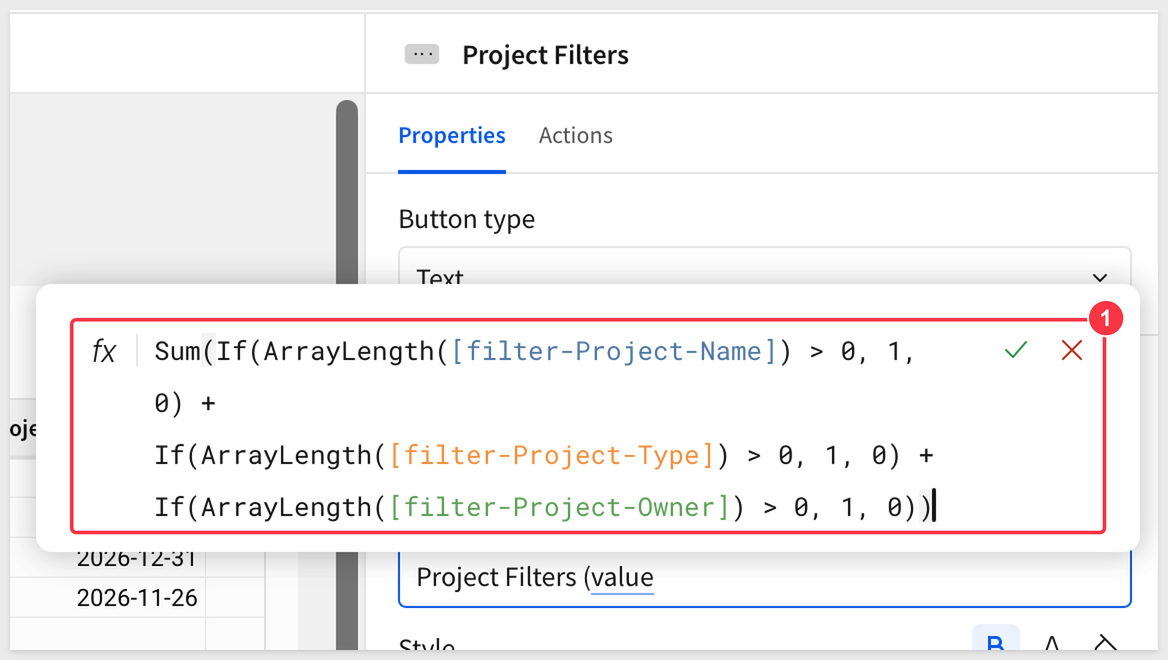
Sum(If(ArrayLength([filter-Project-Name]) > 0, 1, 0) +
If(ArrayLength([filter-Project-Type]) > 0, 1, 0) +
If(ArrayLength([filter-Project-Owner]) > 0, 1, 0))
The formula appears in the editor (1):
Once the formula is good, click the green checkmark:

Add one more ) to make the value surrounded by ().
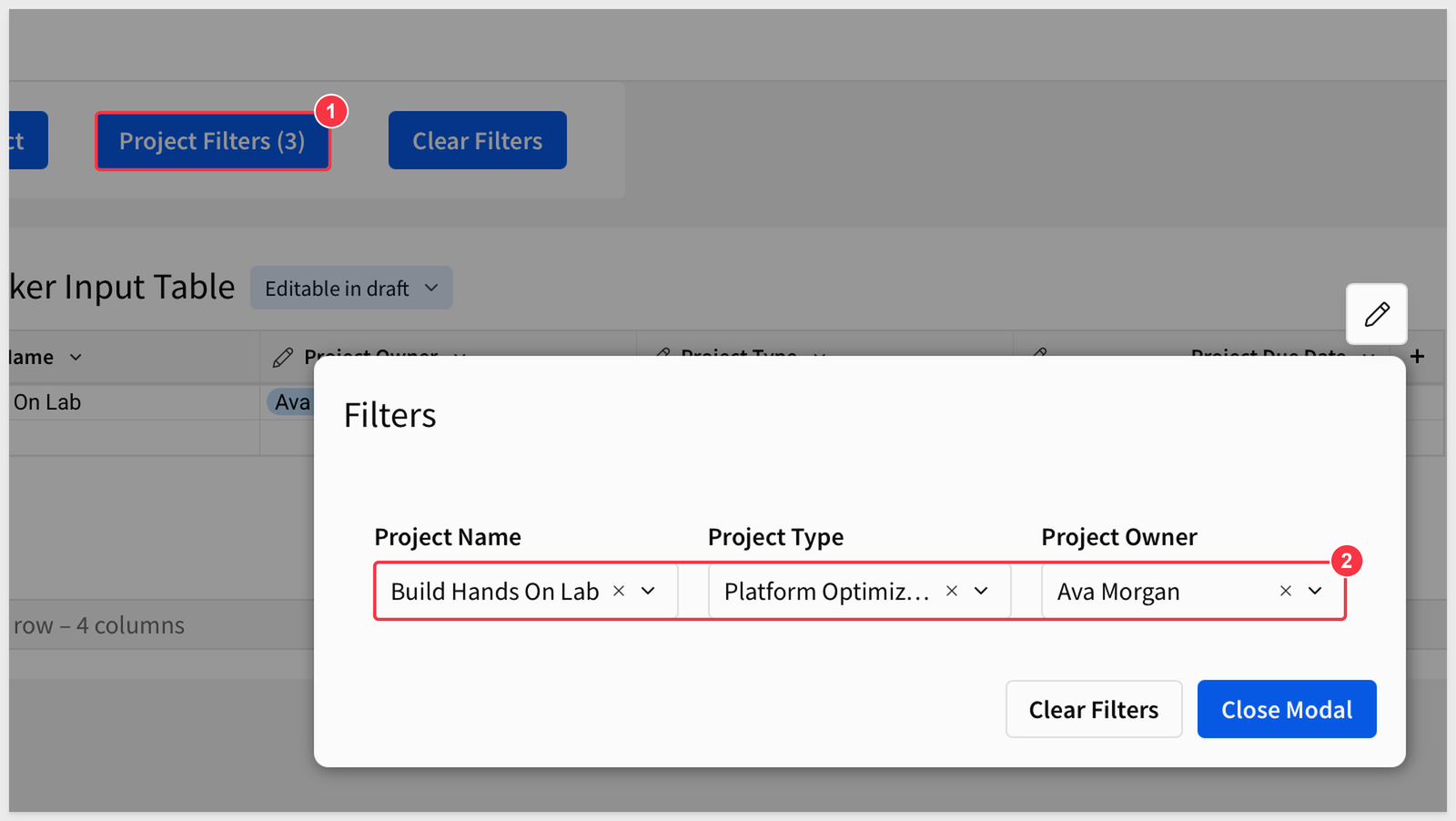
Click the Project Filters button and set a few filters.
This results in a count (1) when filters are selected (2). The number shows how many of the three filters have a selection, not how many values are selected:
Step 1: Add page
Add a new page named Control Panel.
This will be the central hub and spine for the AI App, which ensures governance over the circular flow of data.
Step 2:
On the Project Tracker page, add three new columns from the System columns section of the Add new column menu: Row edit history (1) > Last updated at and Last updated by (2), and Row ID (3).
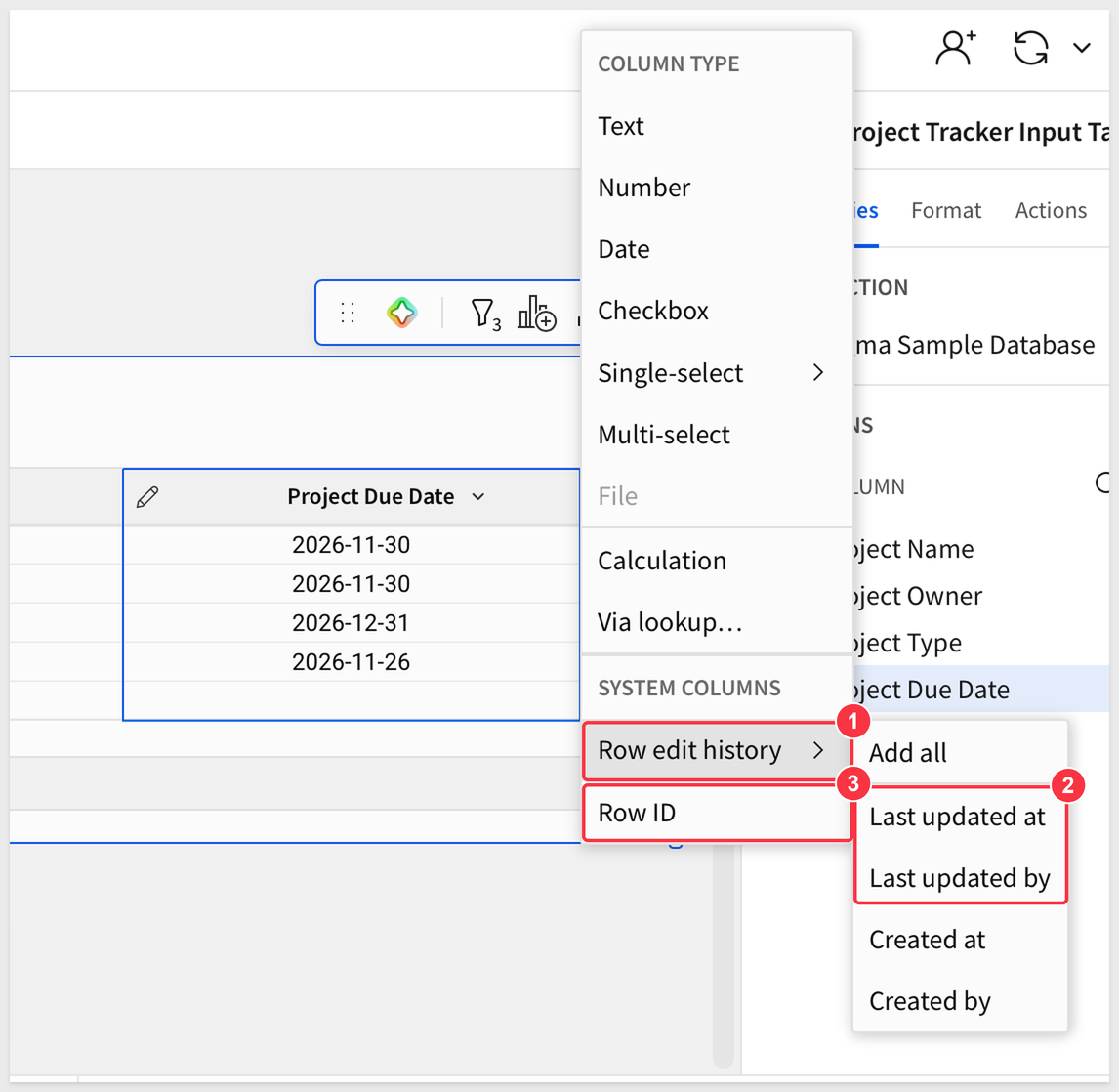
Rename Row ID to Project ID, click its column header and drag it over so that it is in the first position on the table:

Step 3:
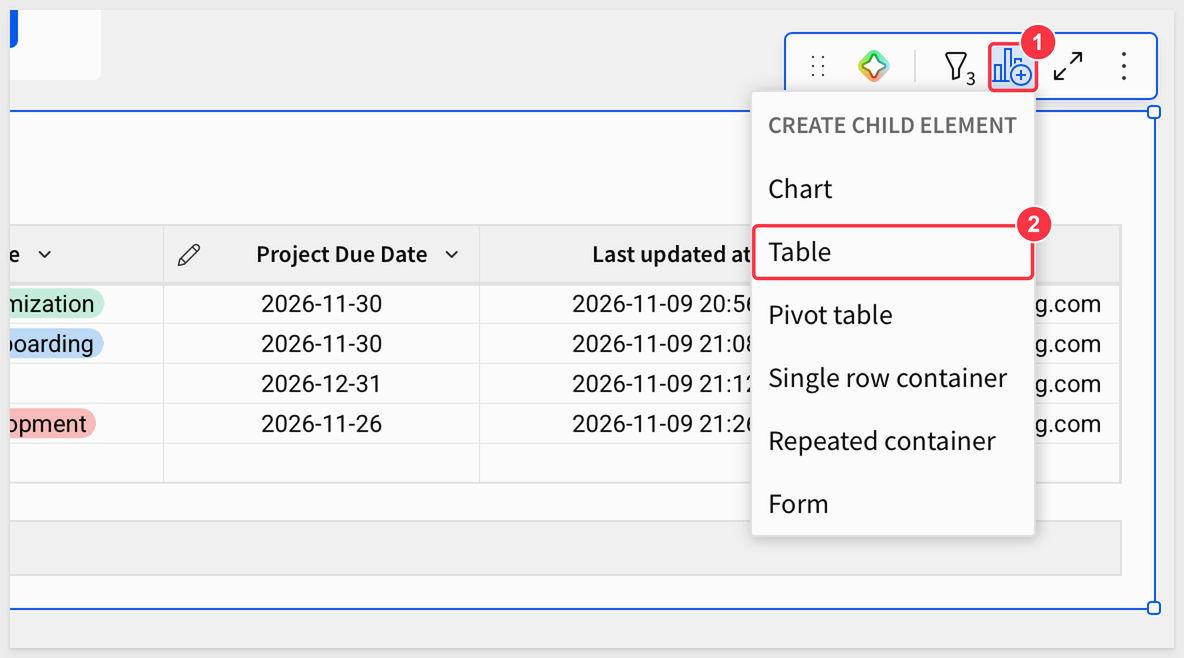
Create a child table from the Project Tracker Input Table: select Create child element (1), then Table (2). Rename the child Project Tracker Stable Table:
Step 4:
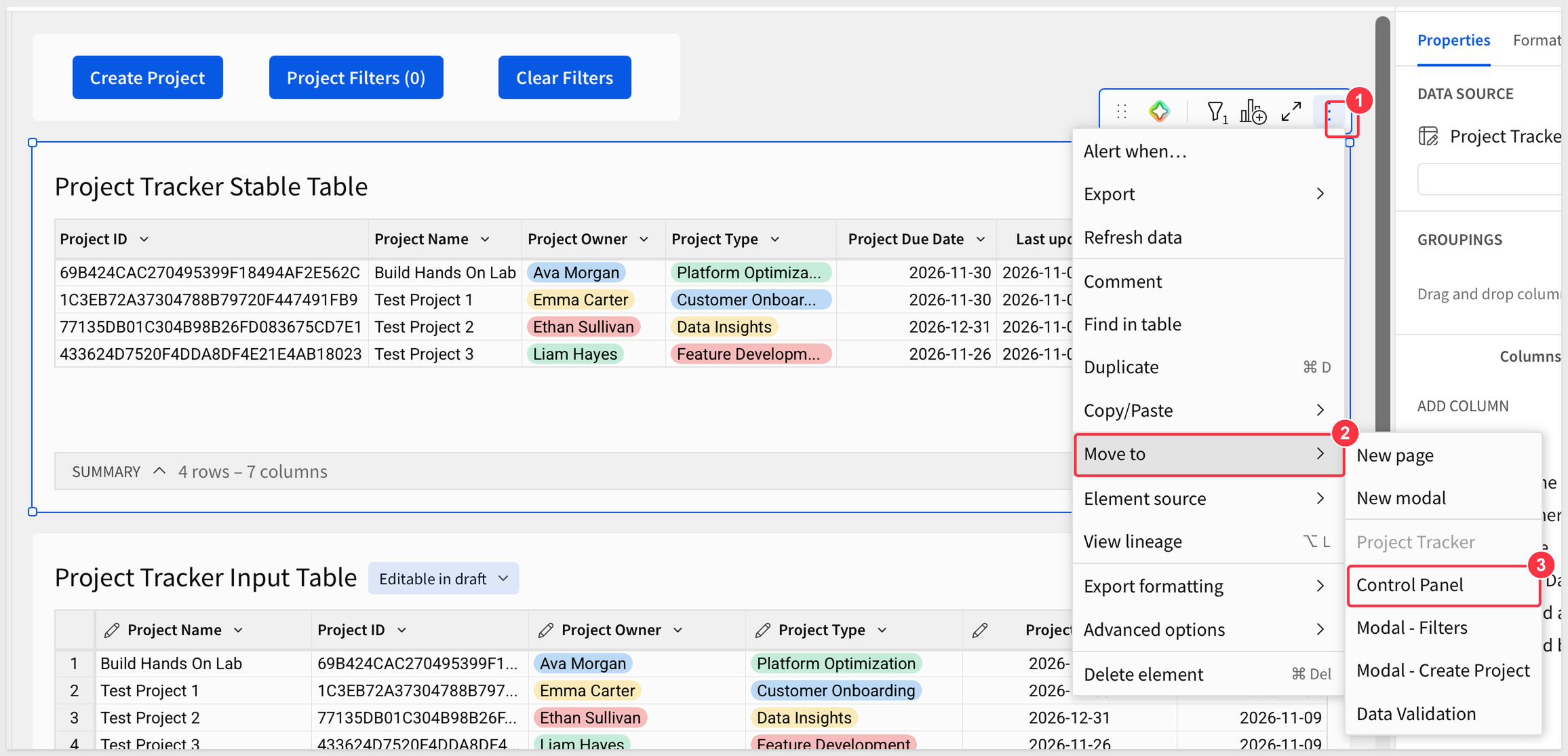
Move the Project Tracker Stable Table to the Control Panel page: open the element menu (1), select Move to (2), then Control Panel (3).
Step 5:
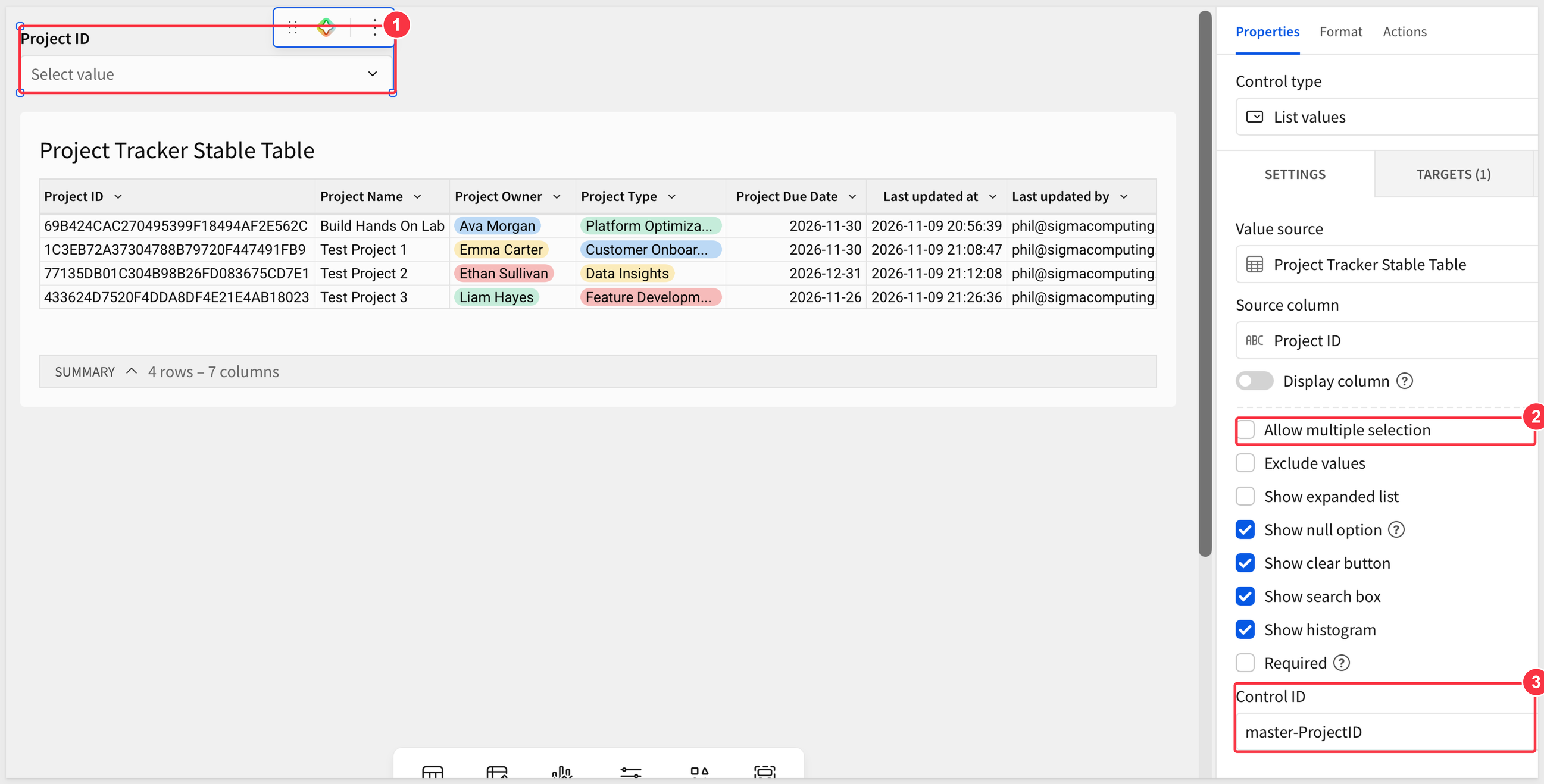
On the Control Panel page, from the Project Tracker Stable Table filter Project ID and convert it to a page control (1).
Rename the Control ID (3) to master-ProjectID.
Step 6:
Add another page control filter, this time for Project Name.
Rename the Control ID to master-Project-Name.
Step 7:
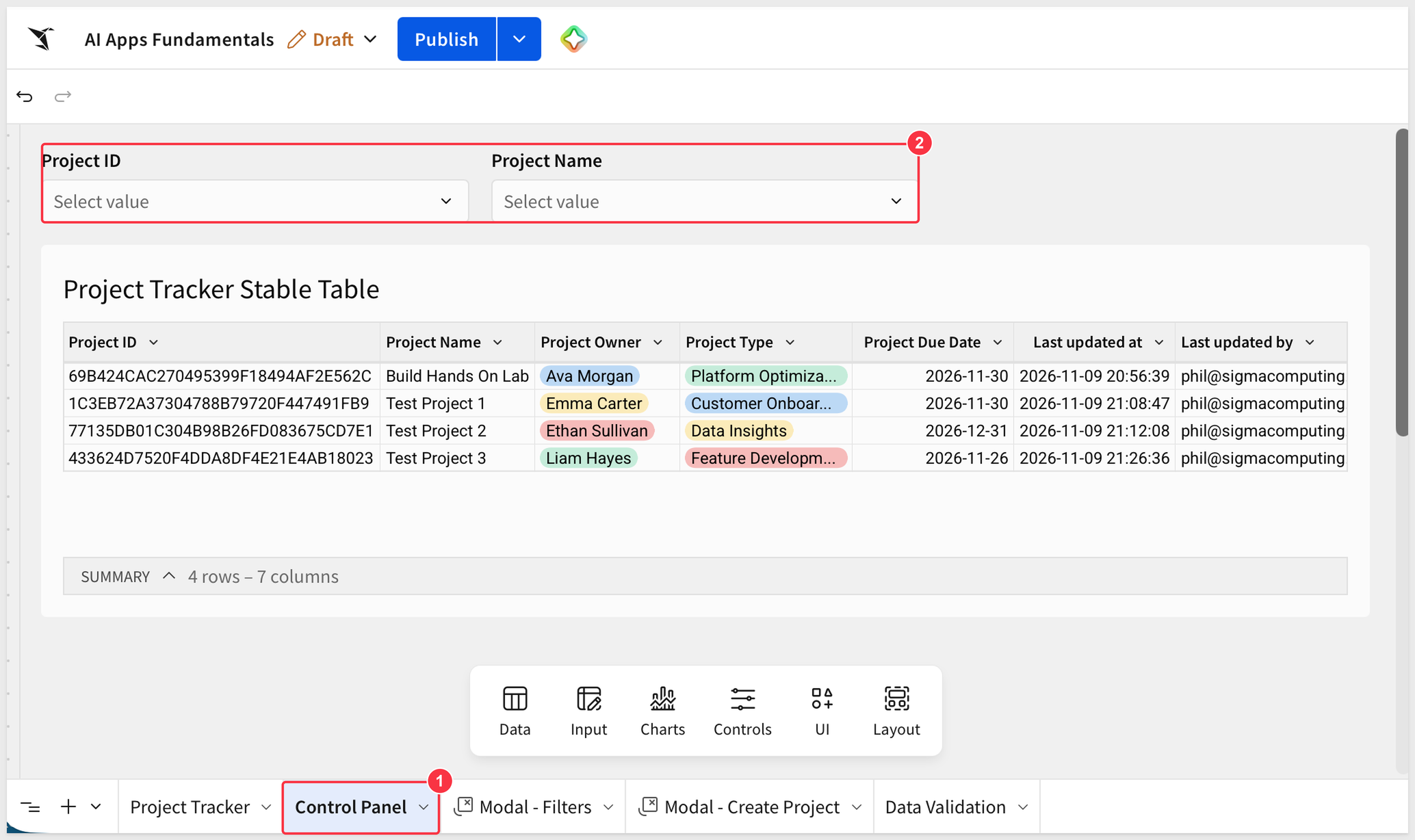
The Control Panel page (1) should look as follows at this stage, with the two page controls (2) above the table:
Step 1:
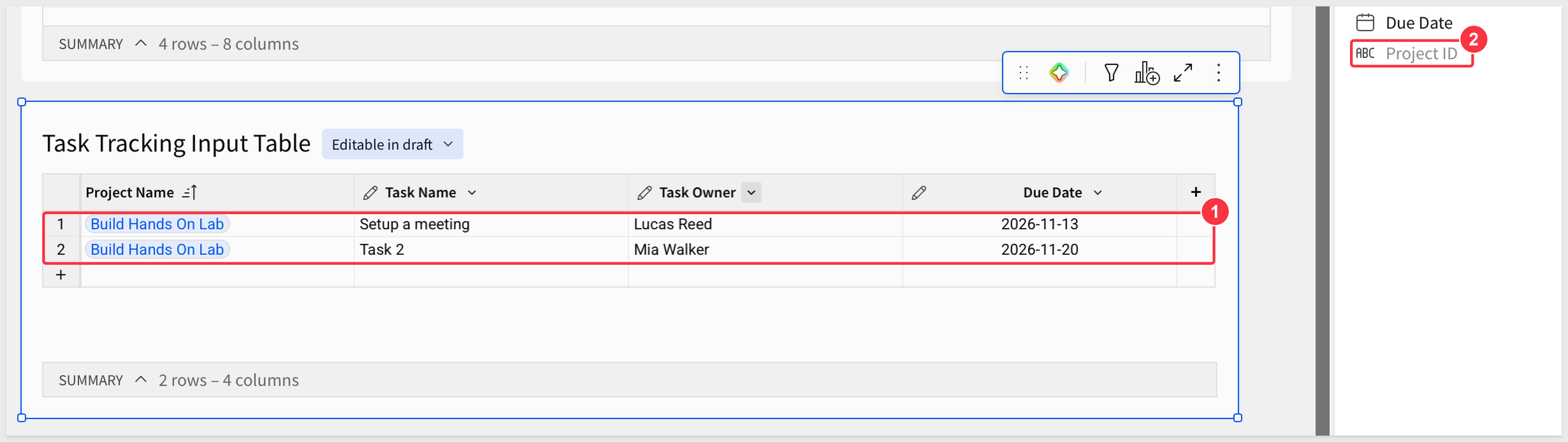
On the Project Tracker page, add a new Empty input table, connect it to the Sigma Sample Database and rename it to Task Tracking Input Table.
Configure columns for Task Name, Task Owner and a Due Date column as Date data type (1):
Step 2:
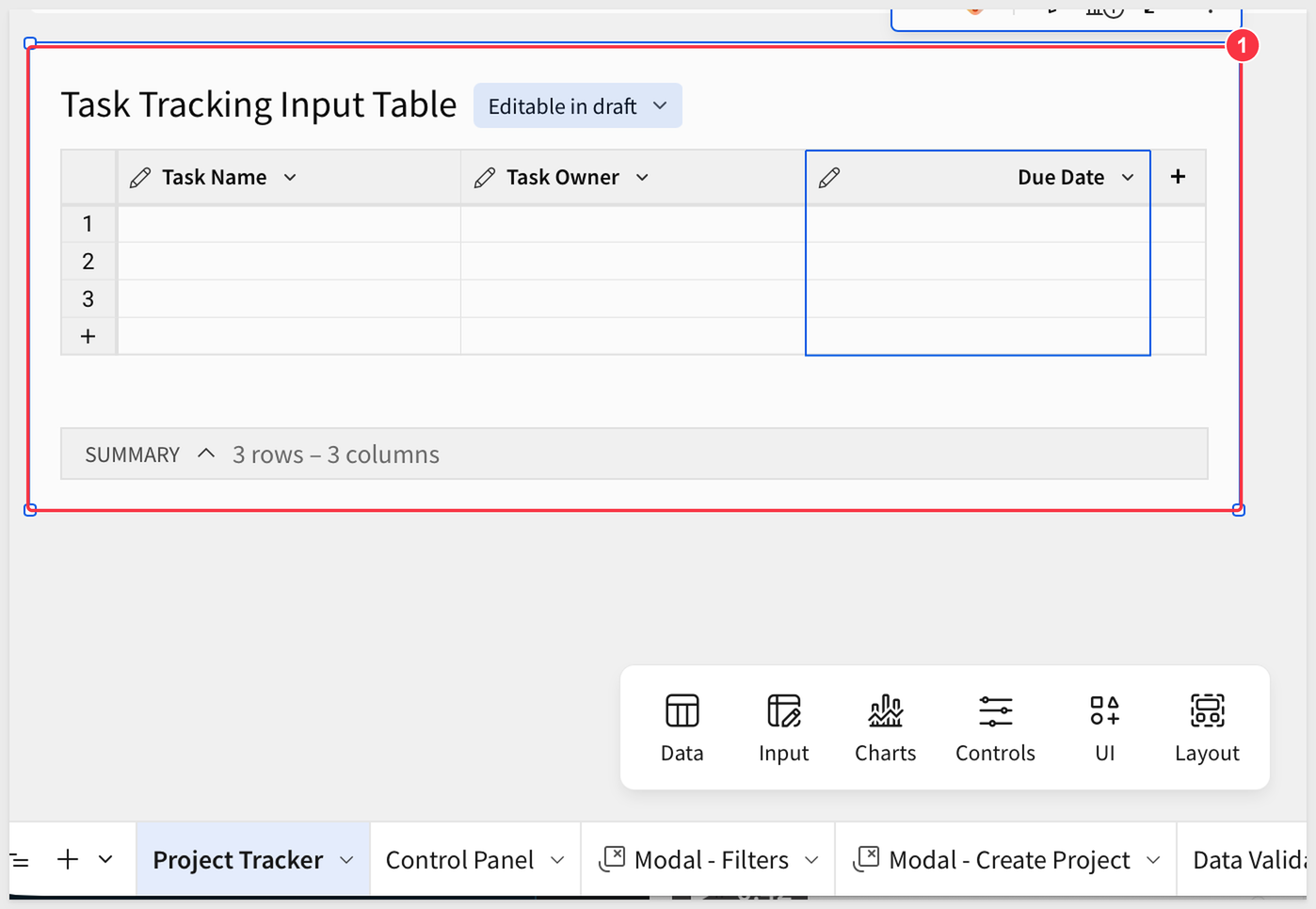
Delete any empty rows (1):
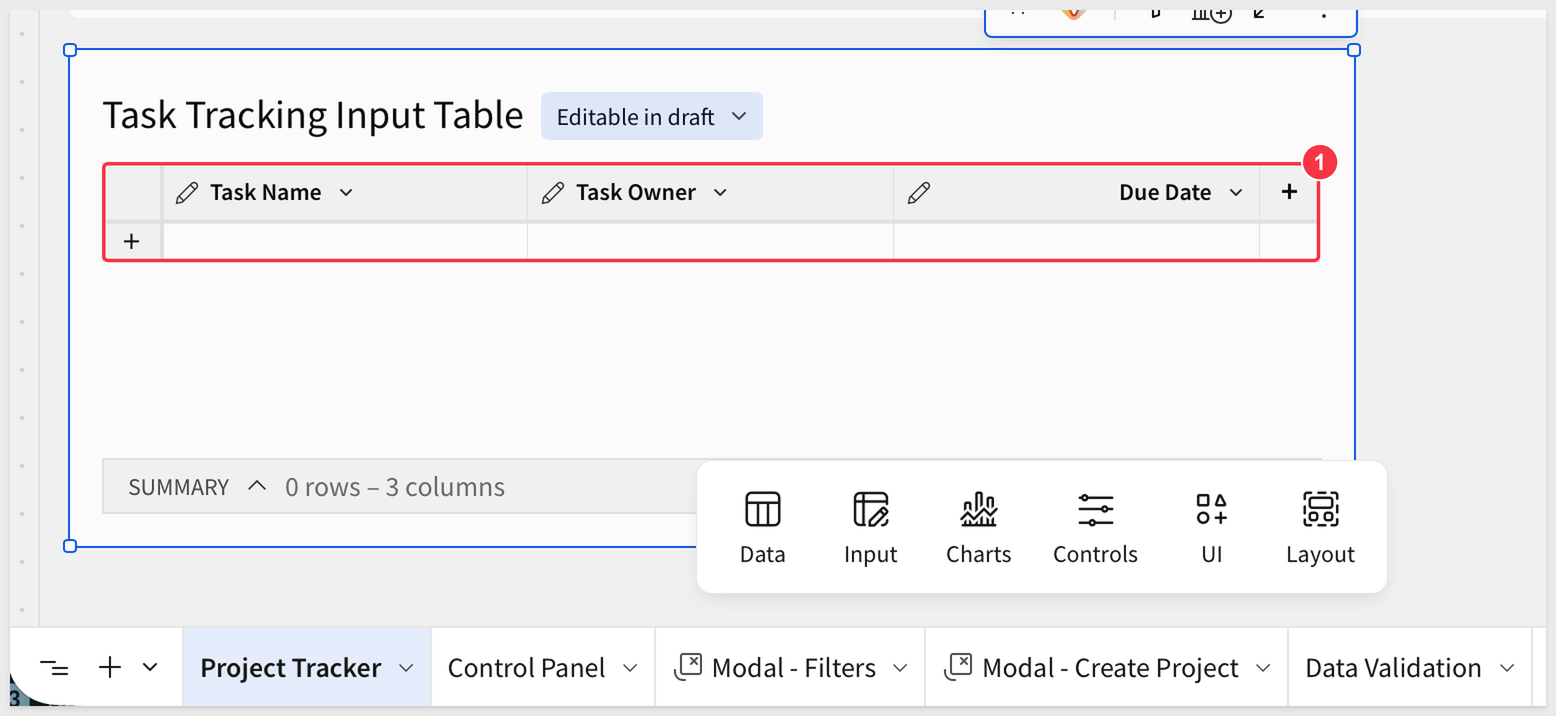
Add an additional text column for Project ID (1):
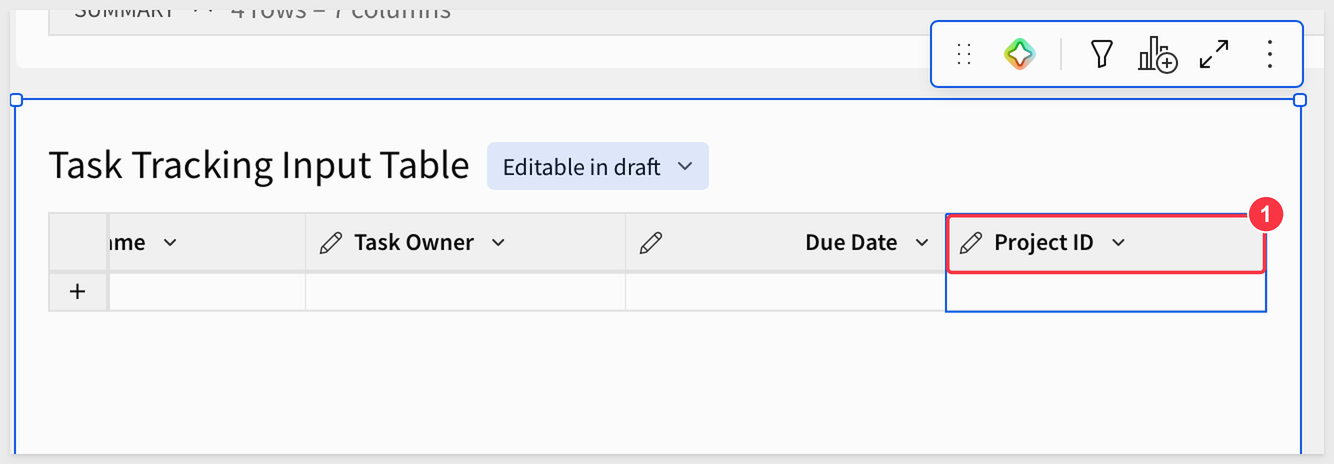
This column will be tied to the Project Tracker Input Table to link tasks to projects.
Step 3:
Add a text input control, List values control, and Date control above the Task Tracking Input Table.
Rename these to Task Name, Task Owner, and Task Due Date.
Set each Control Id as:
Task Name | ct-Task-Name |
Task Owner | ct-Task-Owner |
Task Due Date | ct-Task-Due-Date |
Step 4:
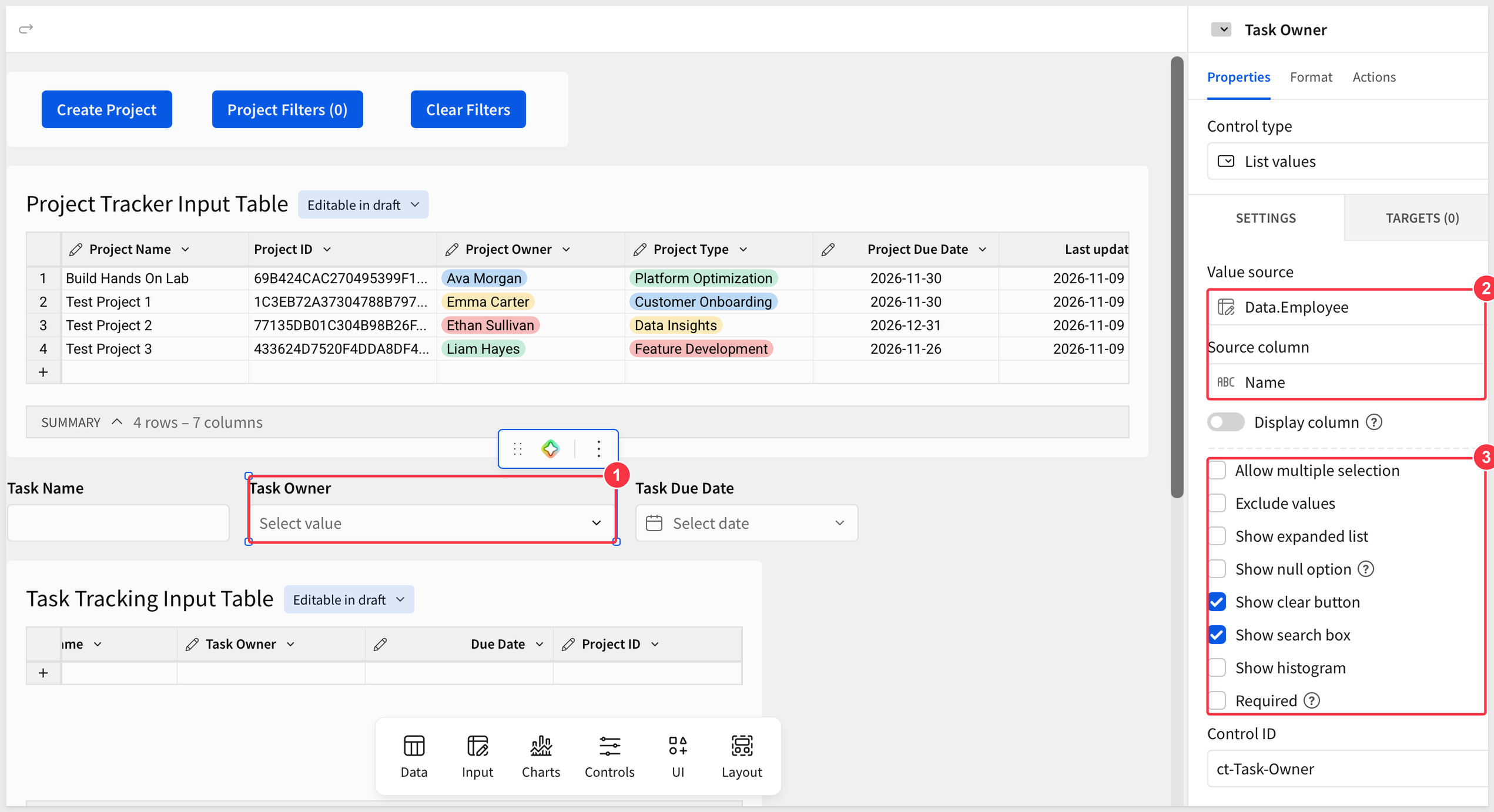
Select the Task Owner control (1) and ensure its Value source is the Data.Employee table and the Source column is Name (2), with the correct items deselected as shown (3):
Step 5:
Create a container named Create Task Container with the three controls.

Step 6:
Move this container to a New modal and rename the modal tab to Modal - Create Task (1).
Change the modal title to Create Task (2):
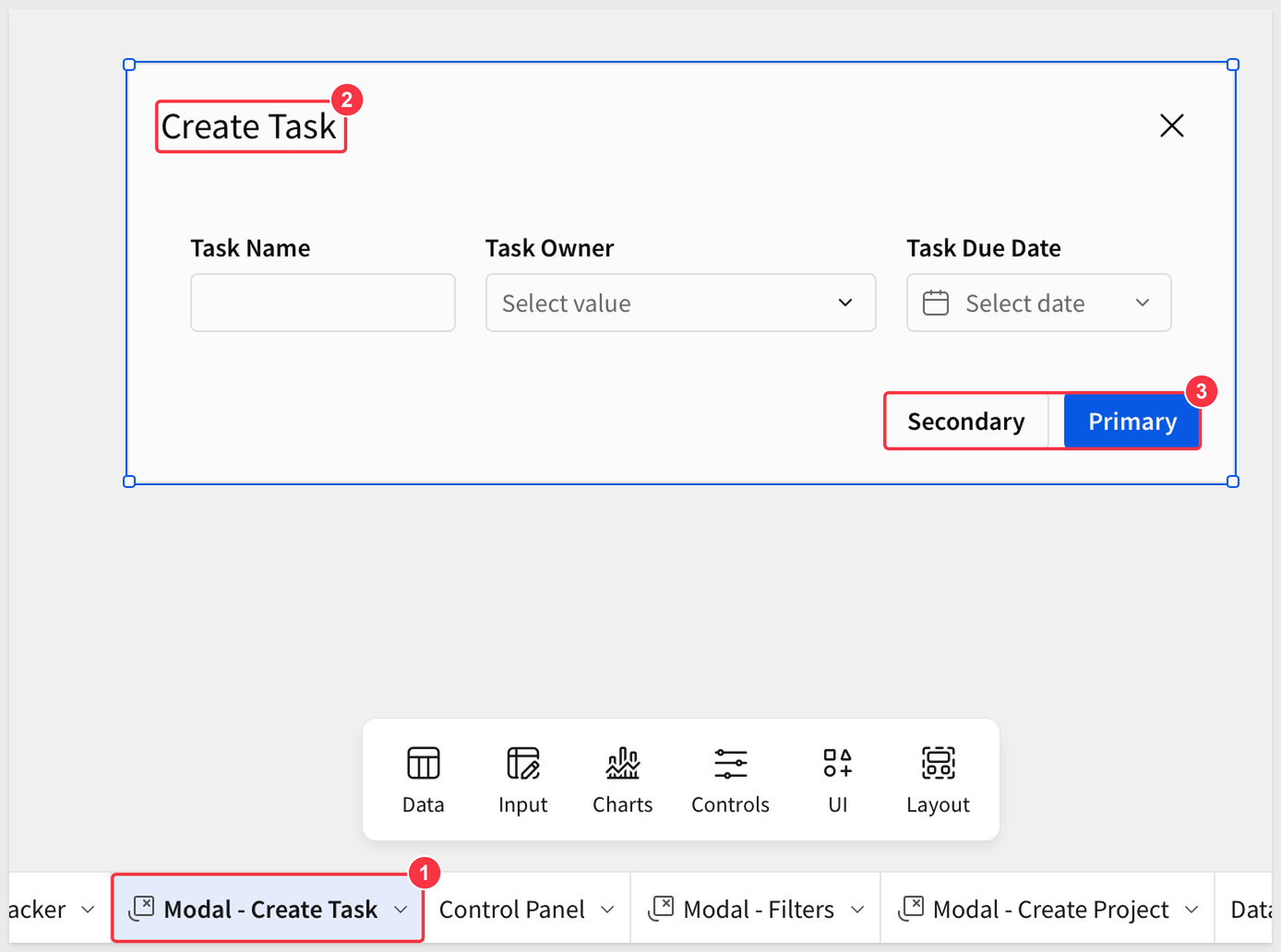
Using the existing primary and secondary buttons (3), change the names to Clear Form and Create Task.
Configure the actions for these buttons as follows:
Create Task (primary button):
Add an Insert row action (1) and make sure you're inserting into the Task Tracking Input Table (2). Set Project ID (3) to the Project ID control on the Control Panel page:
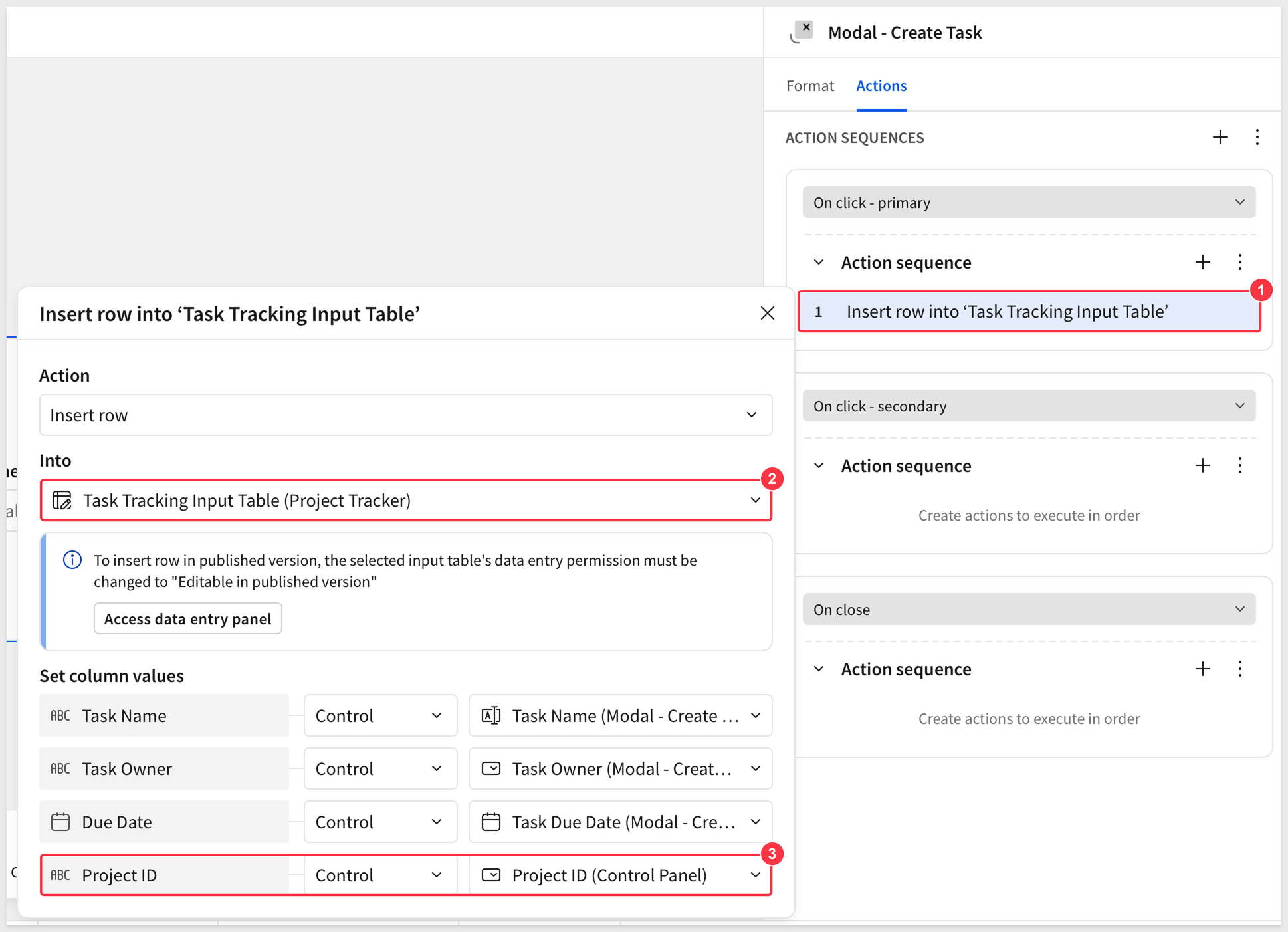
Add two more actions after the Insert row action to clear the controls in the Create Task Container (1) and then close the modal (2):
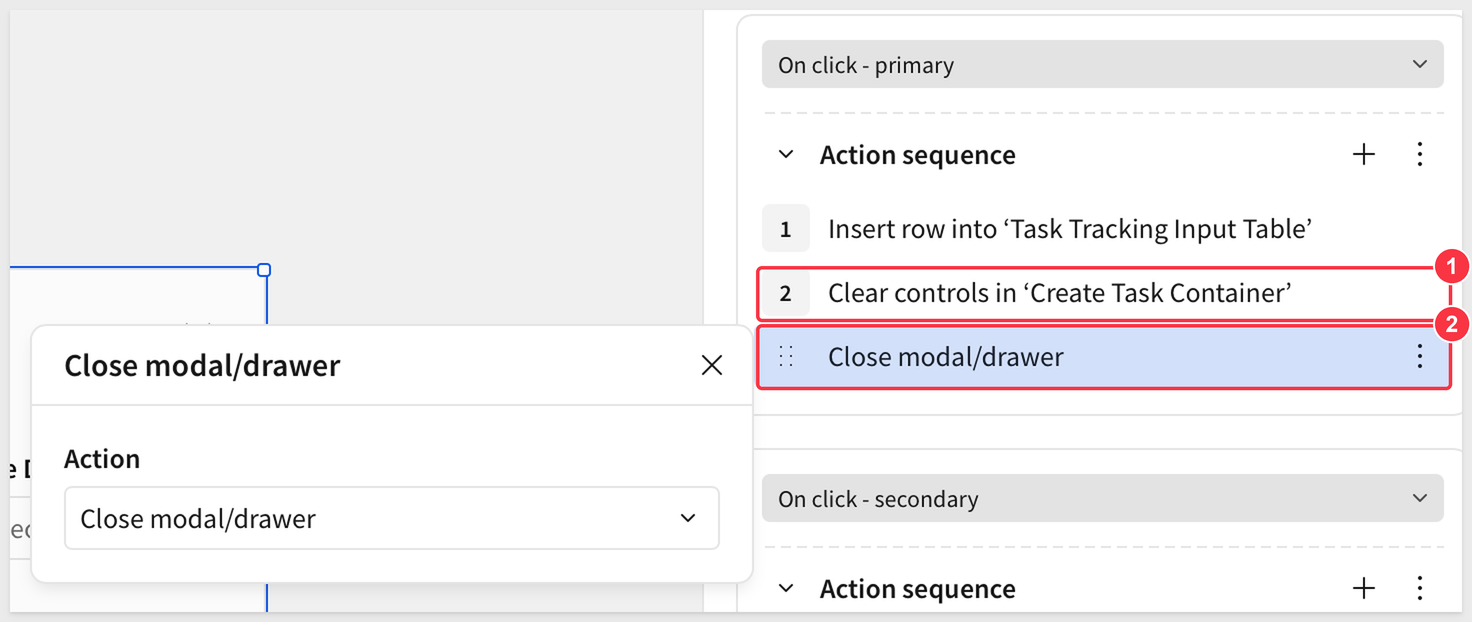
Clear Form (secondary button):
Add a Clear control for the Container with the action set as:

We will use the modal's X to close the modal, if the user does not want to take any action.

Step 7:
On the Project Tracker Input Table, open a column's dropdown and select Add new column (1) > Calculation (2).
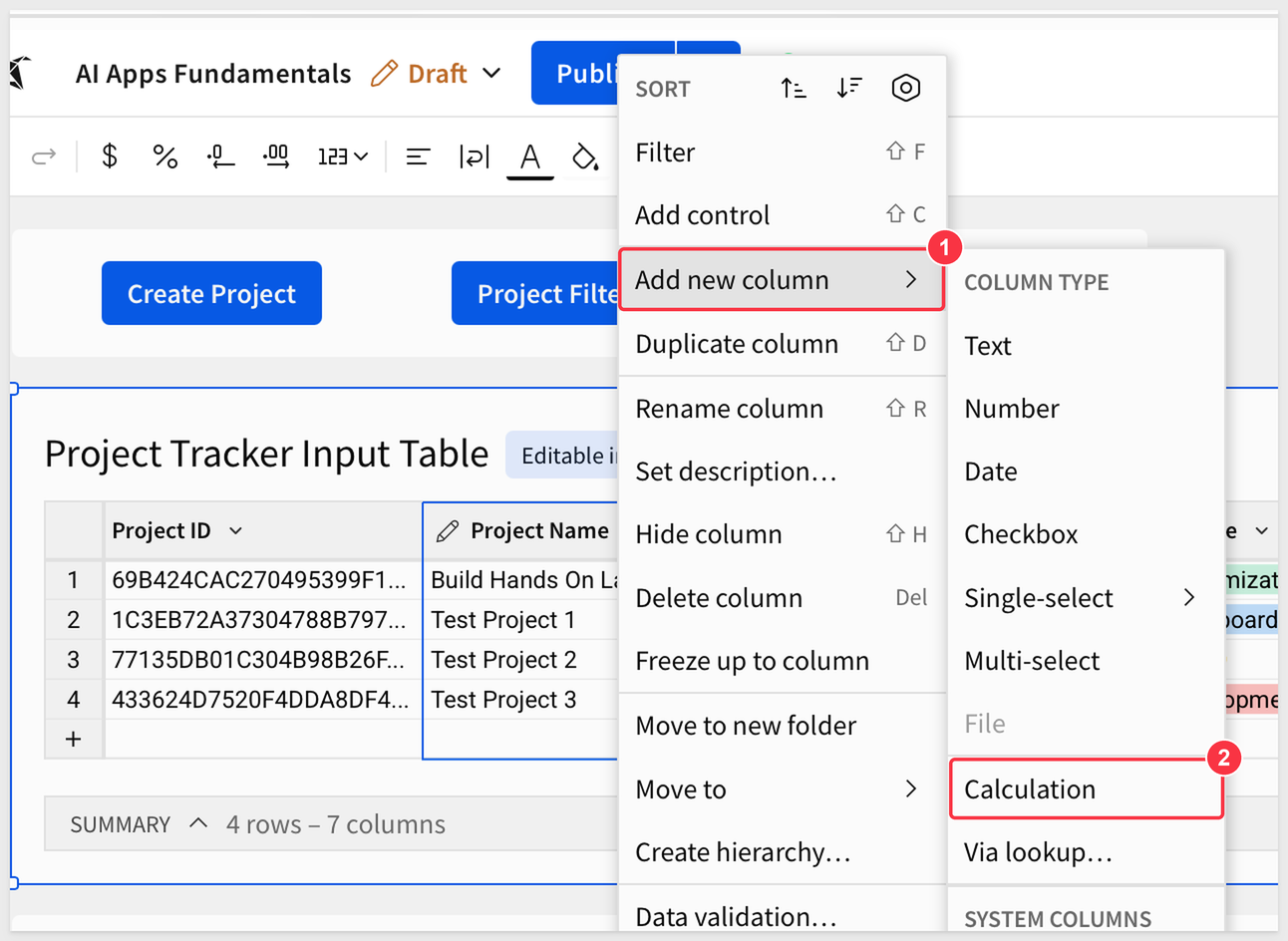
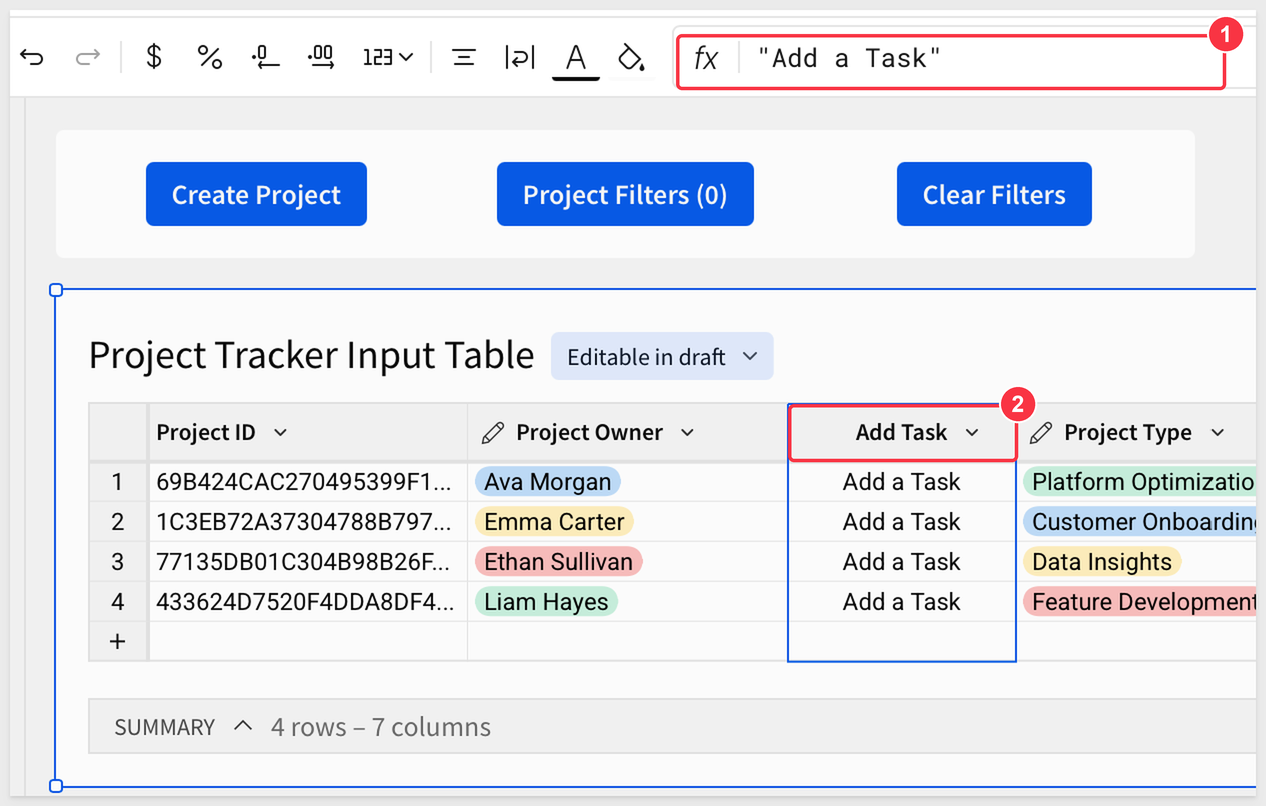
The formula for this calculation will be "Add a Task" (with quotation marks included) in the formula bar (1).
Rename this column to Add Task (2):
Step 8:
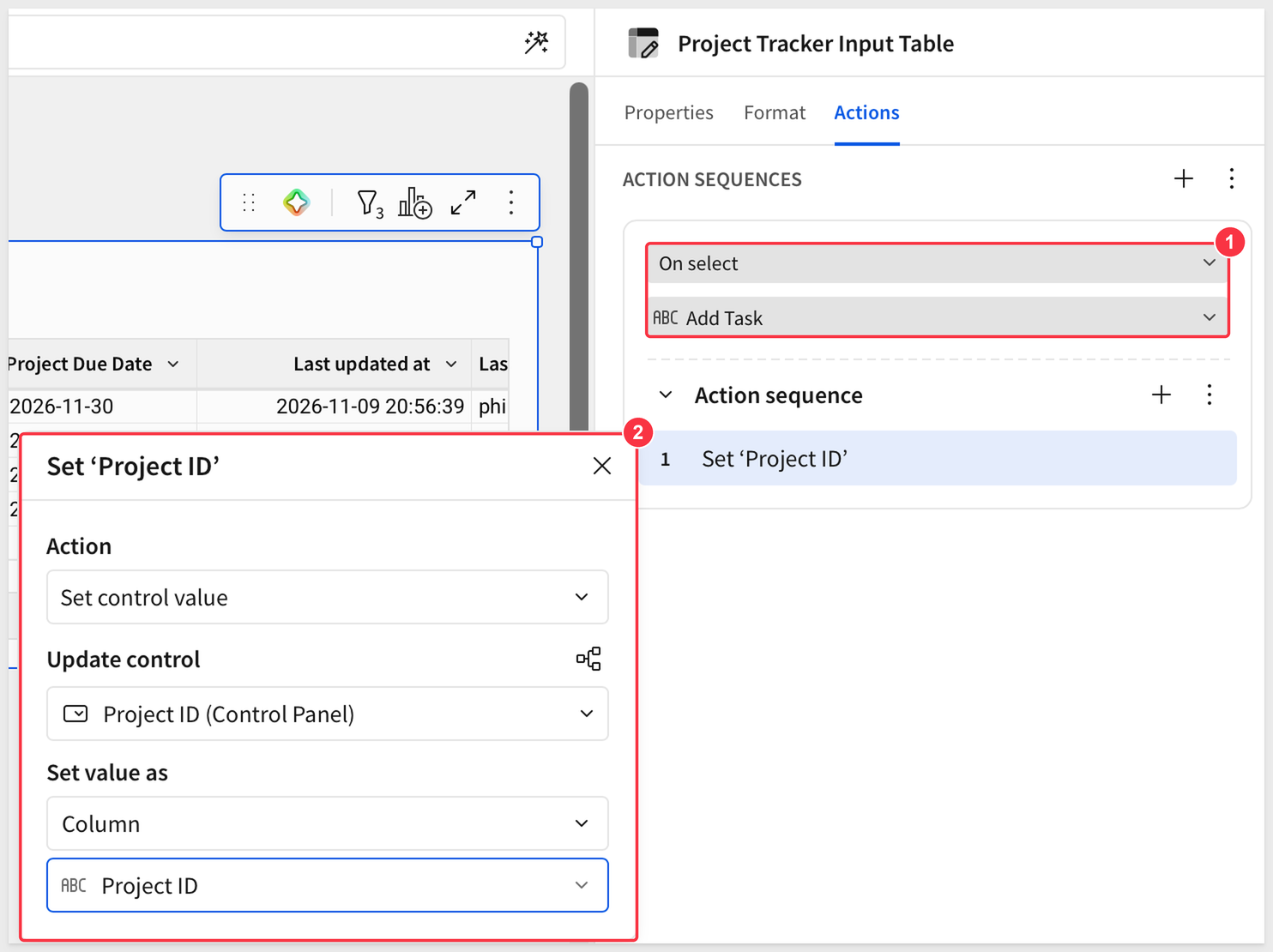
Let's add an action to Add Task.
Configure the action to On select for the column Add Task (1).
Configure the rest of the action to set the Project ID on the Control Panel (2):
Step 9:
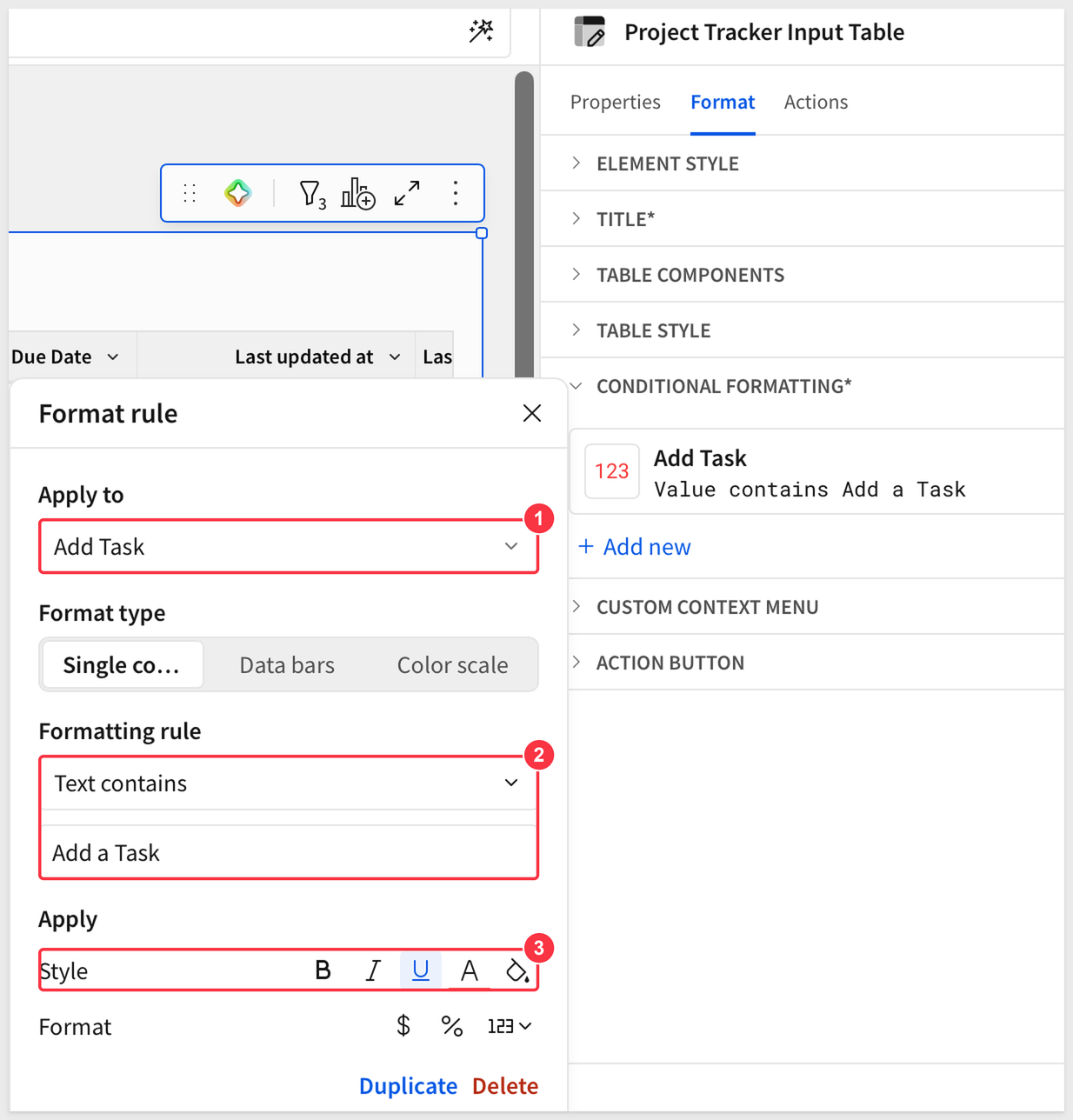
Add conditional formatting to the Add Task column (1) to make it appear as a formatted hyperlink, using a Text contains rule for Add a Task (2) with underline and a font color (3):
Step 10:
Test this action by selecting an Add a Task cell from Create New Task and check the Control Panel page for the Project ID control element. The value that was clicked will appear in the filter (1), and the Project Tracker Stable Table will show only that project (2):
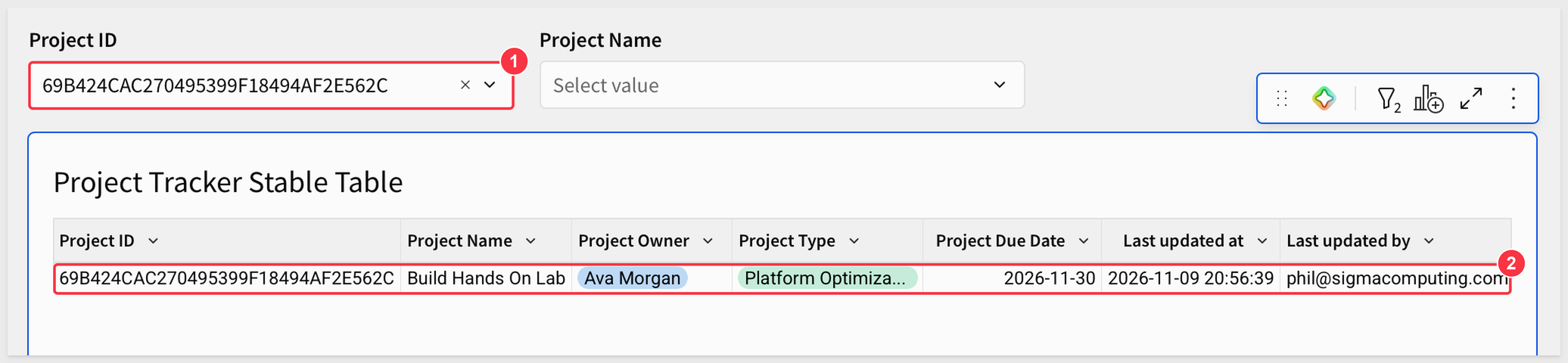
Before continuing, clear the Project ID control (select the ×) so the later tests start from an empty filter.
Step 11:
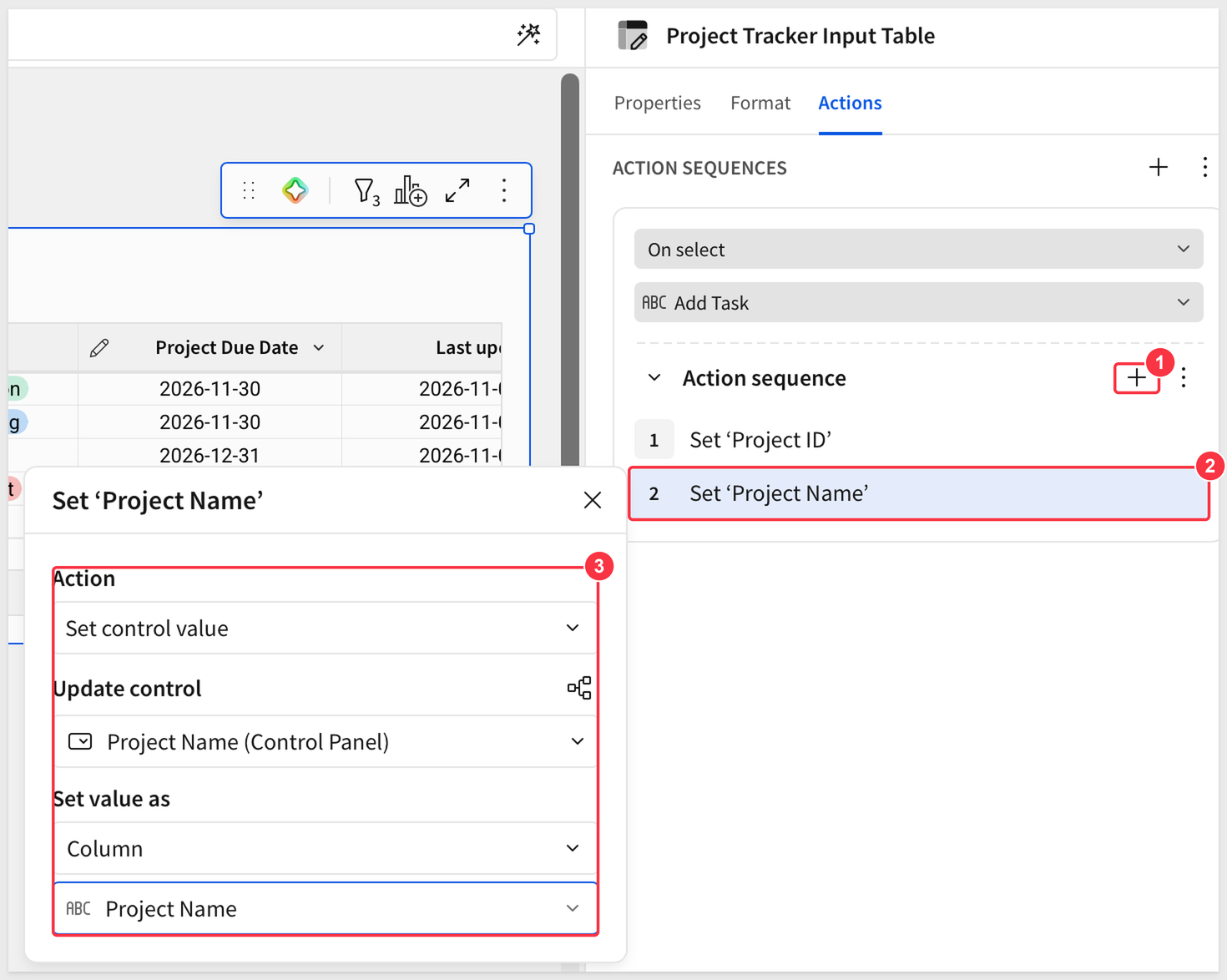
We also want to set the Project Name when the user clicks Add a Task.
Add another action (1) under the Set 'Project ID' action and configure it as Set 'Project Name' (2), updating the Project Name control on the Control Panel with the Project Name column (3):
Step 12:
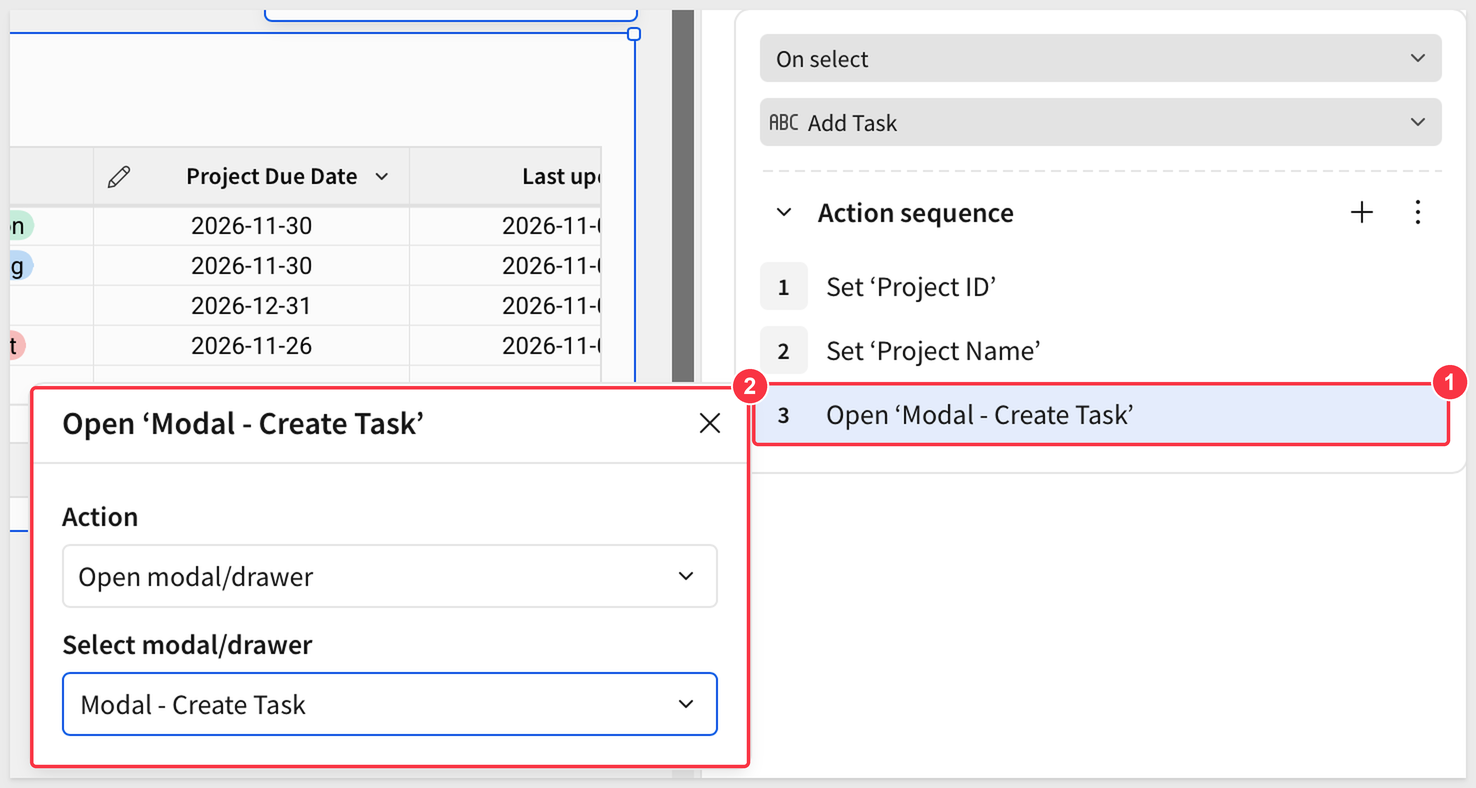
Add a third action (1) with Open modal/drawer selected, and choose Modal - Create Task (2):
Step 13:
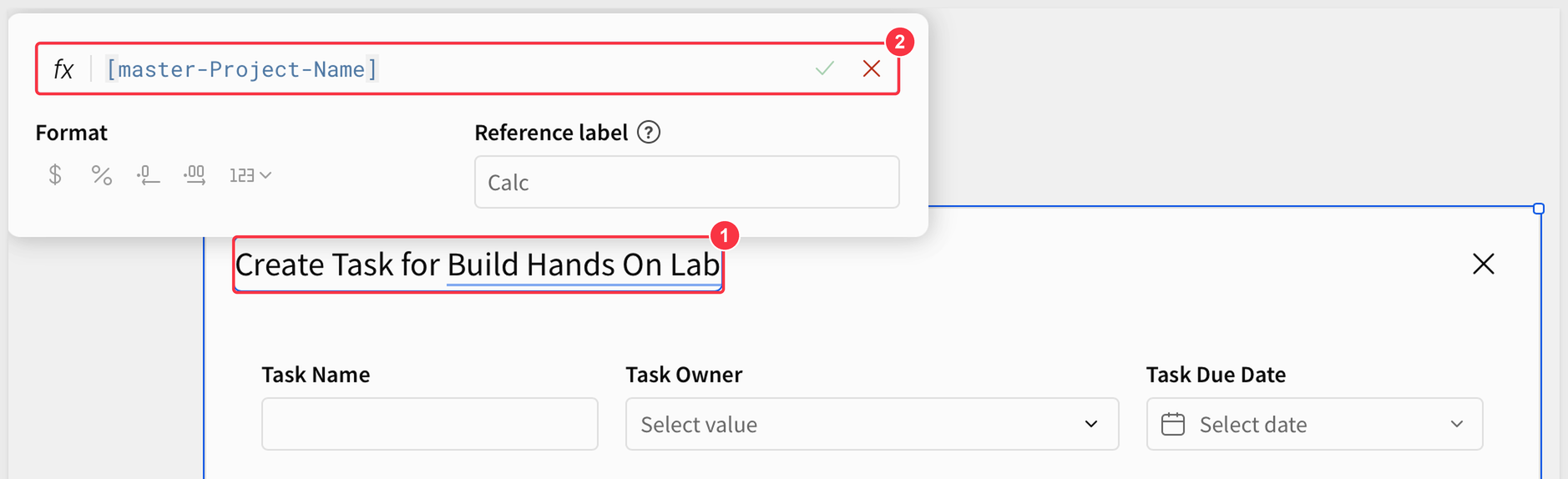
When the modal appears, we want the Project Name to appear in the title so the user is oriented.
On the Modal - Create Task page, select the text Create Task and append it with for followed by =, which opens the formula bar. Use this formula:
[master-Project-Name]
and click the green checkmark. The title now shows the project name (1), from the formula in the editor (2):
Step 14:
Let's test this by clicking Add a Task from any row and entering some test data (1). When done, click Create Task (2):
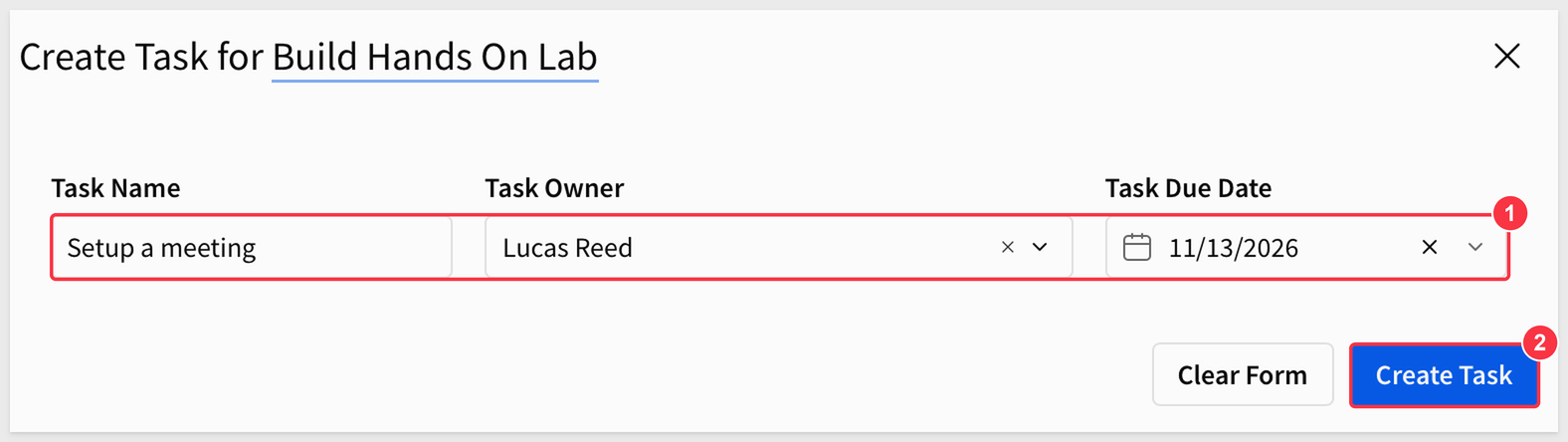
The new task should appear in the Task Tracking Input Table (1), with the Project ID of the project you started from:

Try this multiple times to add new tasks to the task tracking table.
Step 15:
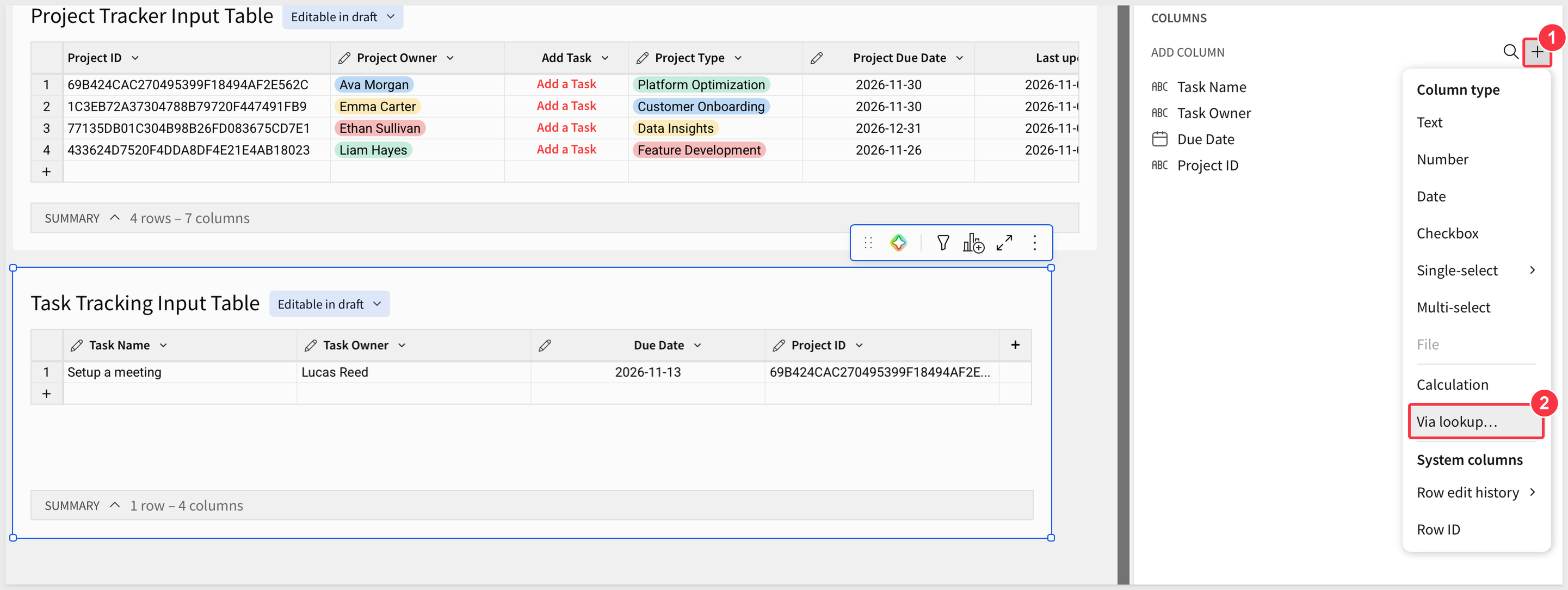
Add a new column via lookup to the Task Tracking Input Table.
This time we used the element panel, COLUMNS section: select the + (1) next to ADD COLUMN, then Via lookup... (2). This is another way to add a column:
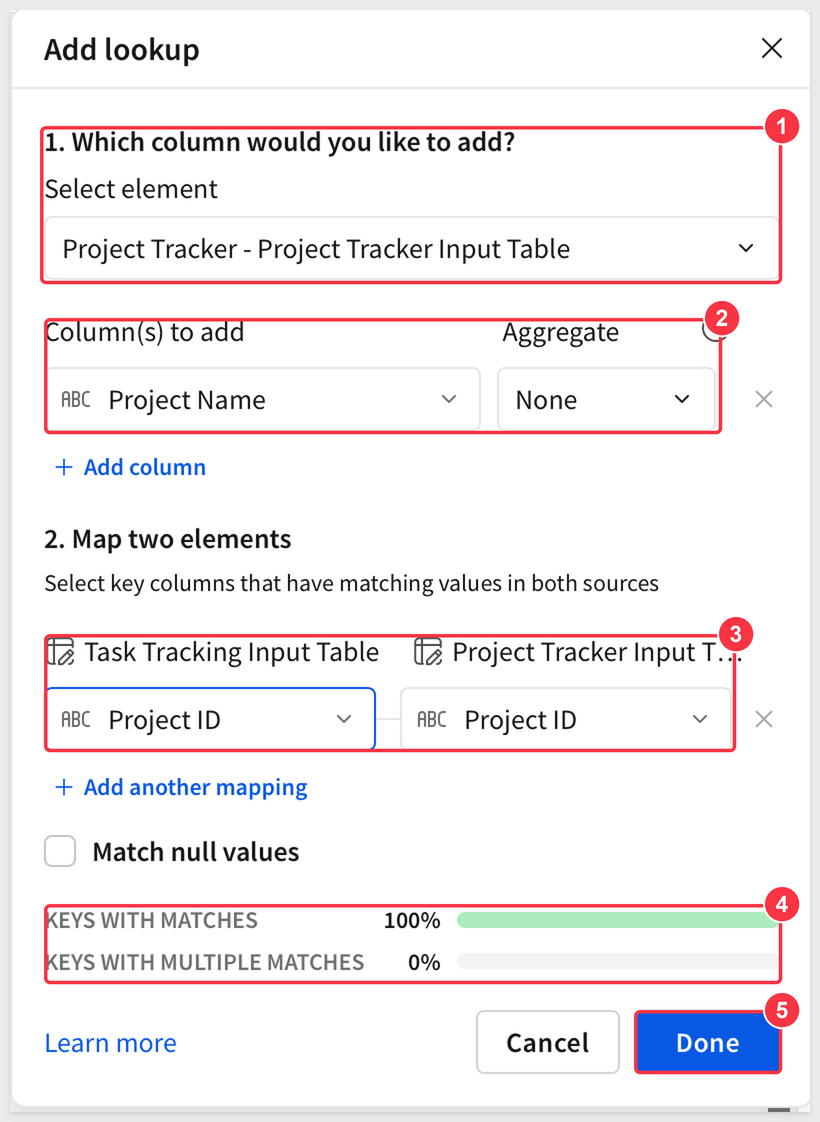
We need to let Sigma know which column(s) we want to bring in and how to "match" the two input tables (e.g., join them). Select the Project Tracker Input Table as the element (1) and add the Project Name column (2). We could also pre-aggregate the columns as we bring them in, but in this case, that is not wanted, so Aggregate stays None.
Map Project ID in the Task Tracking Input Table to Project ID in the Project Tracker Input Table (3). The match summary (4) should show 100% of keys with matches and 0% with multiple matches. Click Done (5):
Step 16:
Rename the new lookup column to Project Name and move it to the first column (1):

For more information on lookups in Sigma, see Add columns through Lookup
Step 17:
Move the Task Tracking Input Table to the Control Panel page.
Now that we have the Project Name we can hide the Project ID column (2).
Add an additional task record for the same project (1) and sort by Project Name:
Step 1:
On the Control Panel page create a new blank input table and connect to the Sigma Sample Database.
Rename it to Status Update Input Table.
Create the following columns:
Project ID
Project Status
Status Owner
Status Date
Set the type for Project ID, Project Status, and Status Owner to text; set Status Date to date (1).
Add the Last updated at and Last updated by columns (2), and the Row ID column, from the System columns menu options.
Rename the Row ID column to Status ID (3) and move it to the first position.
Delete any blank rows:

Step 2:
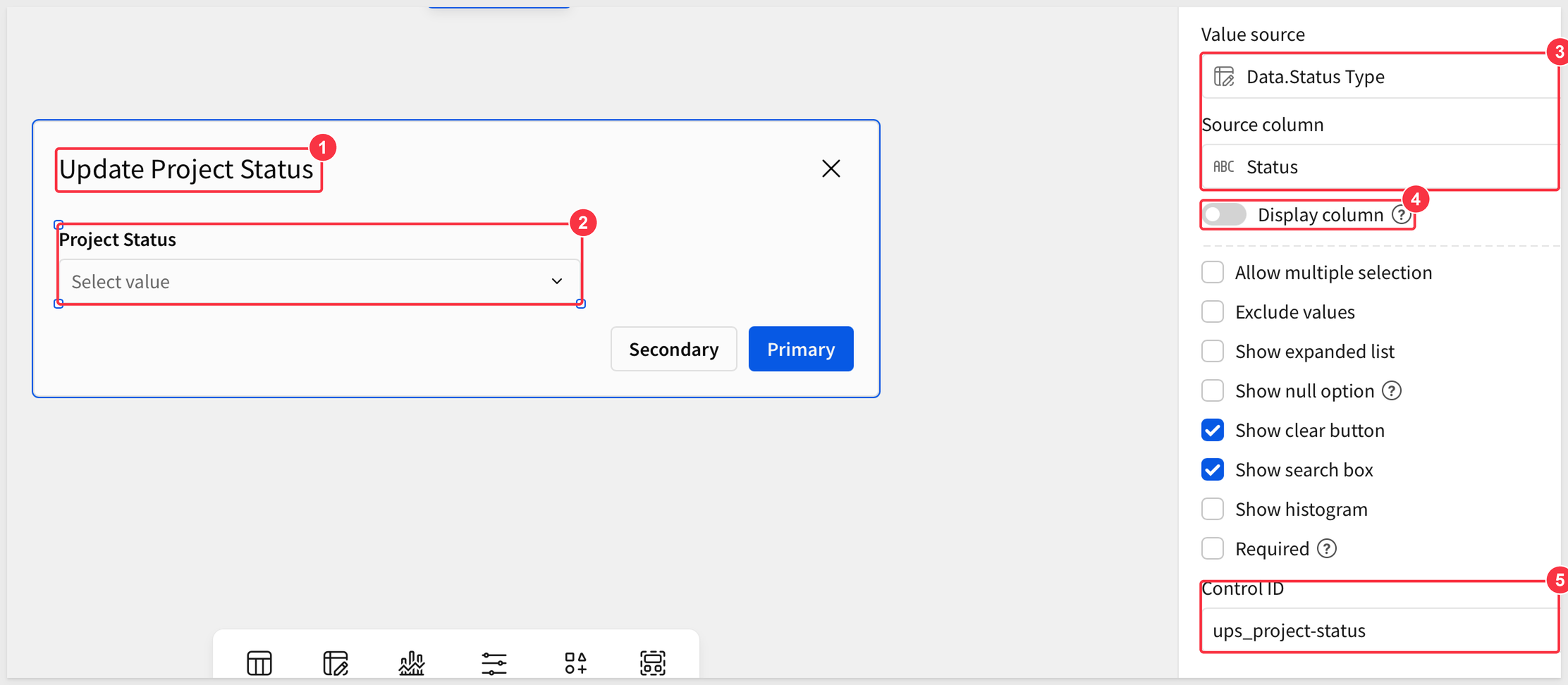
Add a new modal and change the title to Update Project Status (1).
Add a List values control and rename it to Project Status (2).
Set its Value source to Data.Status Type and Source column to Status (3).
Leave Display column turned off (4) as shown below.
Set the Control ID to ups_project-status (5):
Rename the modal page to Modal - Update Status.
Step 3:
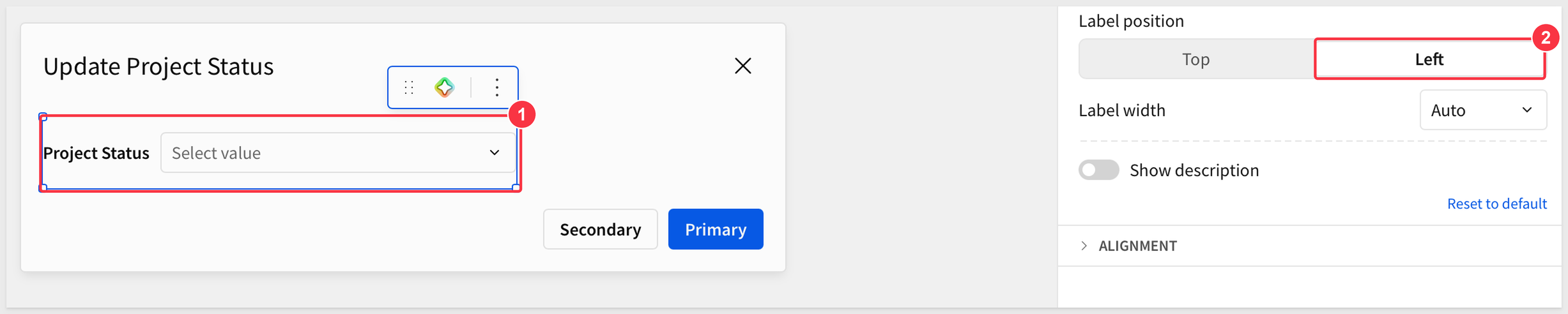
With the Project Status control selected (1), go to Format > Label and set Label position to Left (2) to put the Project Status title on the left:
Step 4:
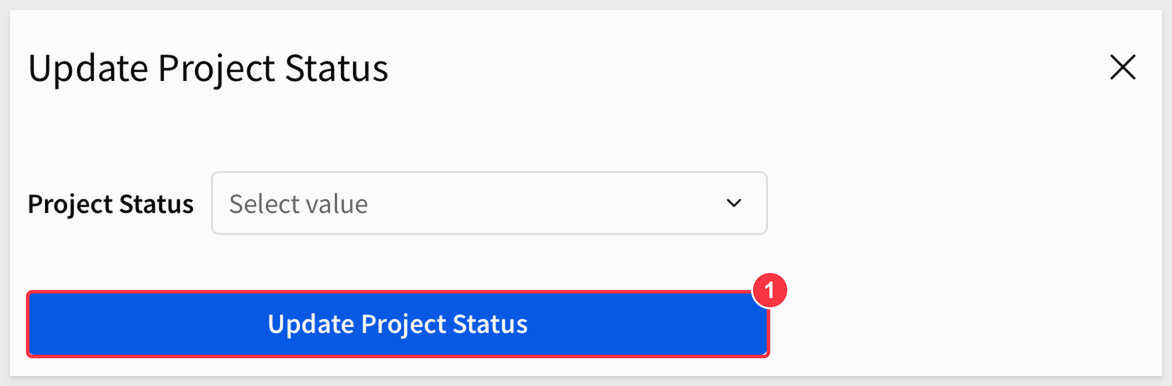
On the modal's Format options, turn off Show primary button and Show secondary button under Footer.
Add a Button and rename it to Update Project Status (1):
Step 5:
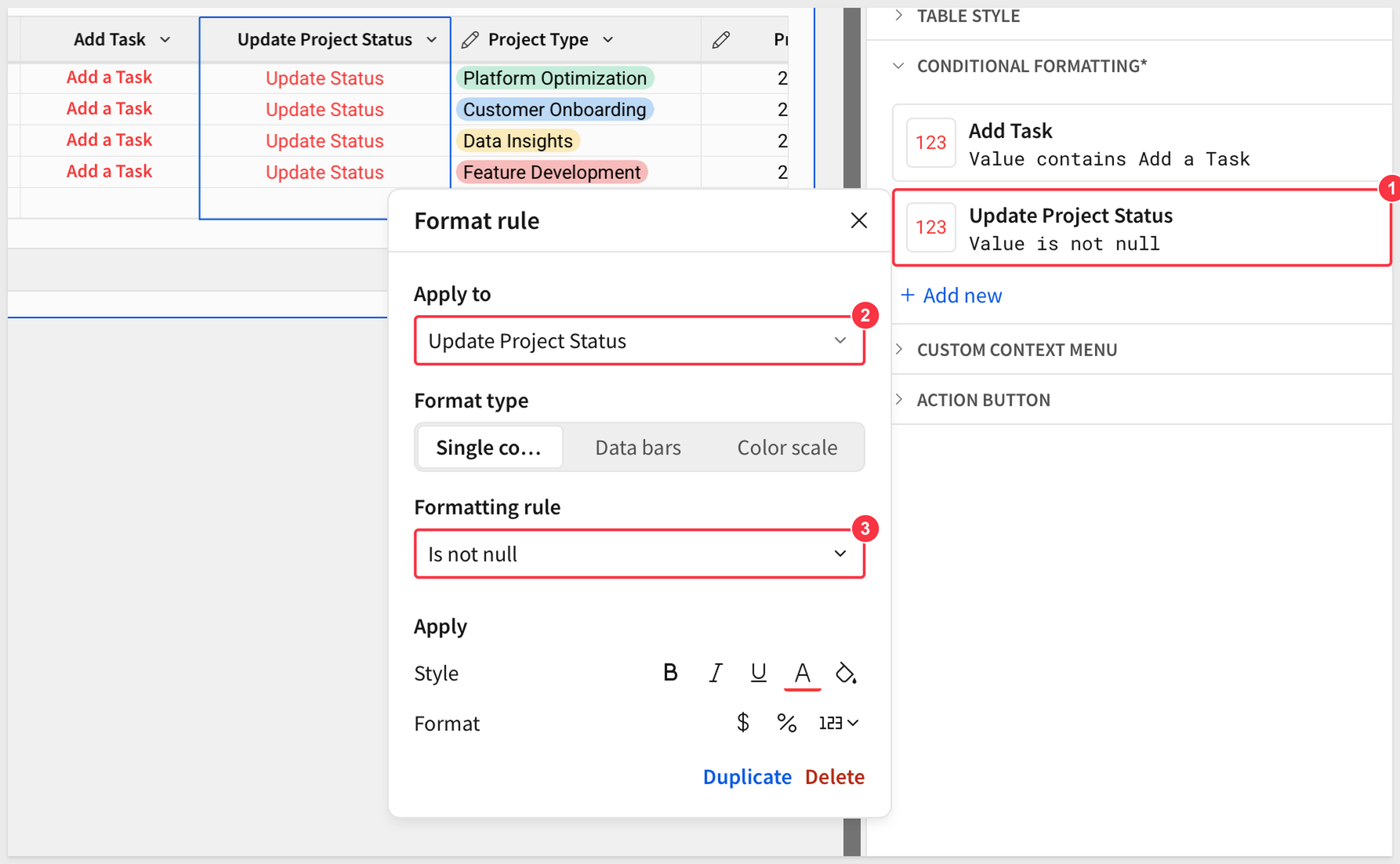
On the Project Tracker page and the Project Tracker Input Table, add a new column via Calculation after the Add Task field and rename it to Update Project Status with a formula:
"Update Status"
Use conditional formatting to give the new column the same red font color as the Add Task column.
Add a new conditional formatting rule for the column (1): set Apply to to Update Project Status (2), change the Formatting rule to Is not null (3), and set the font color, as shown in the screenshot below:
Step 6:
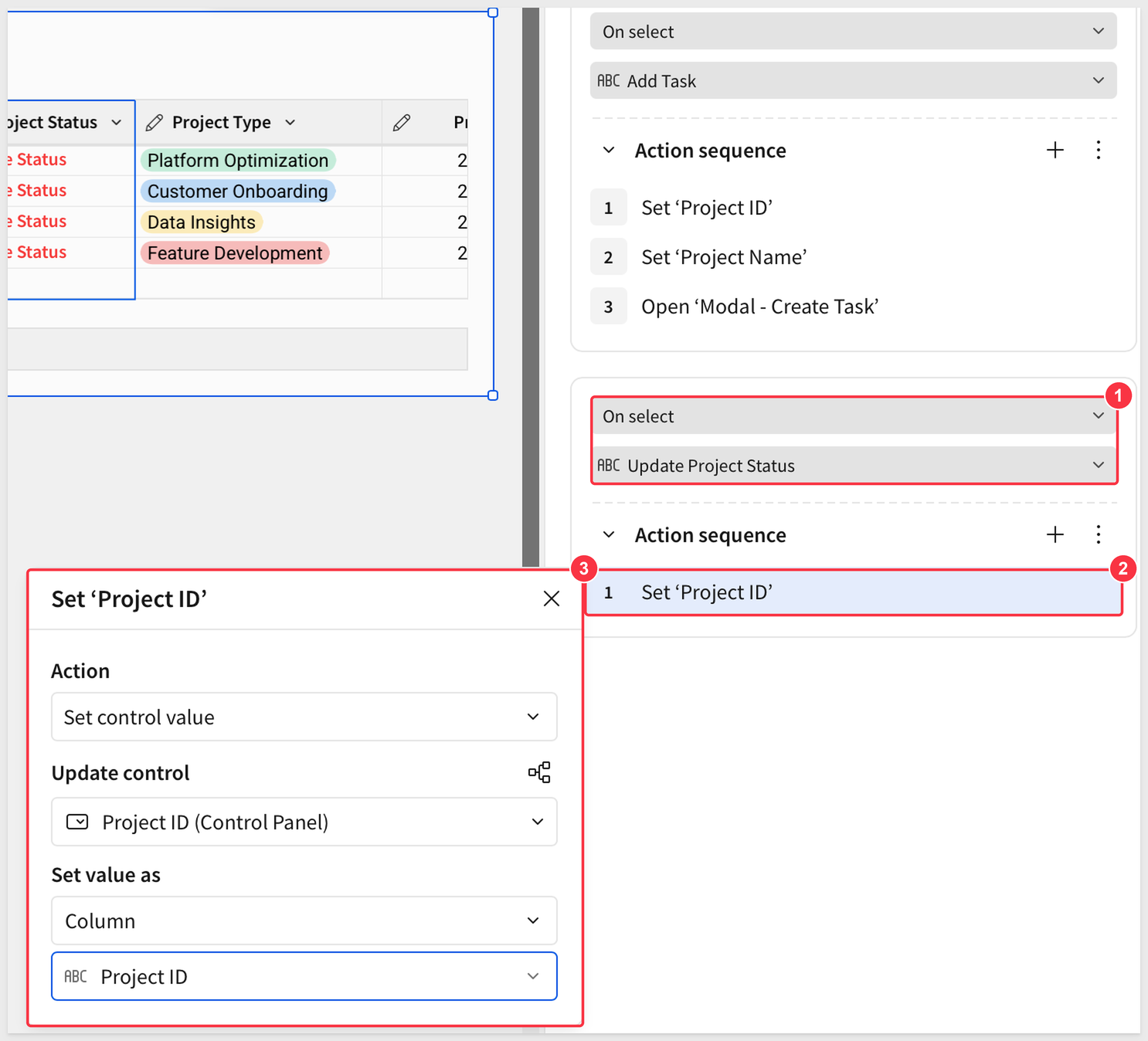
On the actions panel for Project Tracker Input Table, add a new On select sequence for the Update Project Status column (1).
Add an action (2) to set the control value of Project ID from the Control Panel.
Set the value as Column > Project ID (3):
Step 7:
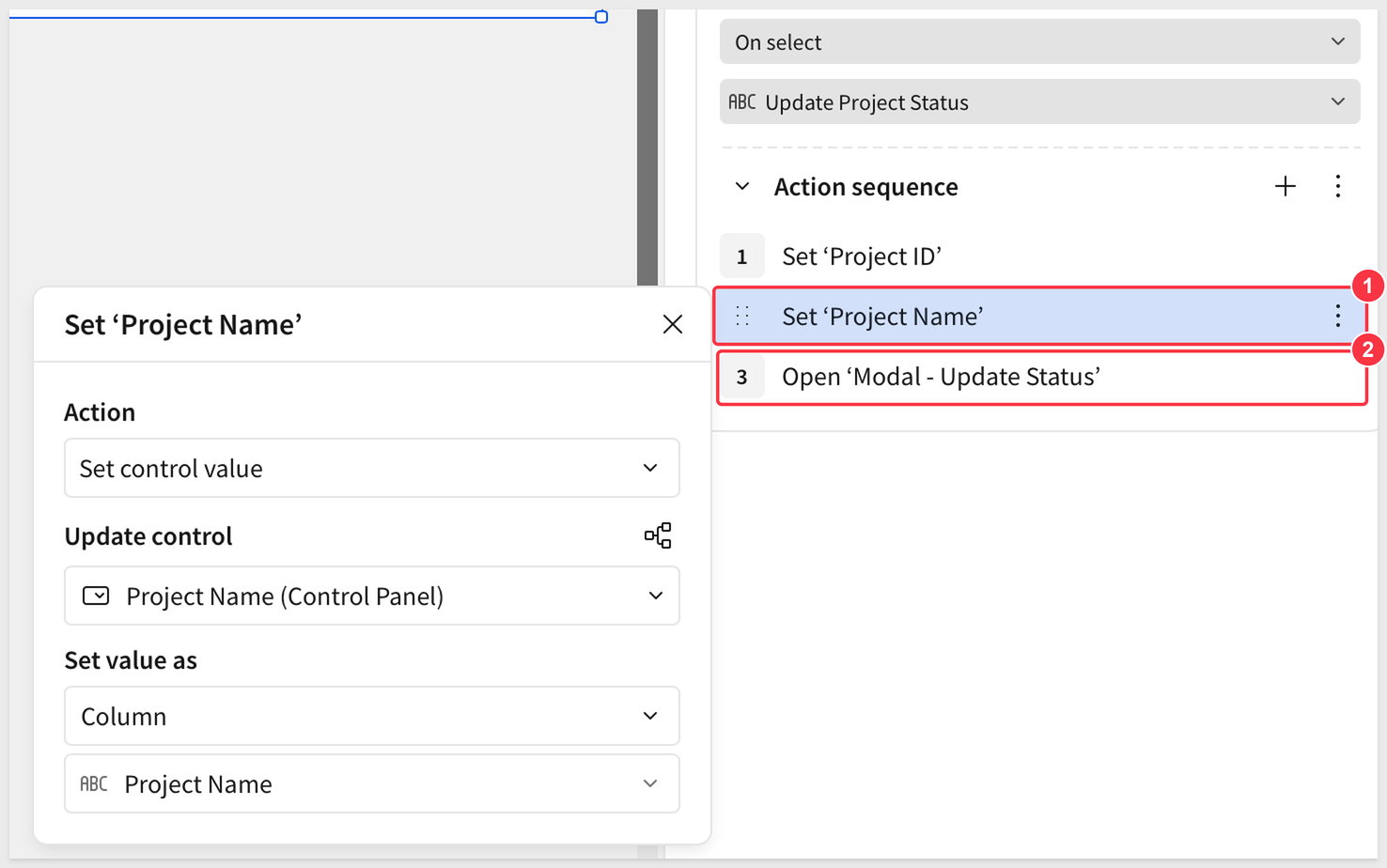
Add a Set control value action for Project Name (1), then an Open modal/drawer action for Modal - Update Status (2):
Step 8:
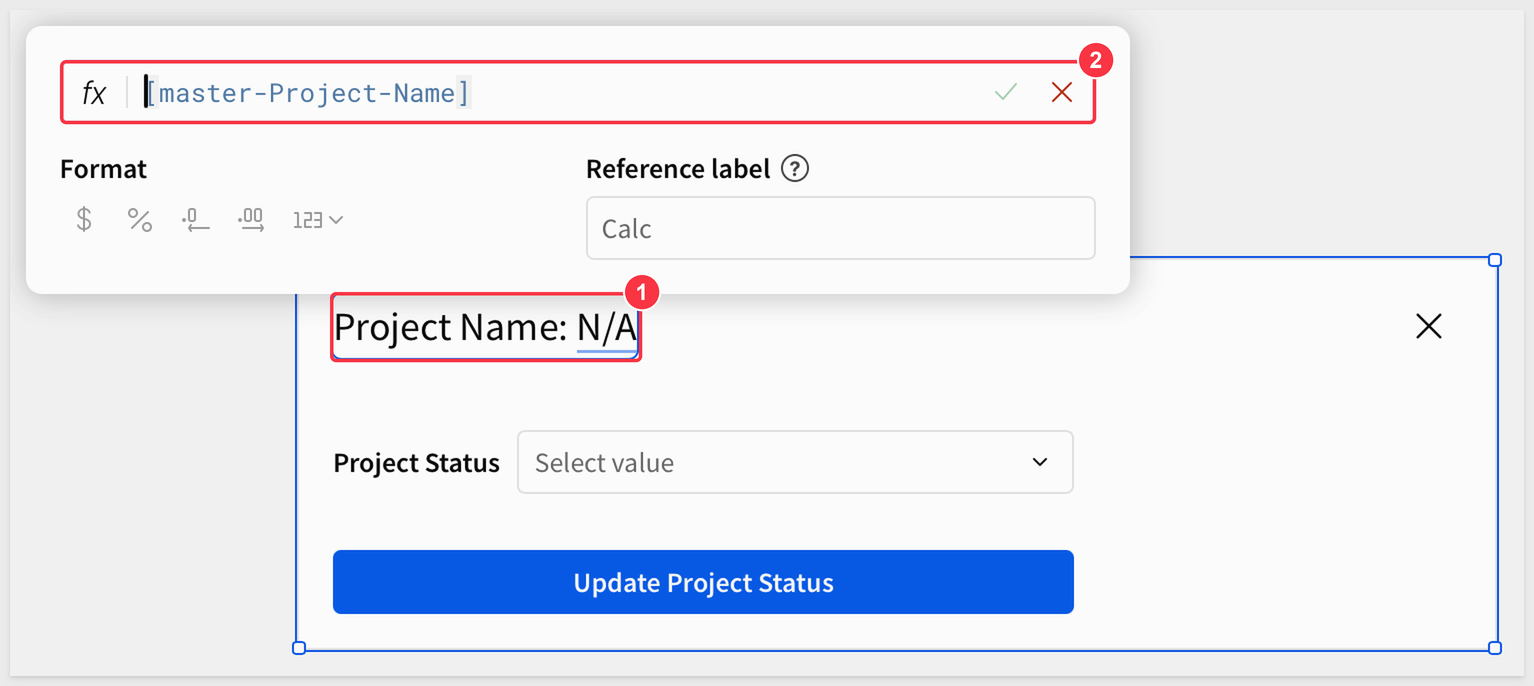
In the header of the Modal - Update Status tab, change the title text to Project Name: followed by an = sign and set the formula to:
[master-Project-Name]
The title (1) takes its value from the formula (2). It reads N/A until a project has been selected:
Step 9:
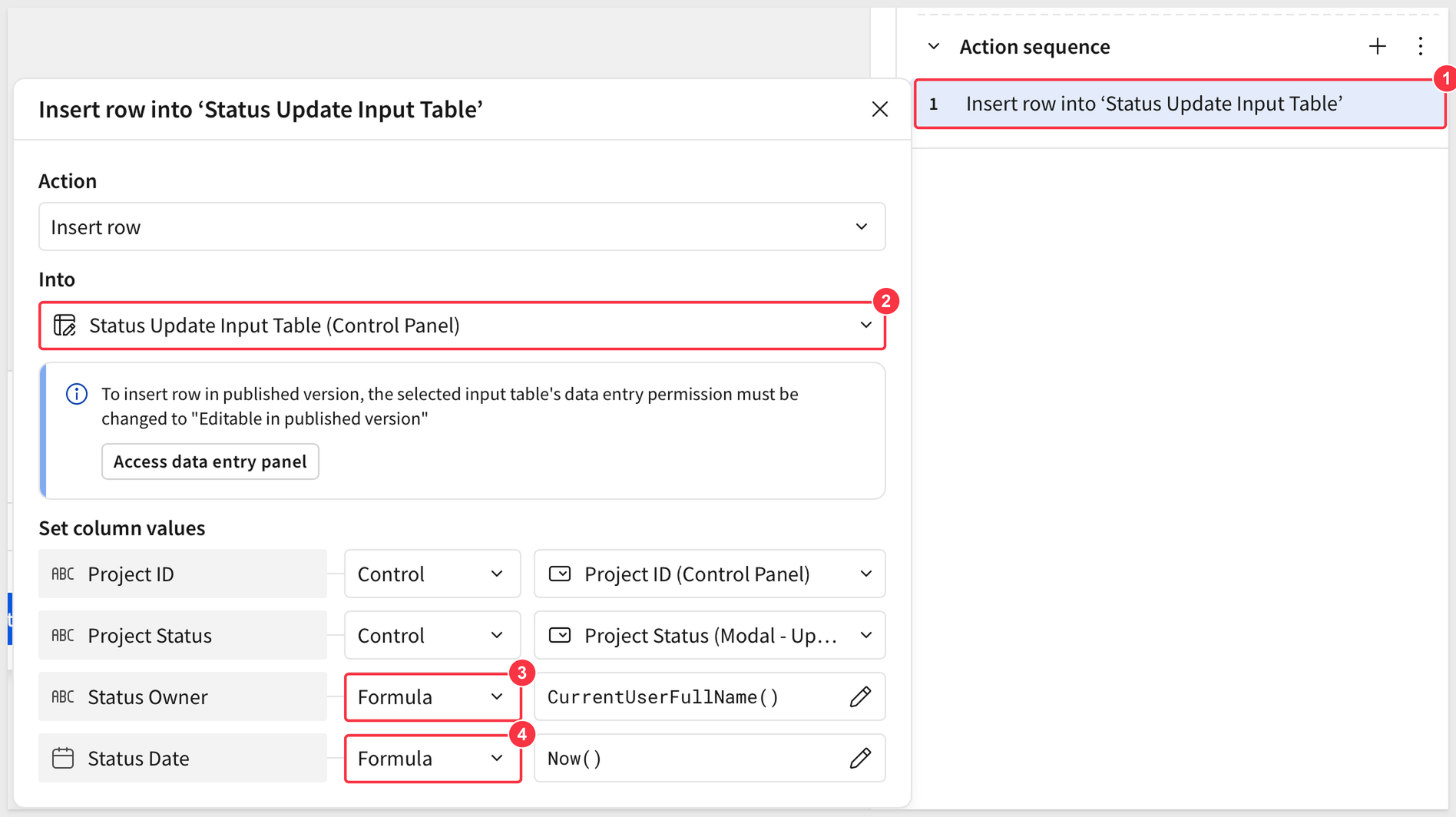
Set the action Insert row (1) on the Update Project Status button.
Ensure this is inserting a row into the Status Update Input Table (2) with Project ID which if you recall is located on the Control Panel page.
Notice that two columns are mapped to two formulas, CurrentUserFullName() (3) and Now() (4), and that the mapping for Project ID and Project Status are different in the screenshot below:
Step 10:
As we have done before, add an action for clearing the Project Status control (1) and set the third action to Navigate in this workbook (2), with the Destination set to Top of page (Project Tracker).
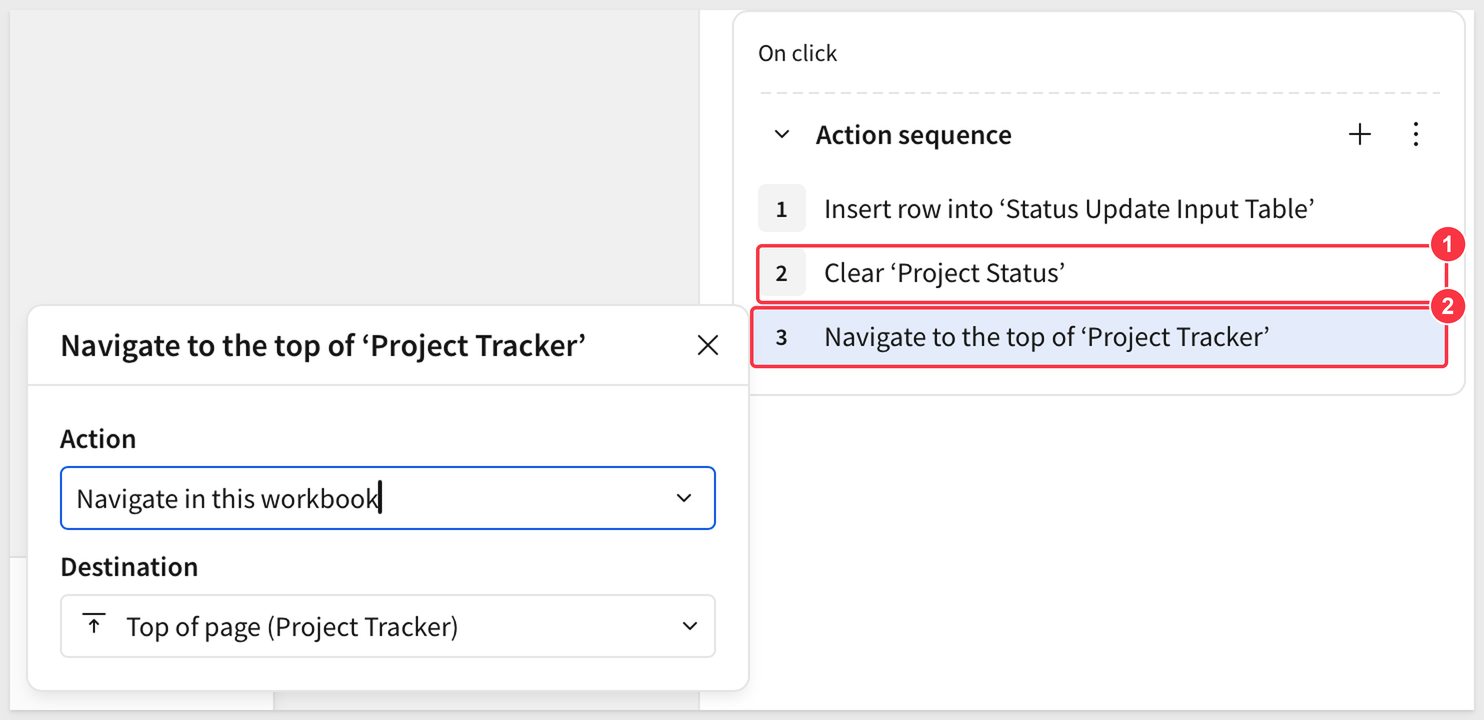
Saving clicks is always appreciated!
Step 11:
Back on the Project Tracker page, select Update Status for any project and test out the functionality of Modal - Update Status.
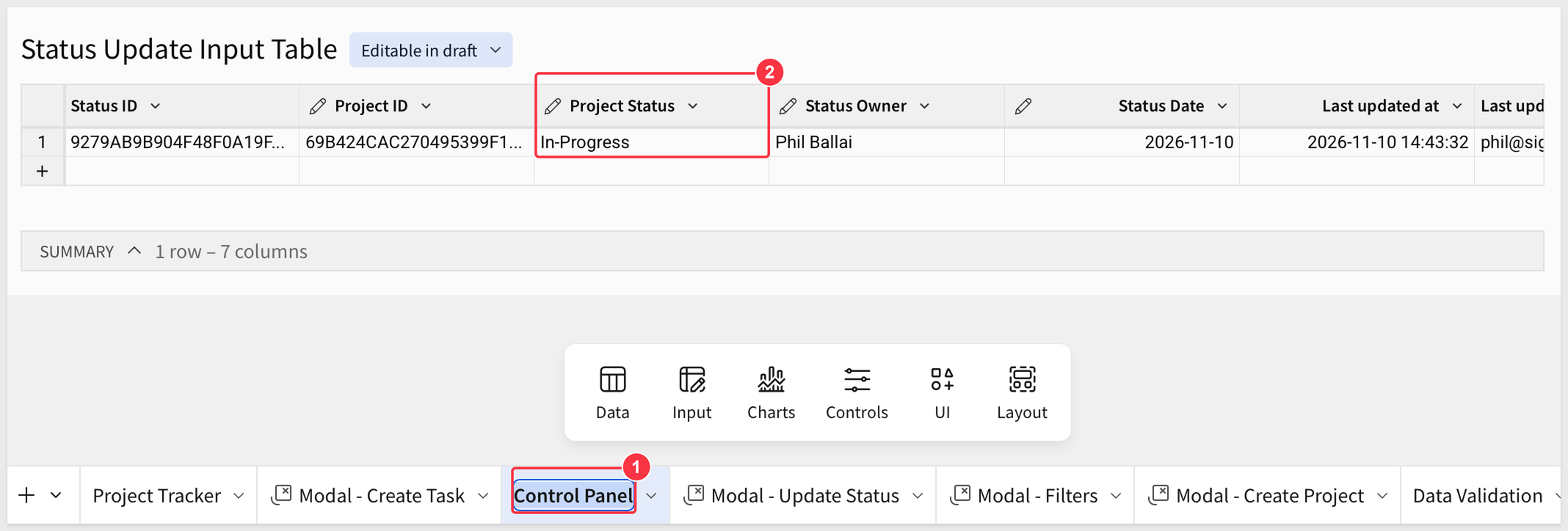
After setting a status and clicking the Update Project Status button we are returned to the Control Panel (1) where we can see the row added with the new status (2):
Step 12:
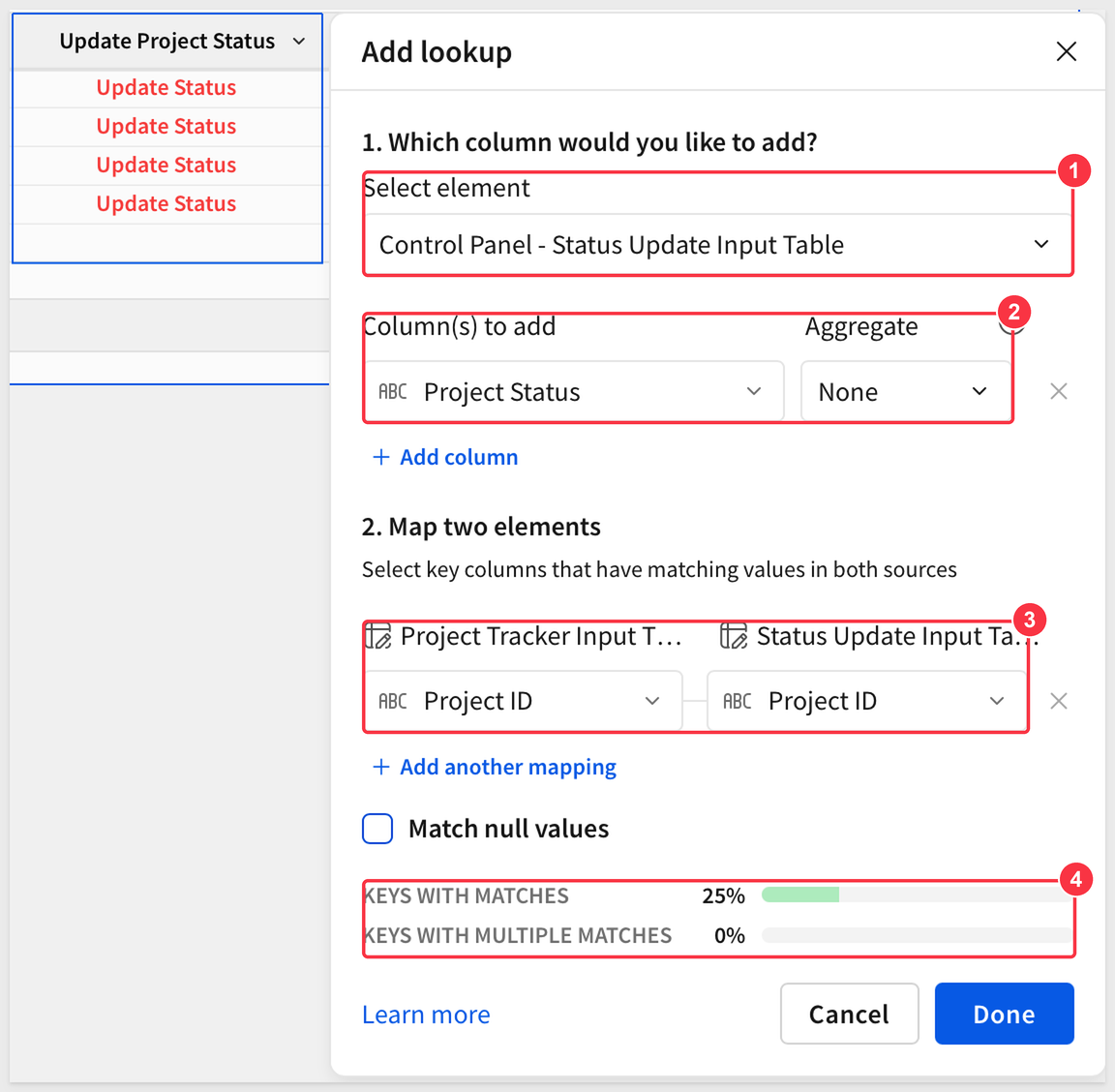
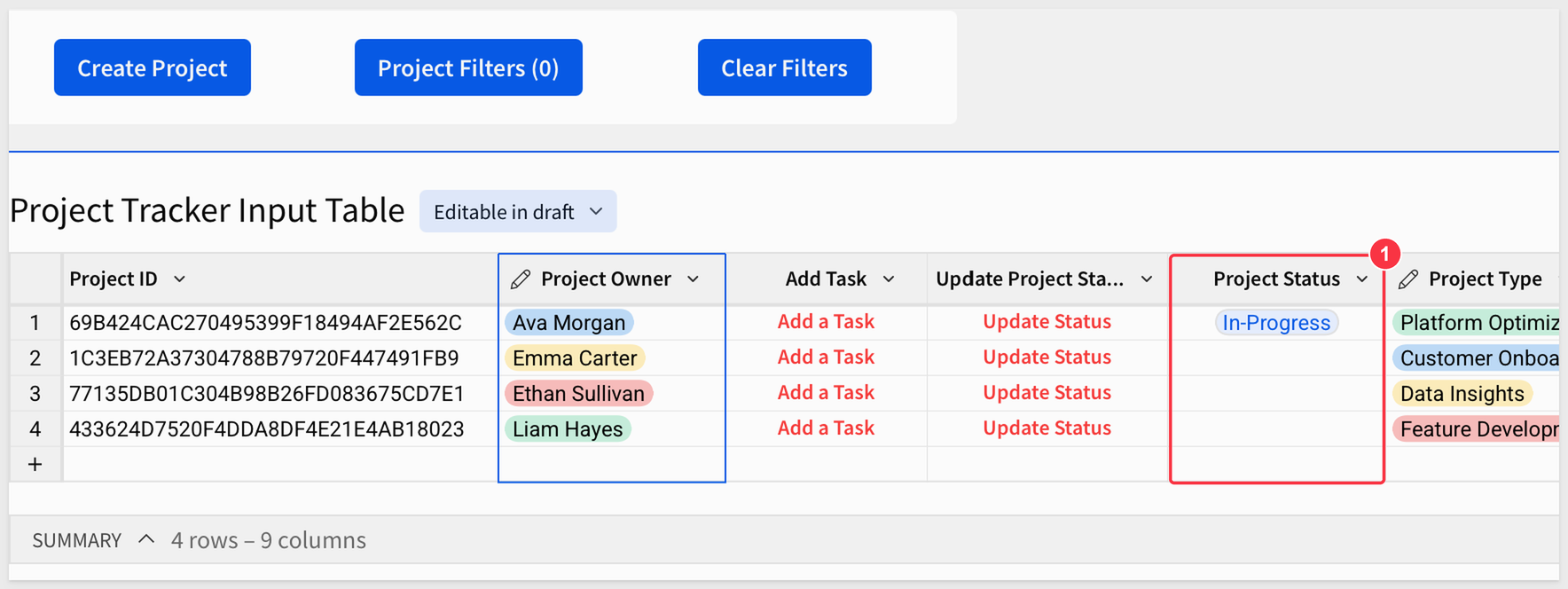
On the Project Tracker page > Project Tracker Input Table, add a new column via lookup on the Status Update Input Table (1), adding Project Status (2) based on Project ID (3).
The match summary (4) shows that not every project has a status yet:
Rename the new column Project Status and move the column to just after Update Project Status column (1):
Step 13:
Now update the project with a second status and see the "multiple values" result under Project Status (1):
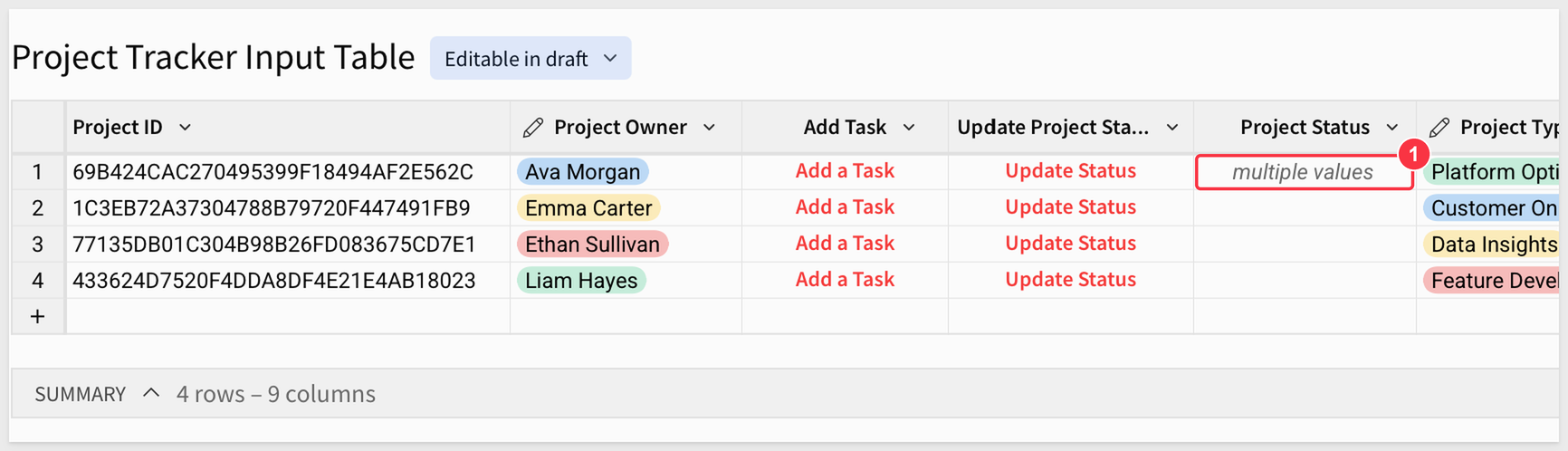
This happens when a lookup is one to many instead of one to one and requires a different approach to enable proper app functionality.
Step 14:
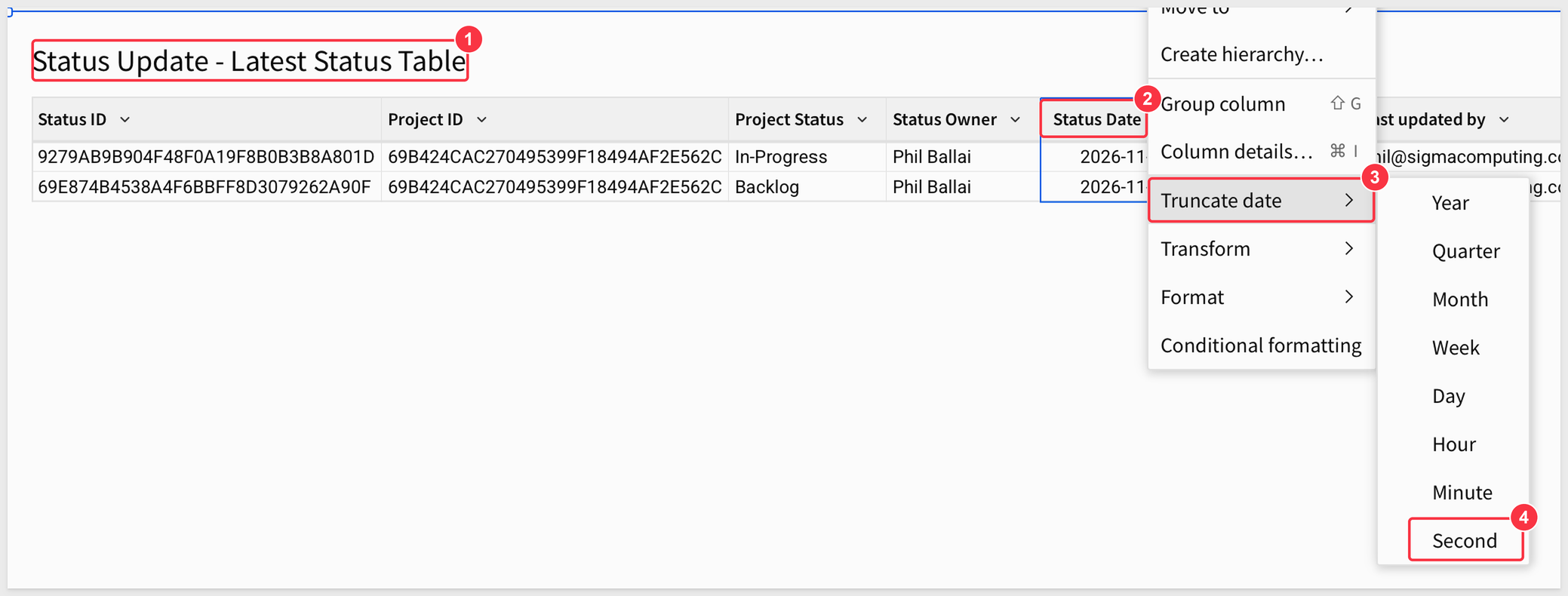
Create a Child table off the Control Panel > Status Update Input Table.
Rename this table to Status Update - Latest Status Table (1).
Open the Status Date column (2) menu and set Truncate date (3) > Second (4):
Step 15:
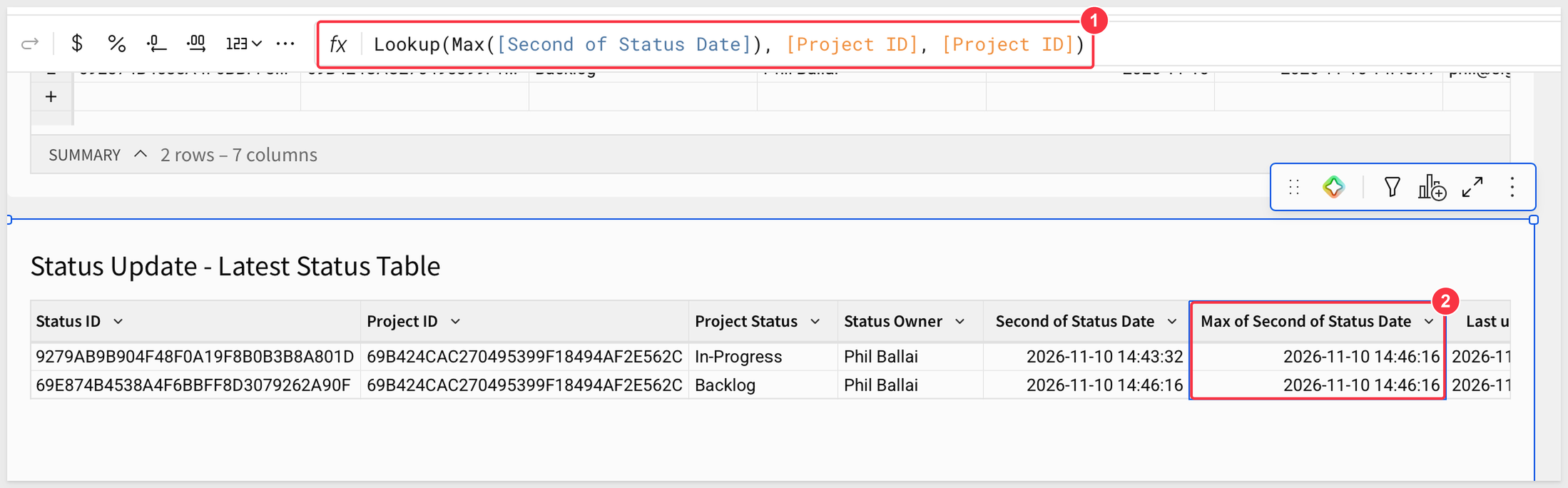
Add a new column to the table, set the calculation to be:
lookup(max([Second of Status Date]), [Project ID], [Project ID])
The formula appears in the formula bar (1), and the new column (2) shows the latest status date for each project:
For more information about functions in Sigma, see Function index
Step 16:
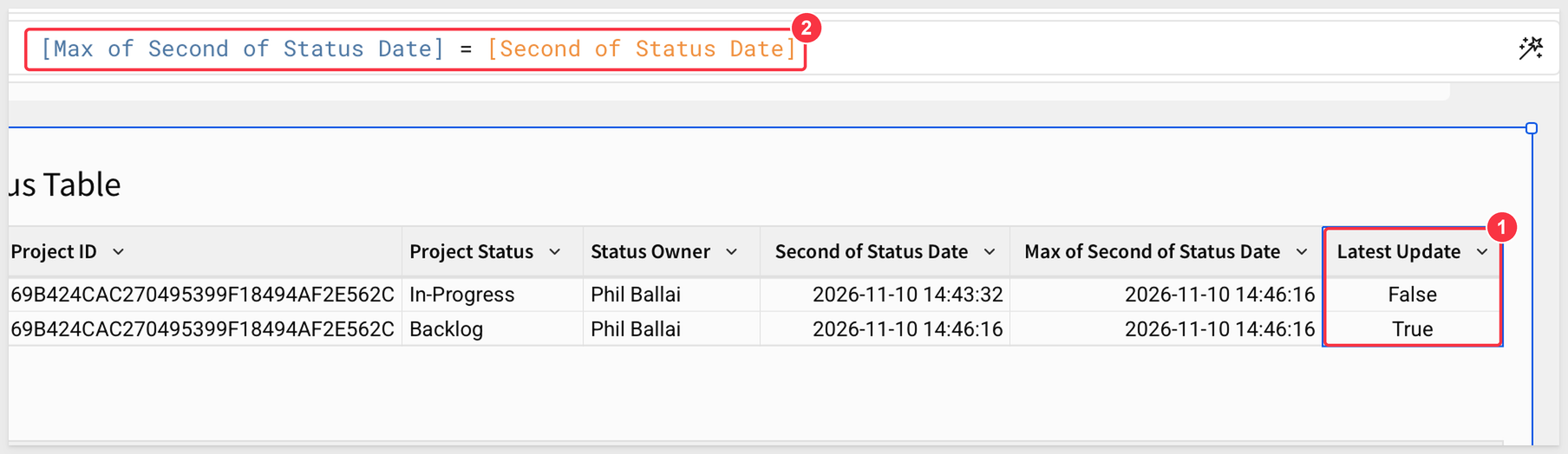
Add a new column named Latest Update with calculation:
[Max of Second of Status Date] = [Second of Status Date]
This will result in a true or false (1) from the formula in the formula bar (2):
Step 17:
Filter this Latest Update column to only show the True status updates: open the filters panel (1), add a filter for Latest Update (2), and select True (3).
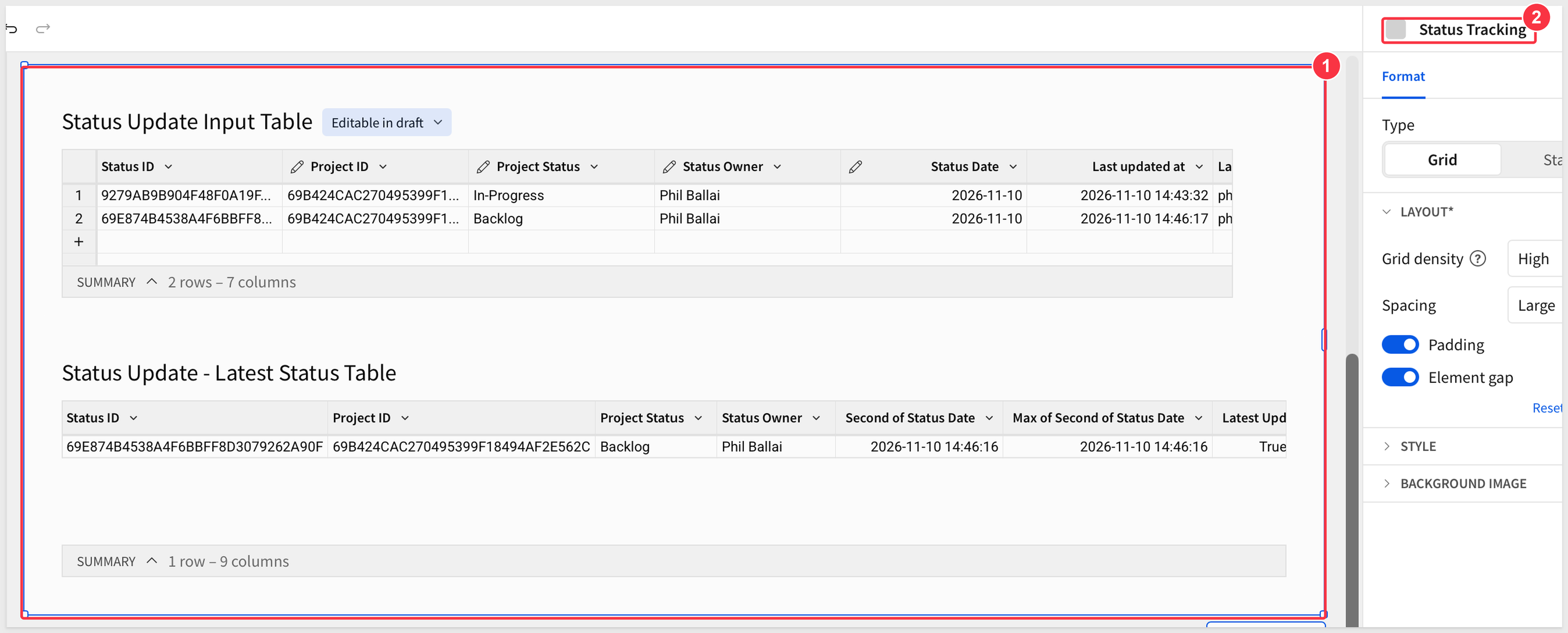
The Status Update Input Table operates as the transaction log, while the Latest Status Table provides just the latest value:
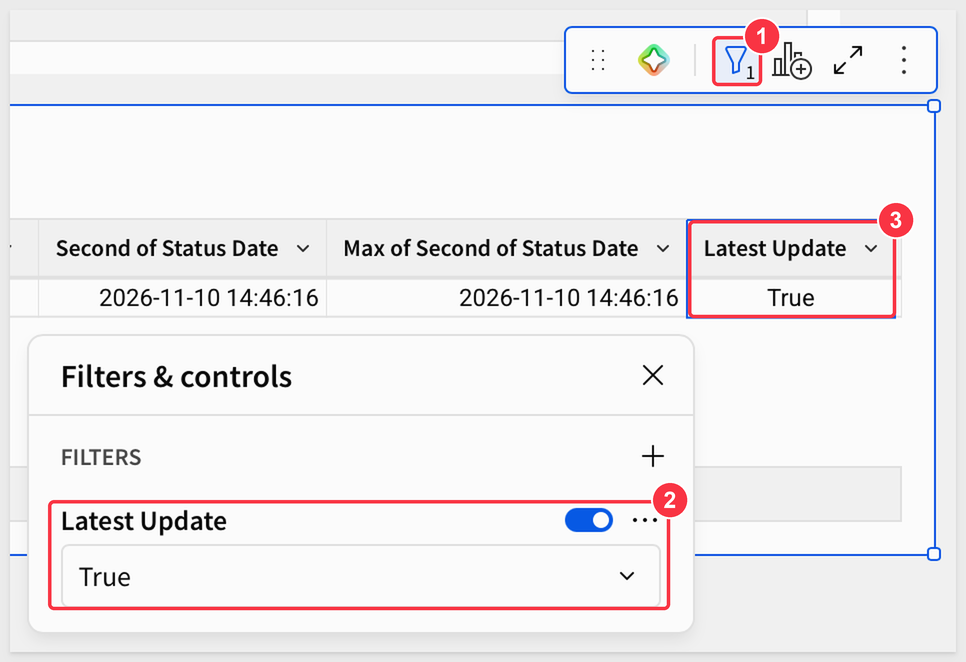
We now have only the most recent status for each project (1):

Having both tables for this and other potential analytics can be powerful.
Step 18:
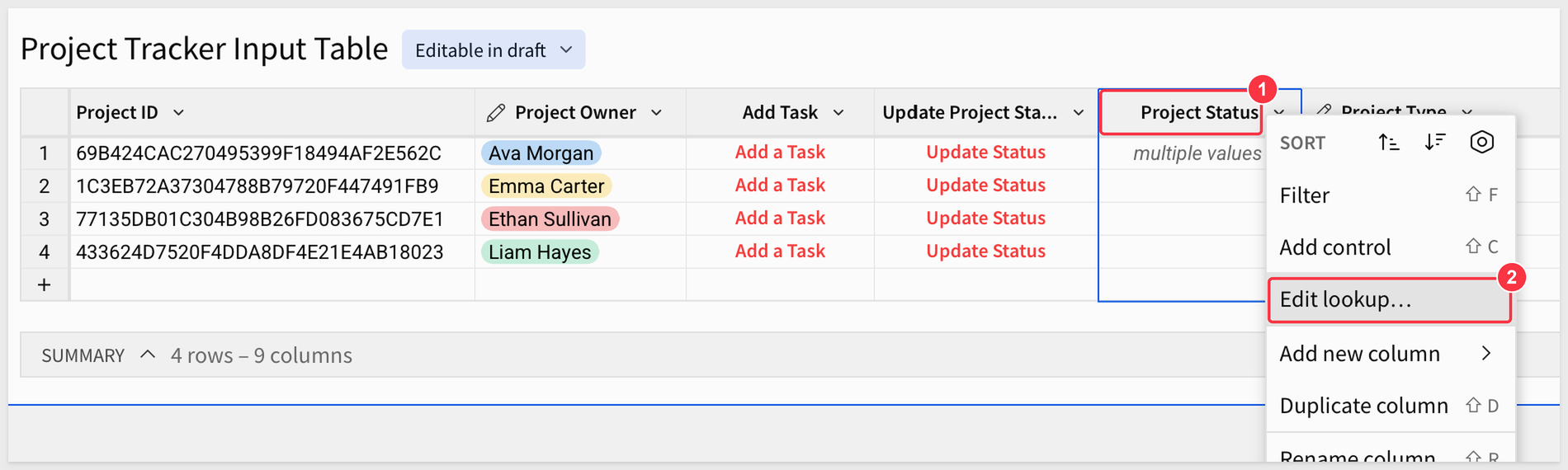
Update the lookup on the Project Tracker Input Table to now look at the Latest Status Table adding Project Status based off Project ID. Open the menu for the Project Status column (1) and select Edit lookup... (2):
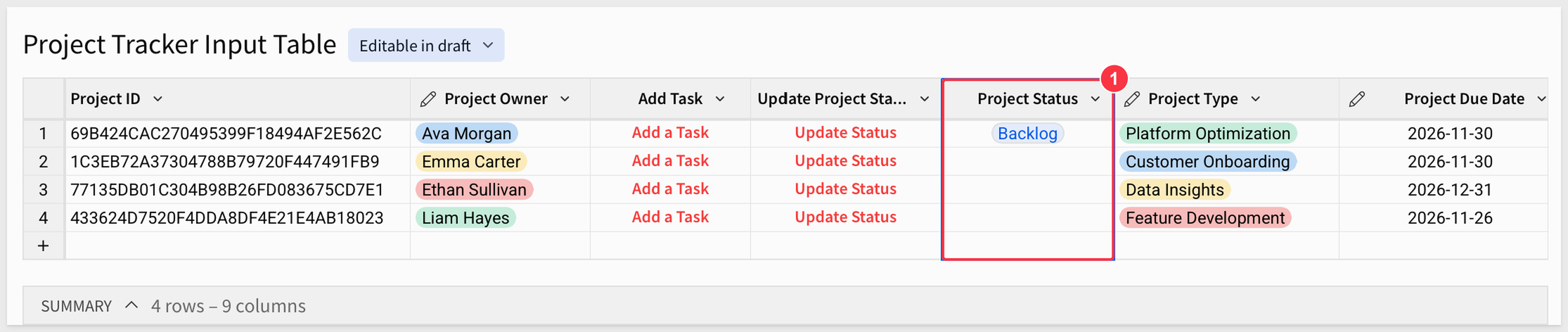
In the Edit lookup dialog, select the Status Update - Latest Status Table element (1), keep Project Status as the column to add (2), and map Project ID to Project ID (3). The match summary (4) shows how many projects have a status:
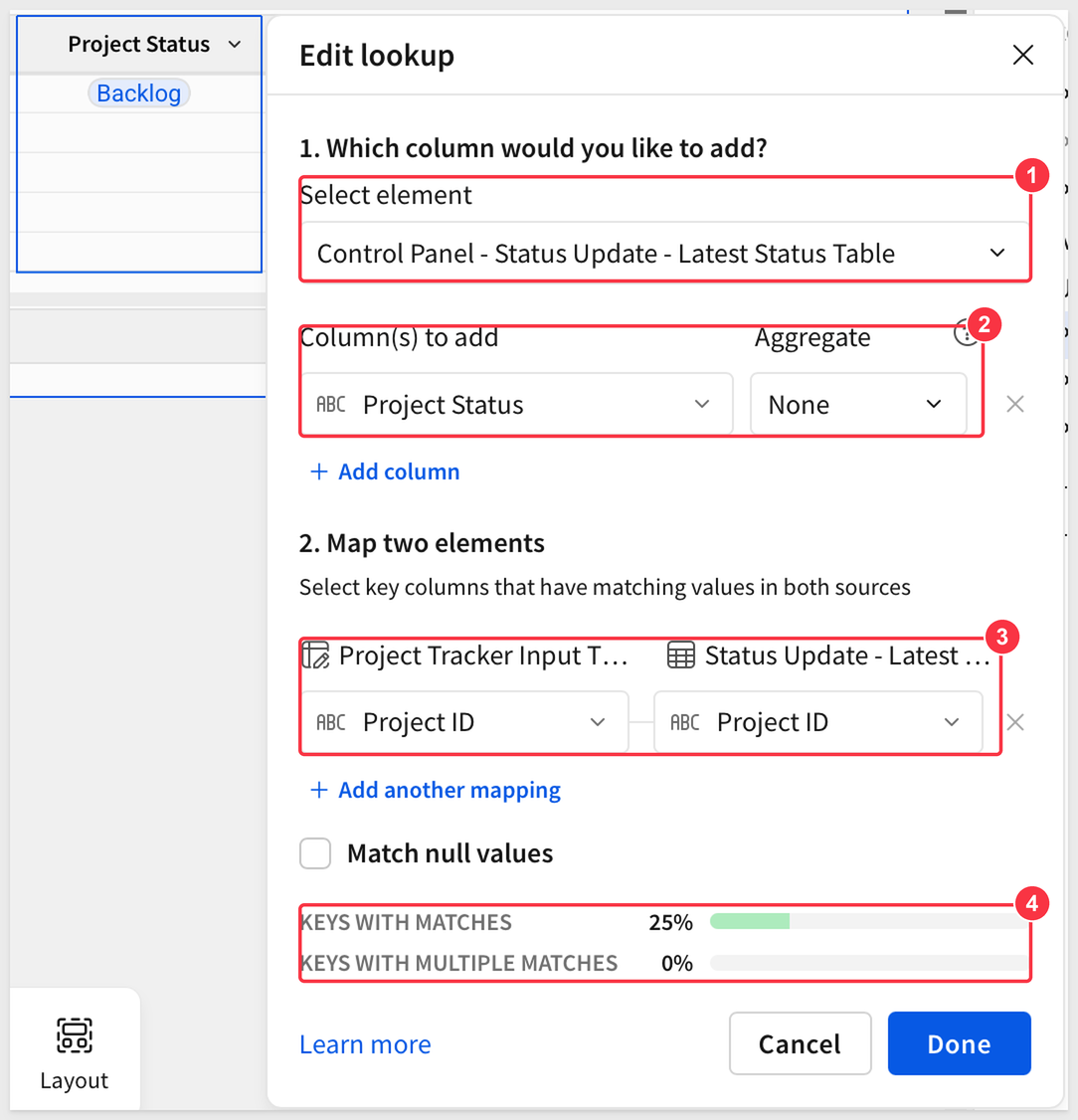
Now our table shows the most recent Project Status (1):
Step 19:
Select the Status Update - Latest Status Table and Status Update Input Table and place them in a container (1) named Status Tracking (2):
Step 1:
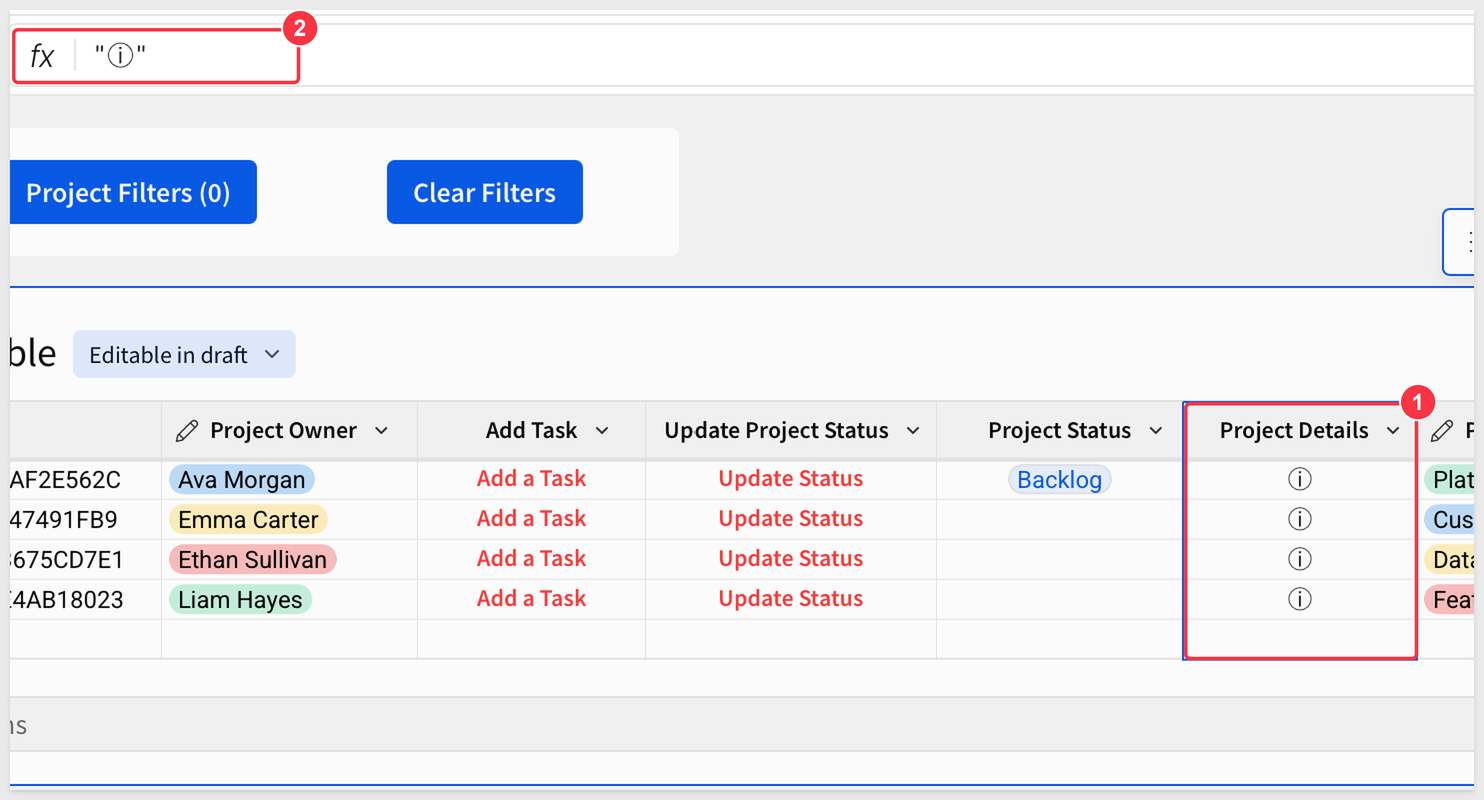
On the Project Tracker Input Table, create a new Calculation column and rename it to Project Details.
Set the column's formula to:
"ⓘ"
This will be used to pop up a modal with project details. The formula (1) gives each row the same icon in the new column (2):
Step 2:
Create a new Modal page and rename it to Modal - Project Details.
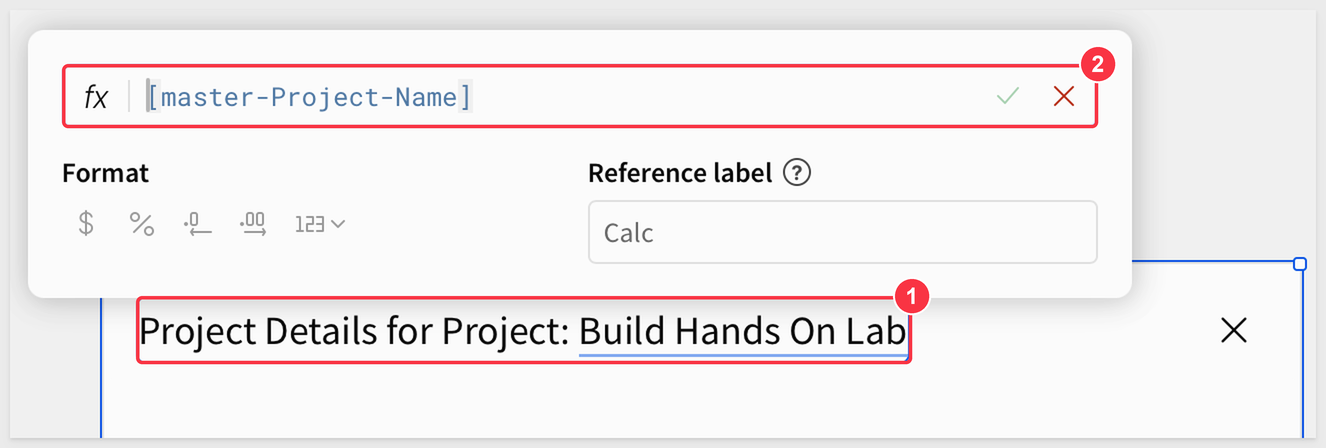
Change the modal's title to Project Details for Project: and the add the = sign.
Using the formula bar, set it to reference:
[master-Project-Name]
The title (1) now shows the project name from the formula (2):
Step 3:
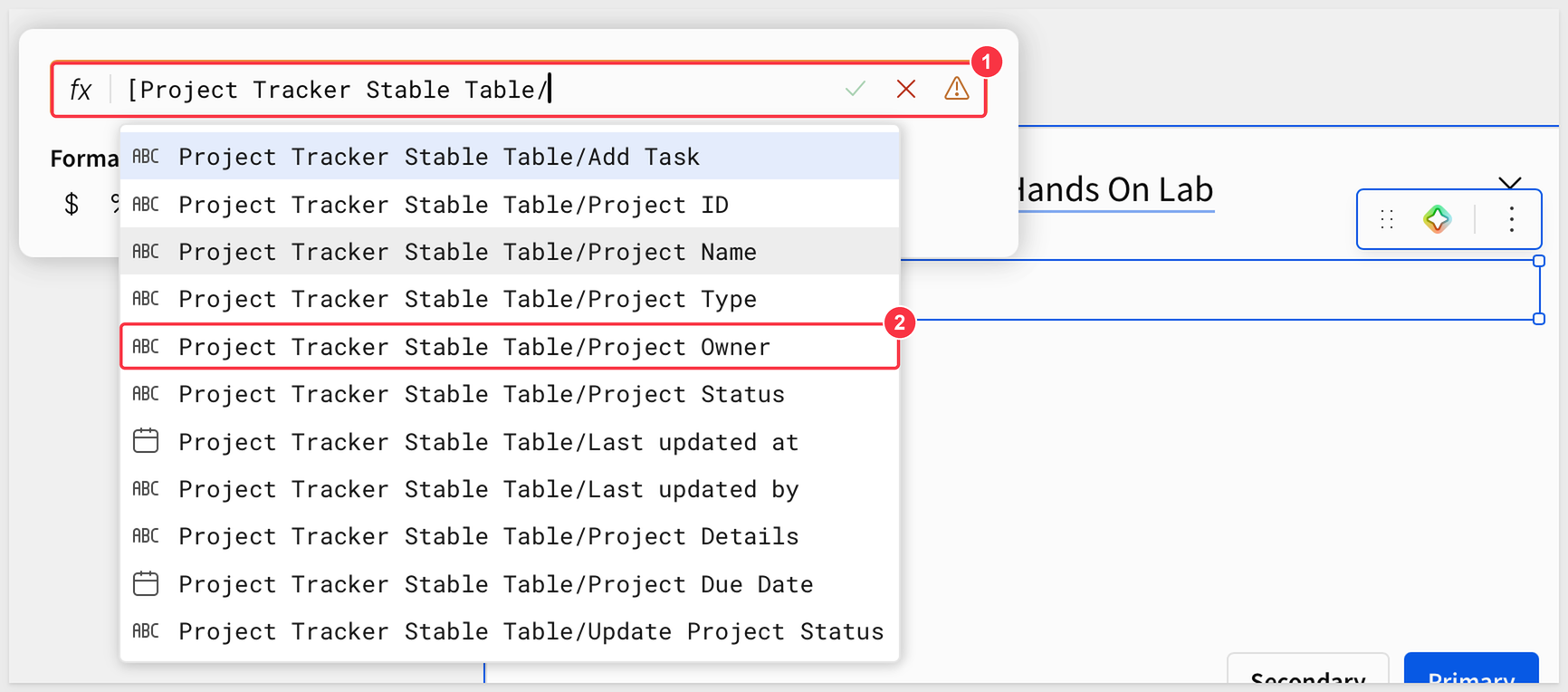
From the elements bar, in the UI group, add a Text control with Project Owner and type =[Pr into the formula bar.
This will return all the matching items. Select Project Tracker Stable Table:
The list will then show all the columns from the selected table. Now we can choose the column we want, Project Owner:
[Project Tracker Stable Table/Project Owner]
As you type the table name followed by / (1), the list shows the columns to choose from (2):
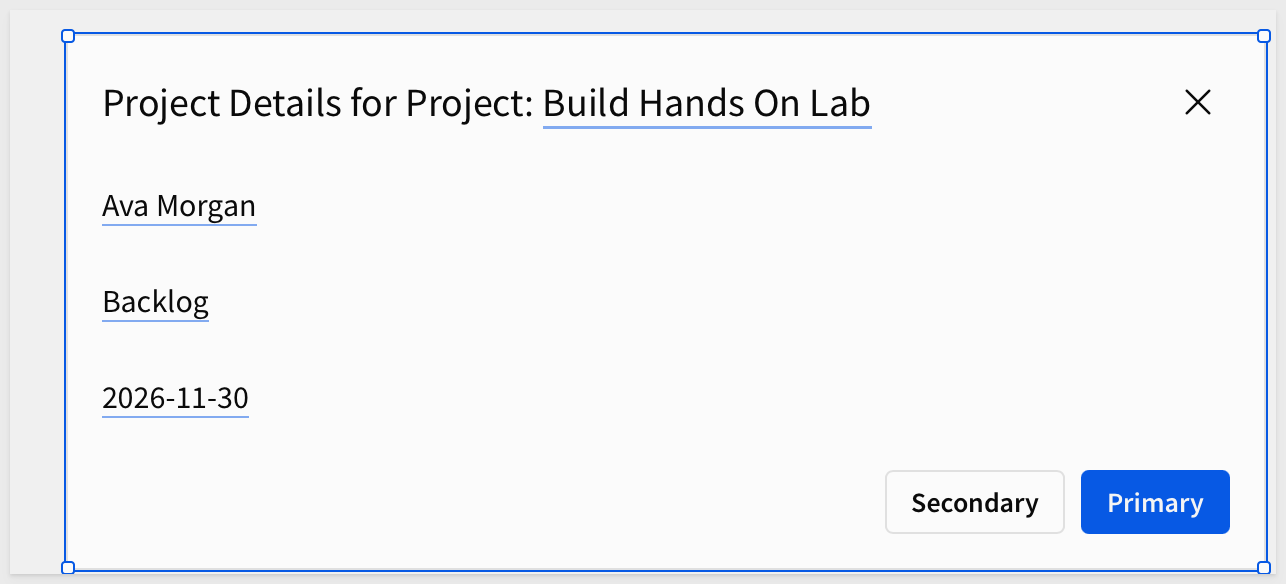
Repeat the process by adding two more lines beneath the first one for:
[Project Tracker Stable Table/Project Status]
and
[Project Tracker Stable Table/Project Due Date]
We now have:
Step 4:
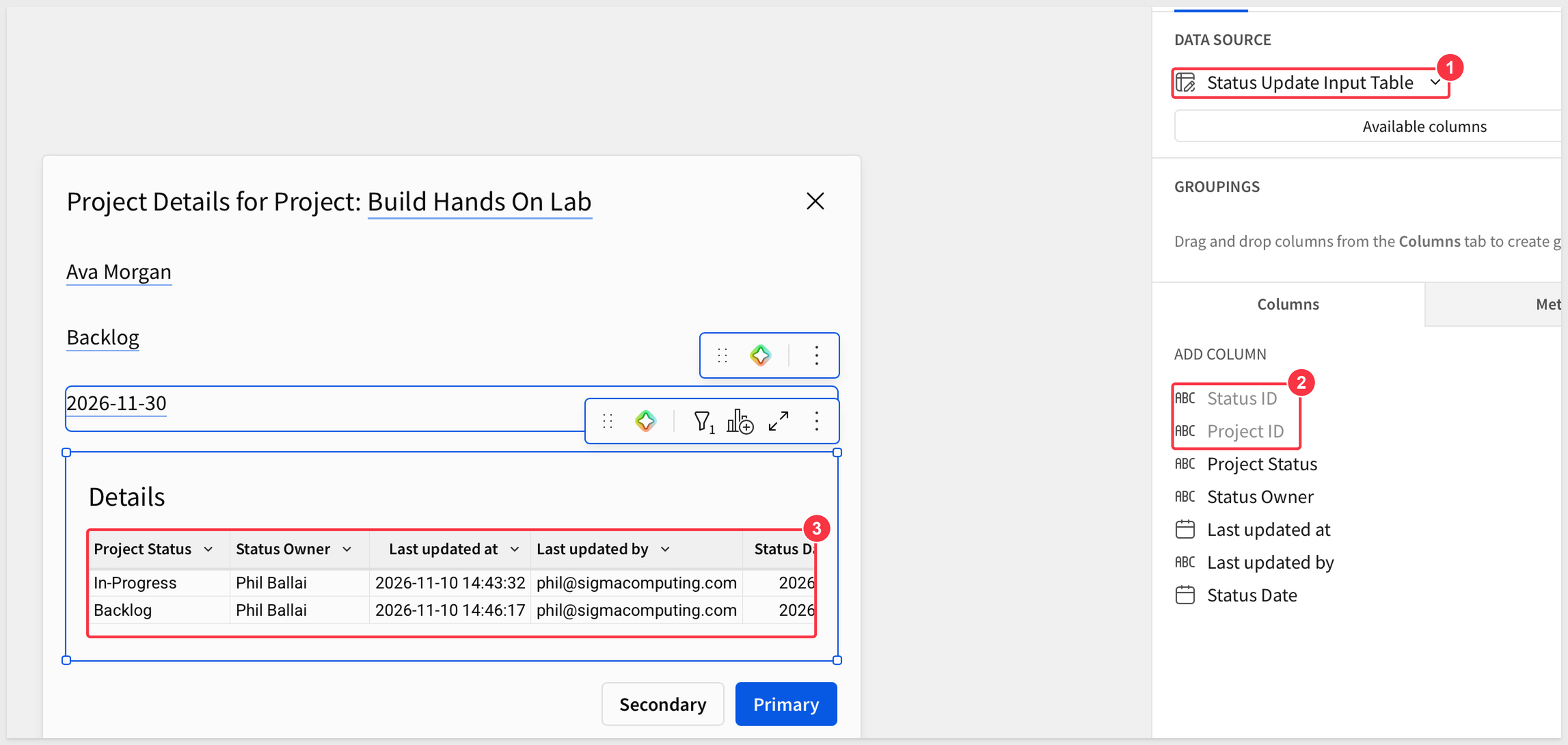
Create another Child table of the Status Update Input Table on the Control Panel page. Then move it to the modal titled Modal - Project Details.
Rename the title of the table to Details.
The Data source (1) is the Status Update Input Table. Hide Status ID and Project ID (2) so the table shows the remaining columns (3):
Step 5:
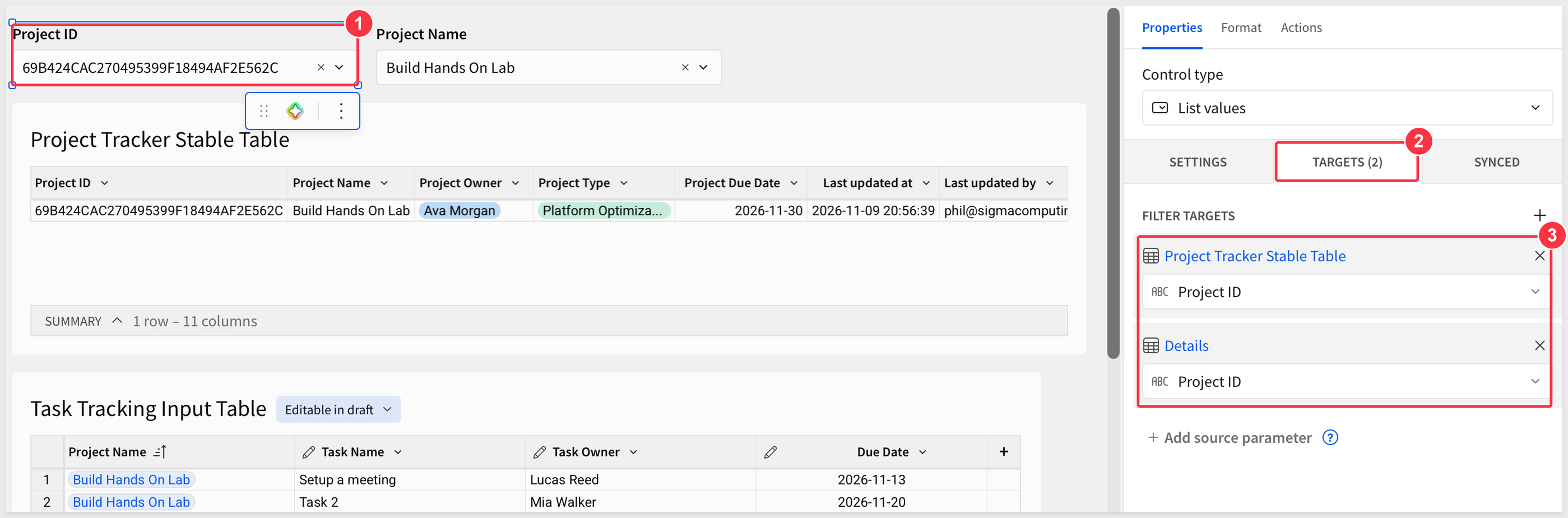
On the Control Panel page, select the Project ID control and select TARGETS in the element panel.
Add filter target to update the Project ID on the Details table on the Modal - Project Details modal. The Project ID control (1) now lists two targets (2), including Details (3):
Step 6:
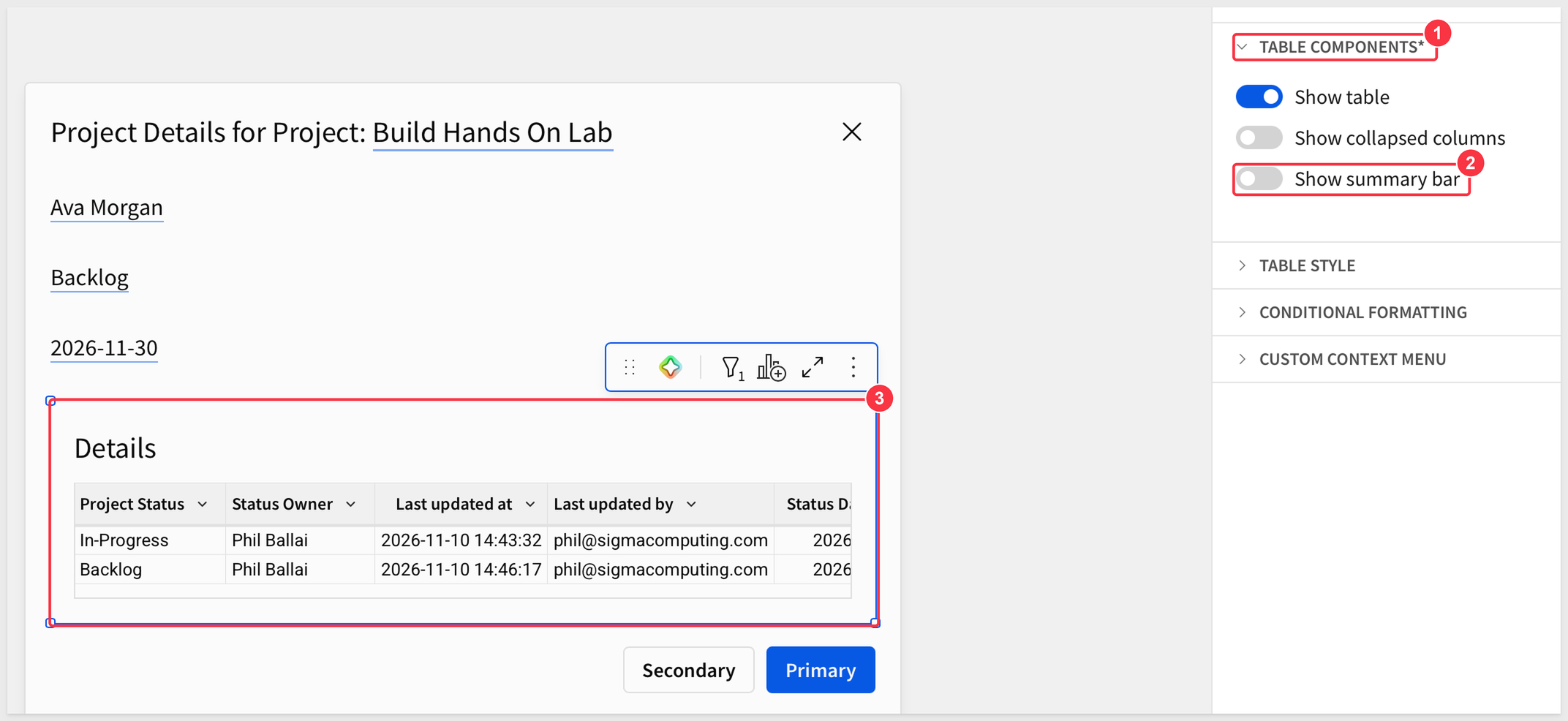
With the Details table selected on the Modal - Project Details tab, go to Format > Table components (1) and turn off the Show summary bar option (2). Modify any other options to style the table (3) to suit:
Step 7:
We also want to include all the related tasks for the selected project.
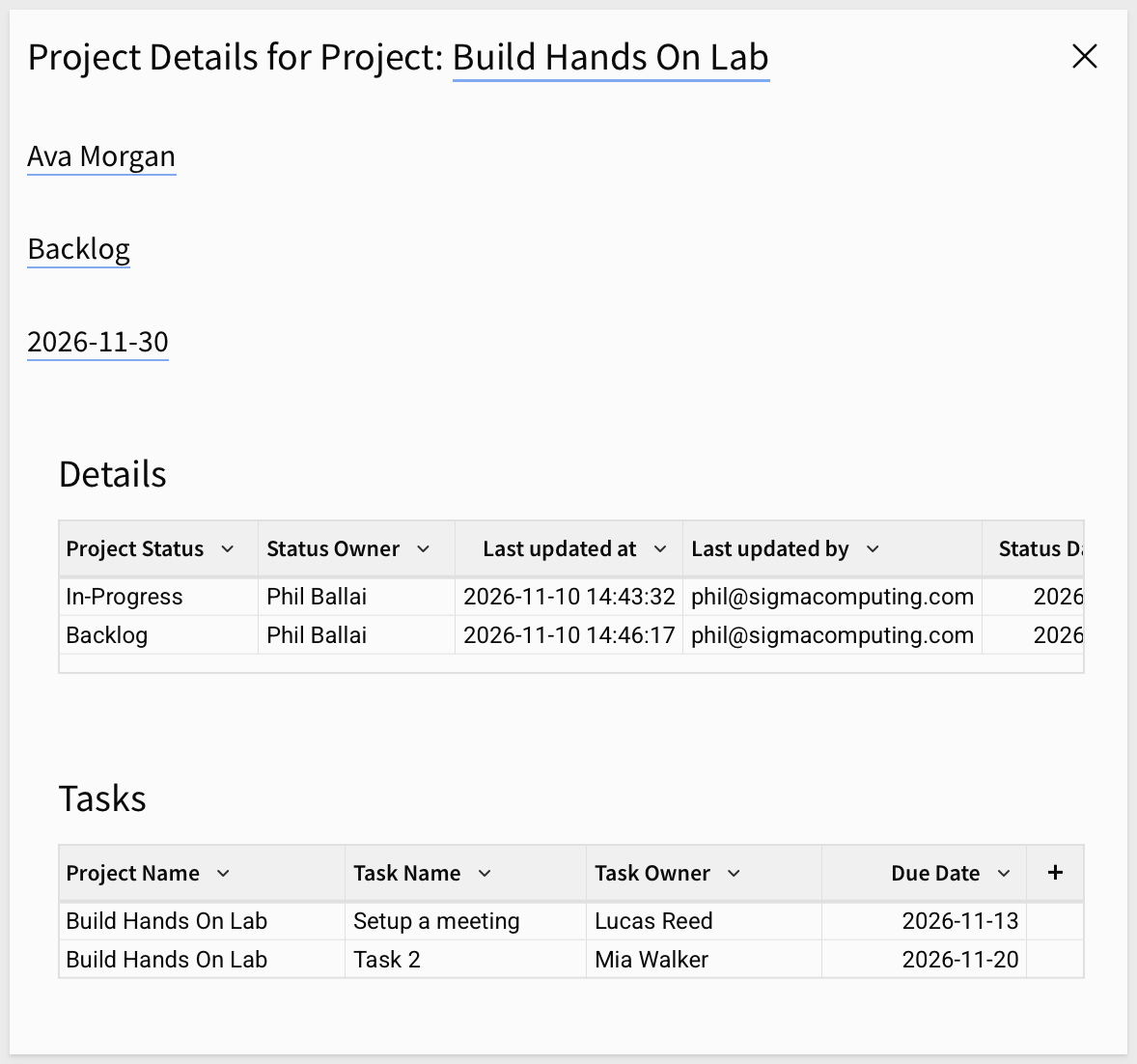
Repeat the steps used for the Details table to add a Tasks table:
On the Control Panel page, create a Child table on the Task Tracking Input Table and move it to the Modal - Project Details.
Open the modal by clicking the ⓘ or by directly opening the modal page.
Remove the summary bar, disable the Secondary and Primary buttons, and change the table's name to Tasks.
Set the Project Name control on the Control Panel to target the Tasks table and the column Project Name. The modal should look like this now:
Step 8:
The Project Details column on the Project Tracker Input Table needs an action to open the modal.
On the Project Tracker page, select the Project Tracker Input Table and go to Actions. Add a new On select sequence for the Project Details column (1).
Add a Set control value action (2) for the Project ID control on the Control Panel, with the value set to Column > Project ID, then an Open modal/drawer action (3) for Modal - Project Details:

Test it by selecting the ⓘ in any row. The modal opens with the project's name, owner, status, due date, Details and Tasks.
Step 9:
It may be useful to be able to add tasks for this modal as well.
On the Modal - Project Details modal, add a button titled Add New Task (1). On the Actions tab (2), configure the action to Open modal/drawer and select Modal - Create Task (3):
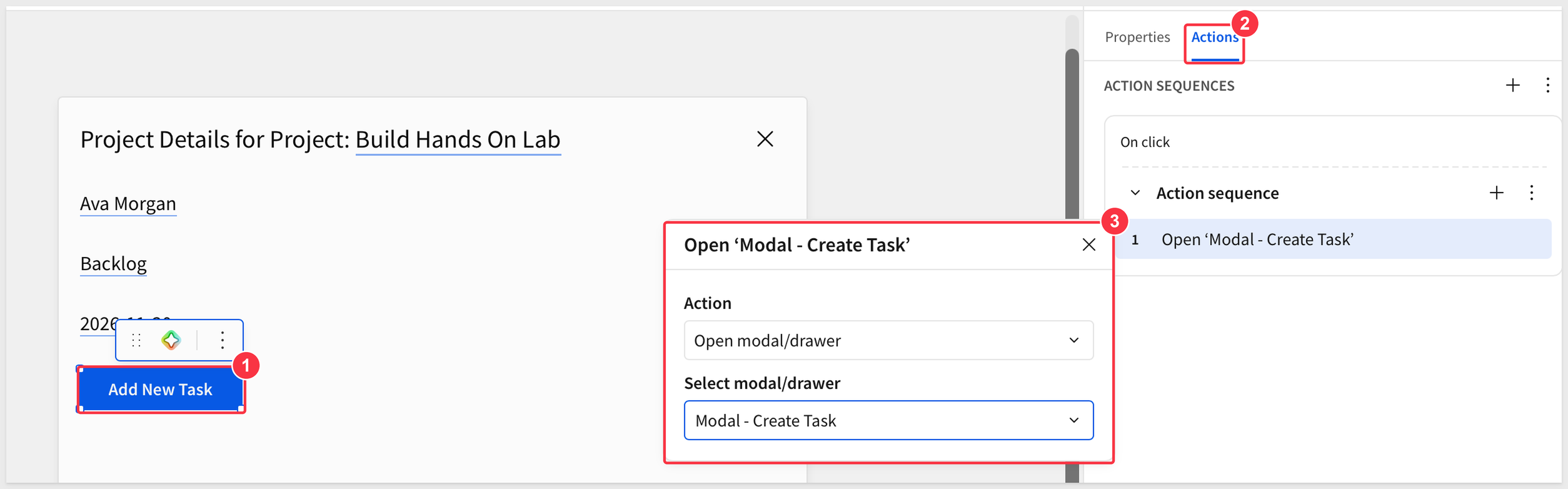
To test the workflow, first go to the Project Tracker page and select the ⓘ in the Project Details column of a project. This sets the Project ID that the modal depends on, and adding a task will not work without it.
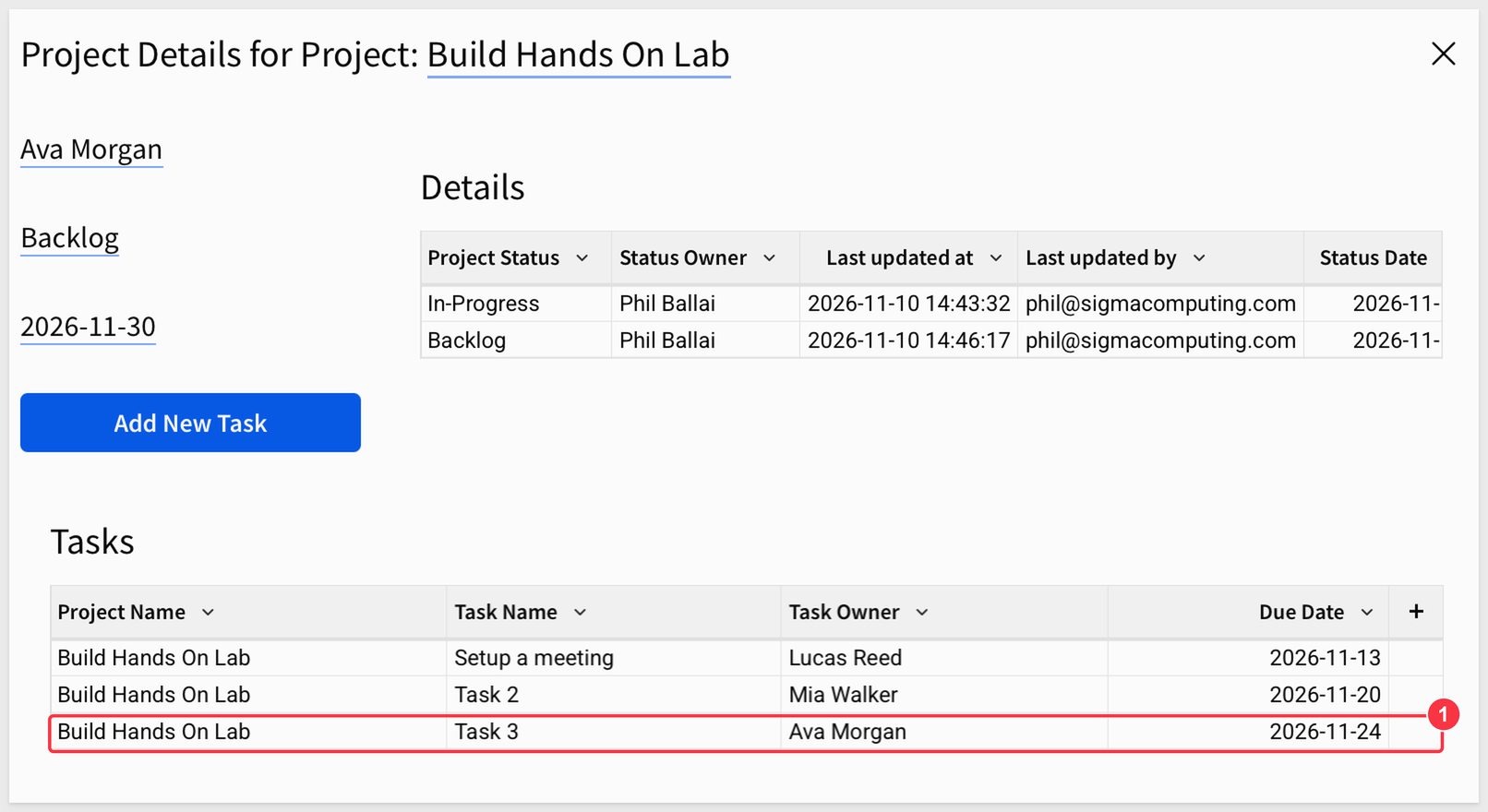
In the modal, click Add New Task and add another task to the list. After moving a few elements around, the new task (1) appears in the Tasks table:
For completeness, it may be useful to include an Update Status button here as well. Since the steps are basically the same, you can do that yourself now.
Configure its action to open the modal Modal - Update Status.
That was quick and easy to extend the workflow now that our base app pages and modals are set up.
Step 10: Adding a Visualization
Going one step further, let's add a Charts > Bar chart (1) to the Project Details for Project modal. In the element panel (2), set the Data source to Tasks, the Y-axis to Task Owner and the X-axis to Count of Due Date:
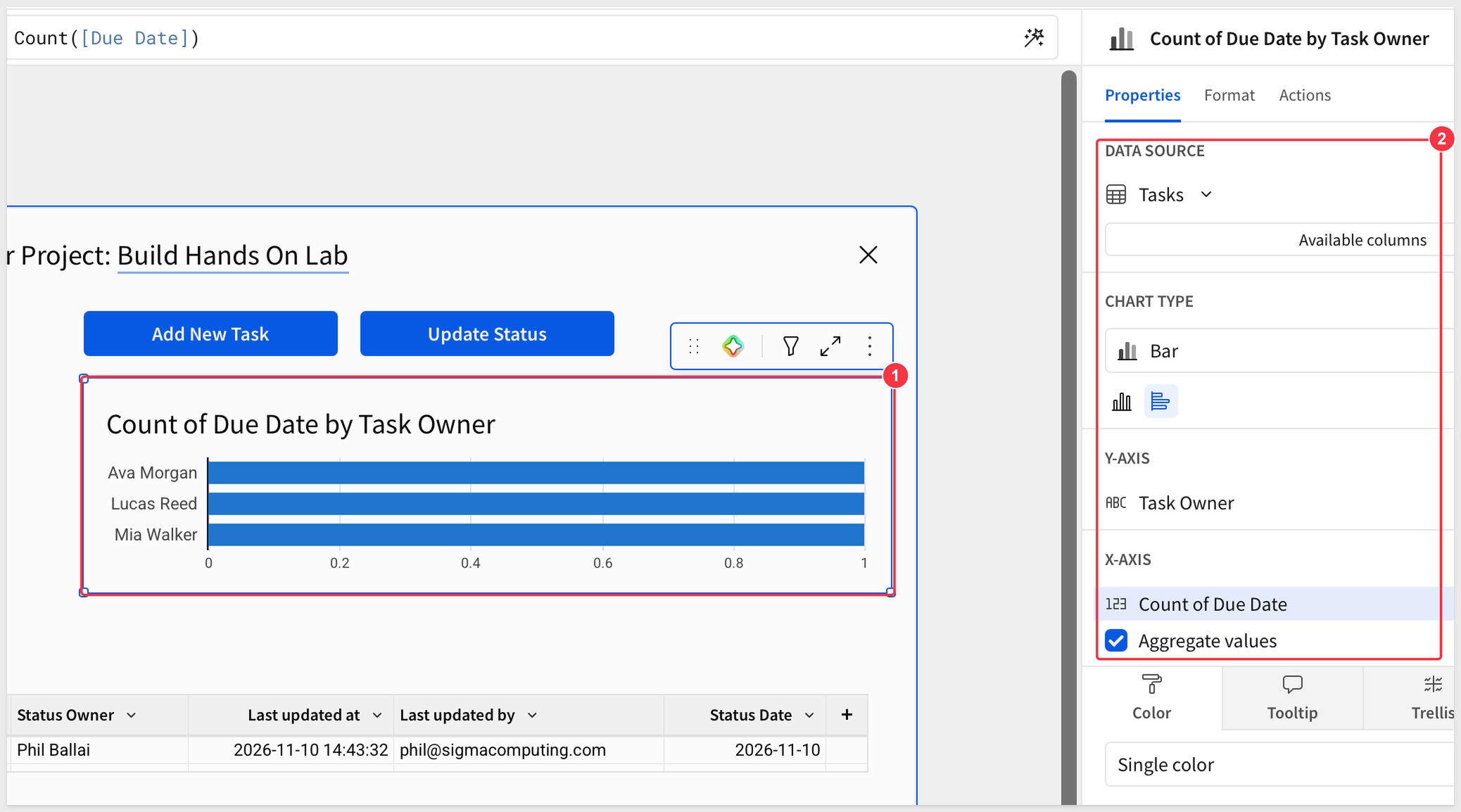
Sigma's design significantly reduces the time it takes to create a design that suits your needs.
We can apply some styling but we will touch on that in the last section. Styling in Sigma is really easy so it is best to make sure the functionality all works first, and then make it look pleasing to the eye.
For more information on how Sigma supports responsive design, see Responsive design for desktop and mobile layouts
Step 1:
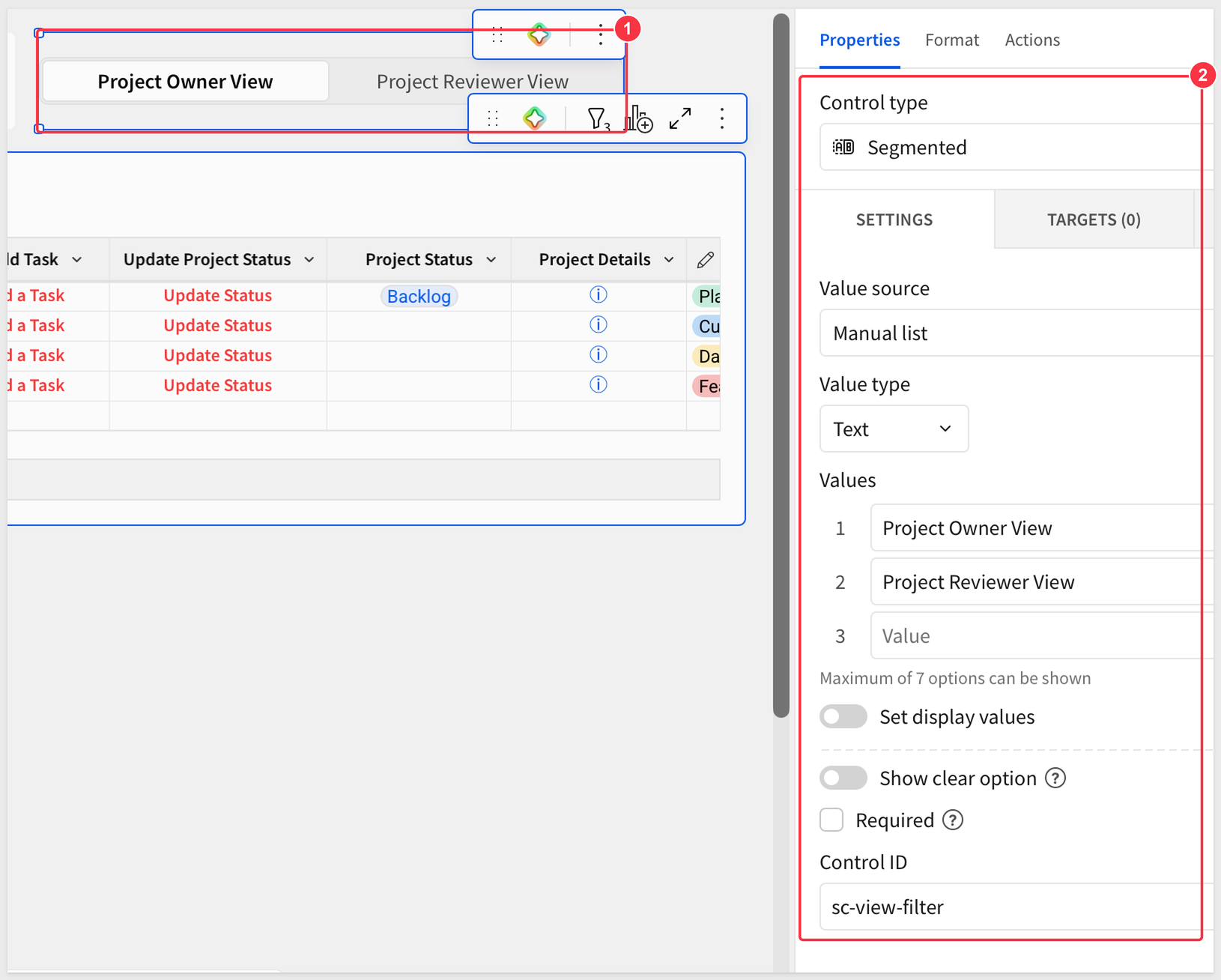
On the Project Tracker page, add a Controls > Segmented Control
Configure the Values as
Project Owner View
and
Project Reviewer View
Remove the label (title) as we have done in the previous steps, under the Format > LABEL section.
The segmented control (1) and its settings in the element panel (2) will look like this:
Step 2:
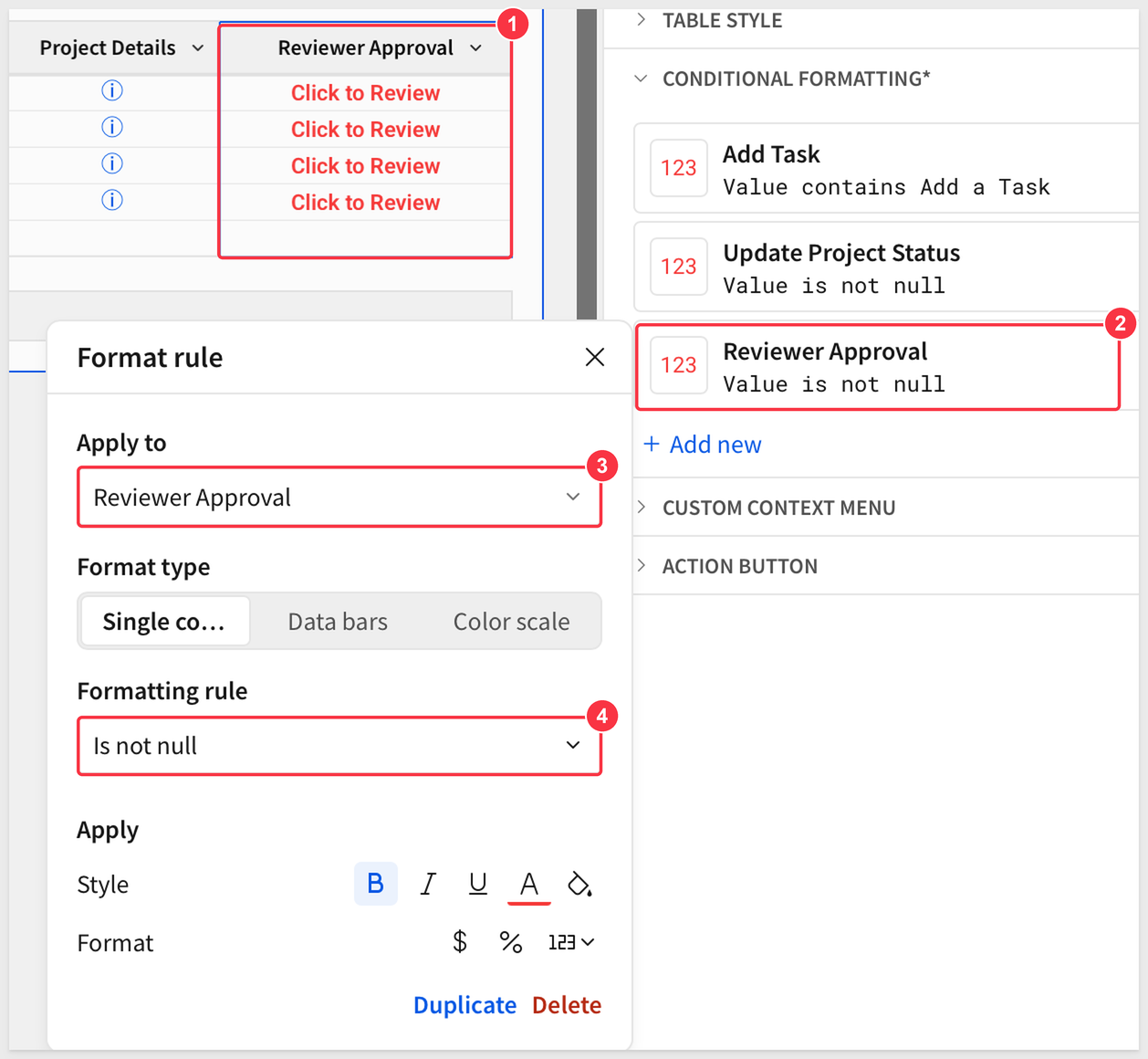
Add a new Calculation column to the Project Tracker Input Table called Reviewer Approval.
Set the formula to
"Click to Review"
The new column (1) needs the same red font as the other action columns. In Format > CONDITIONAL FORMATTING, add a new rule (2) with Apply to set to Reviewer Approval (3) and Formatting rule set to Is not null (4), then set the font color to red:
Step 3:
Select the segmented control (1) and open Actions (2).
In the Action sequence menu (3), add a Condition (4):
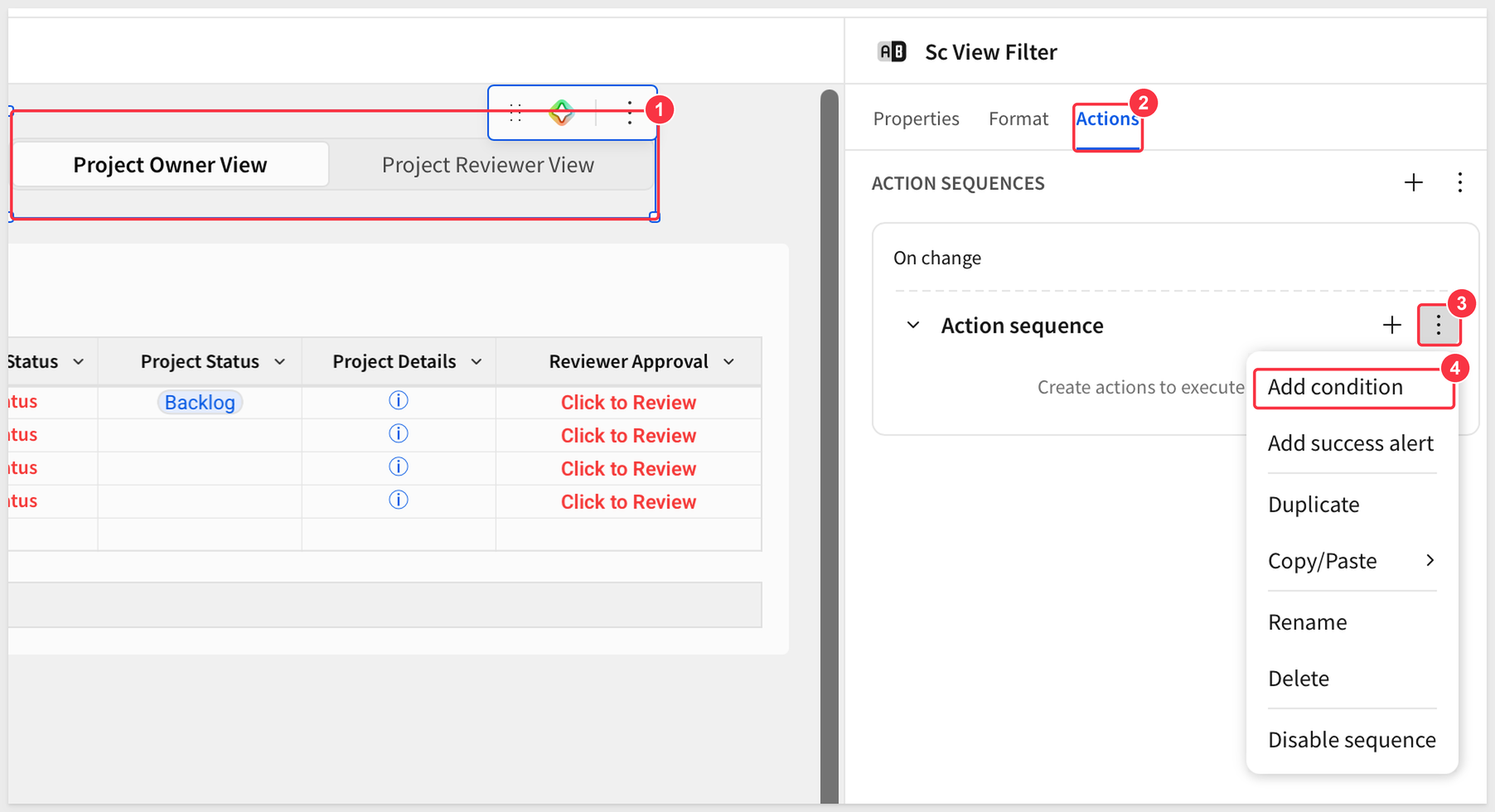
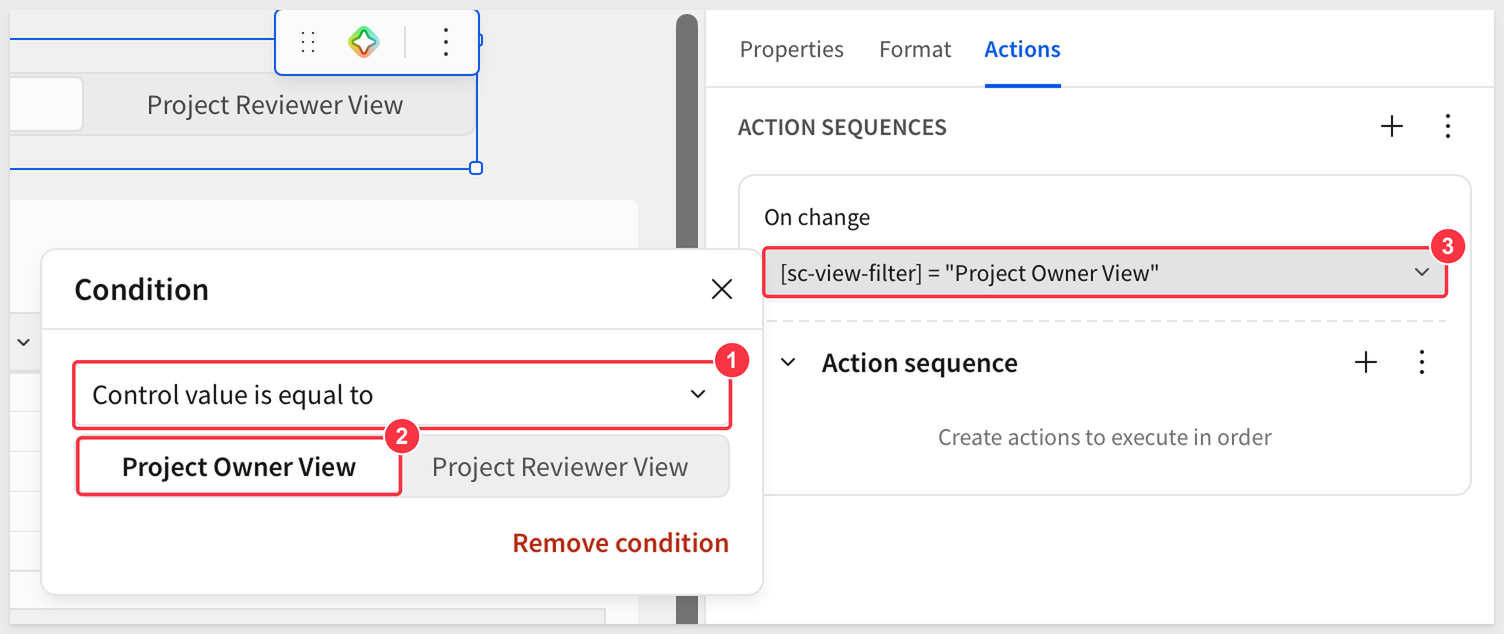
Set the condition to Control value is equal to (1) and select Project Owner View (2). The condition (3) now appears on the action sequence:
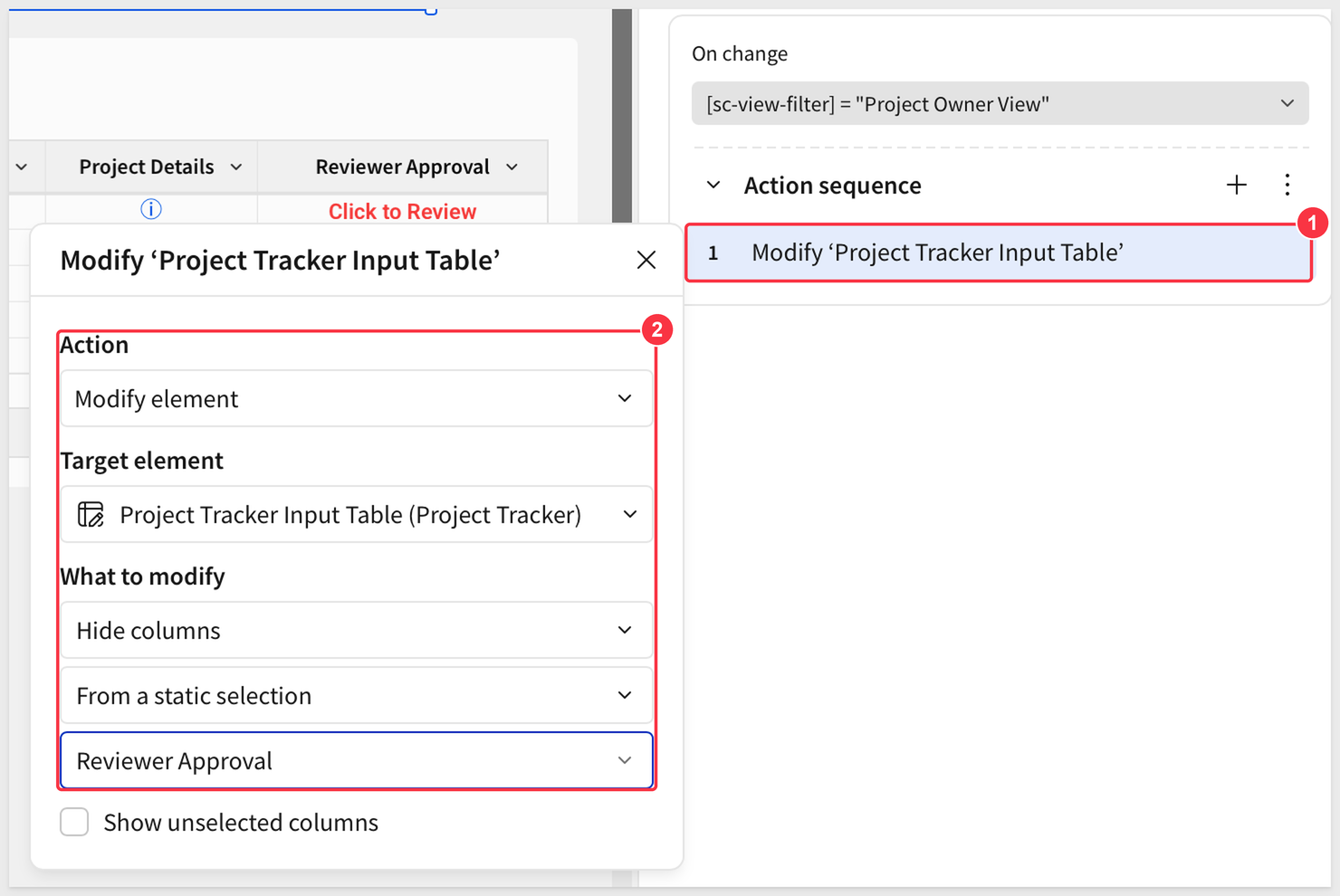
Add a Modify element action (1) targeting the Project Tracker Input Table, and configure it (2) to Hide columns From a static selection with Reviewer Approval selected:
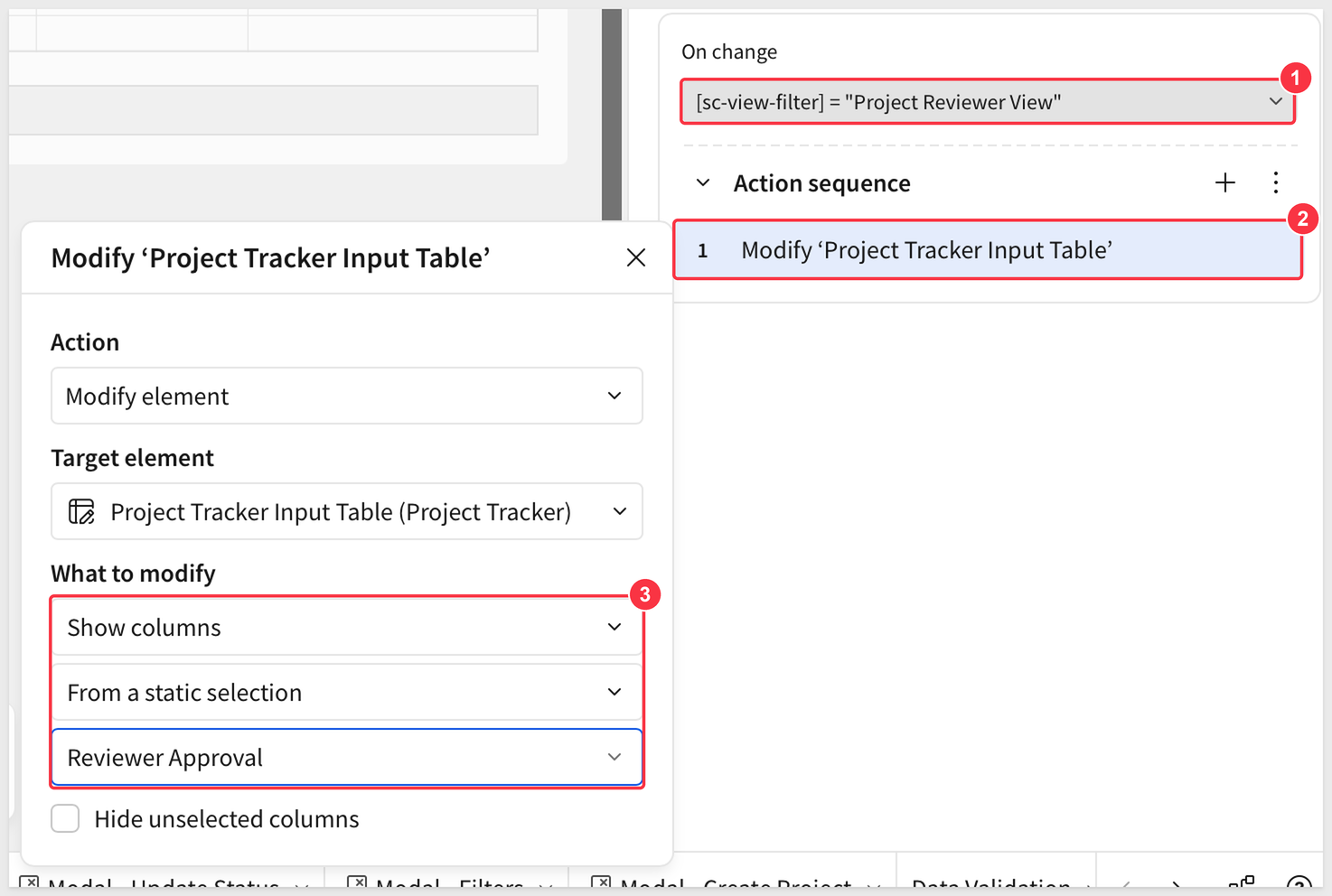
Click the + next to ACTION SEQUENCES to create another sequence. Set its condition to Project Reviewer View (1), then add a Modify element action (2) with What to modify set to Show columns From a static selection, and Reviewer Approval selected (3):
Step 4:
On the Data Validation page, create a child table off Data.Status Type and rename it Status Type Stable Table.
Move this table to the Control Panel.
Step 5:
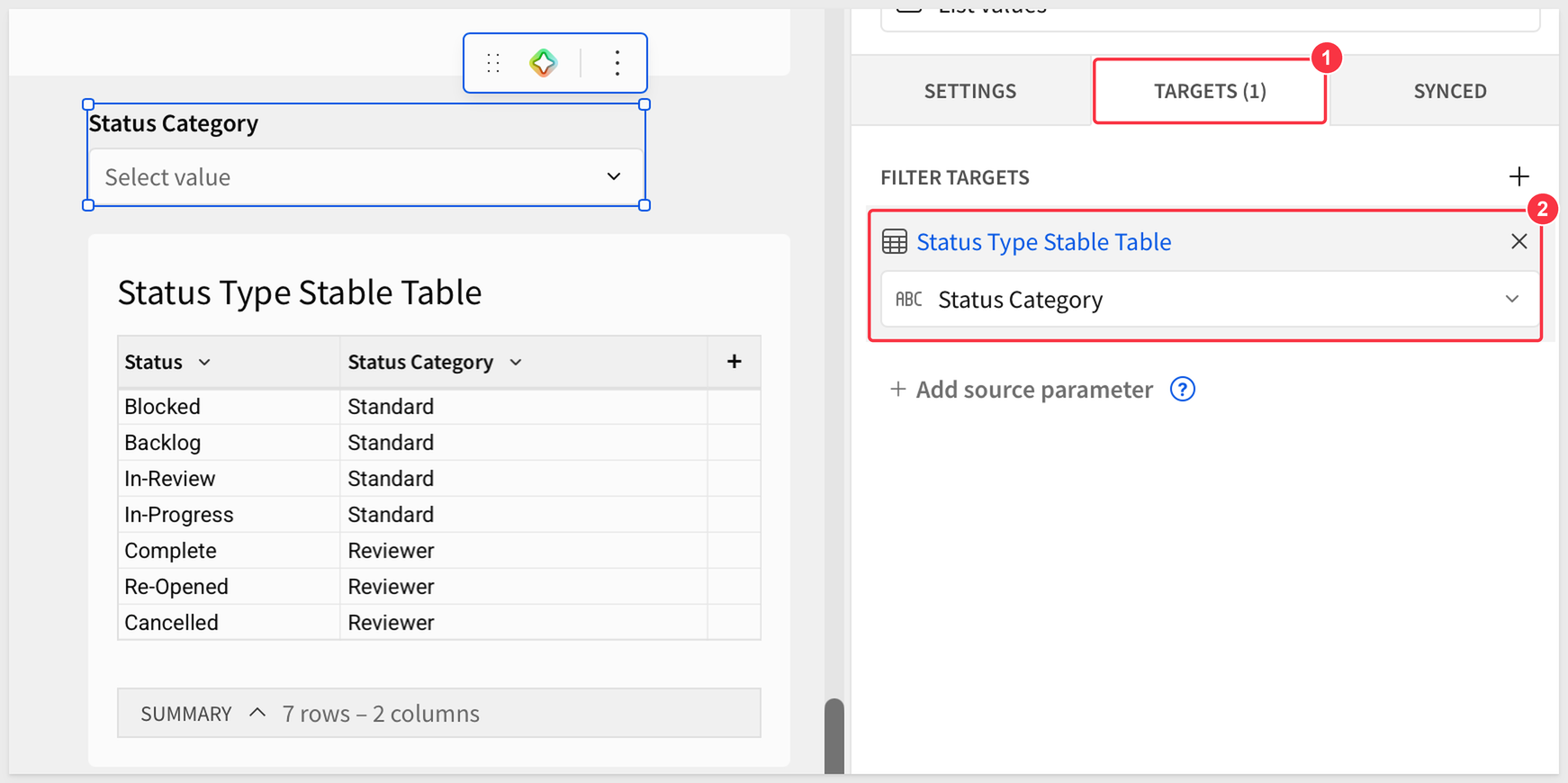
On the Control Panel page, add a filter for Status Category and convert it to a page control (1).
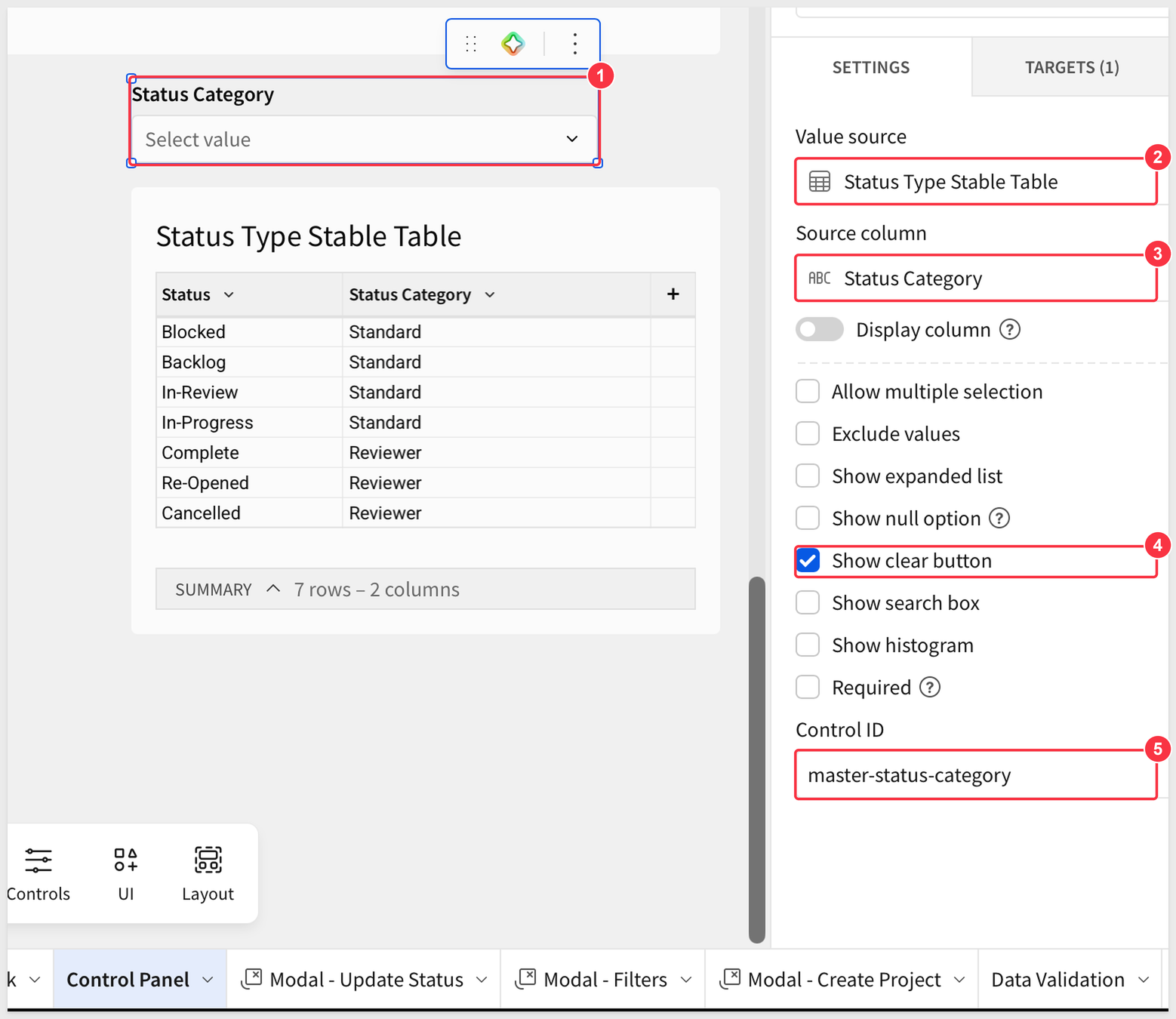
Configure the Value source (2) as the Status Type Stable Table and the Source column (3) as Status Category. Configure the control to only Show clear button (4).
Update the Control ID (5) to use the pattern we established earlier:
On TARGETS (1), make sure the filter target (2) is the Status Type Stable Table with Status Category as the column:
Step 6:
Return to the Project Tracker page and select the Project Tracker Input Table.
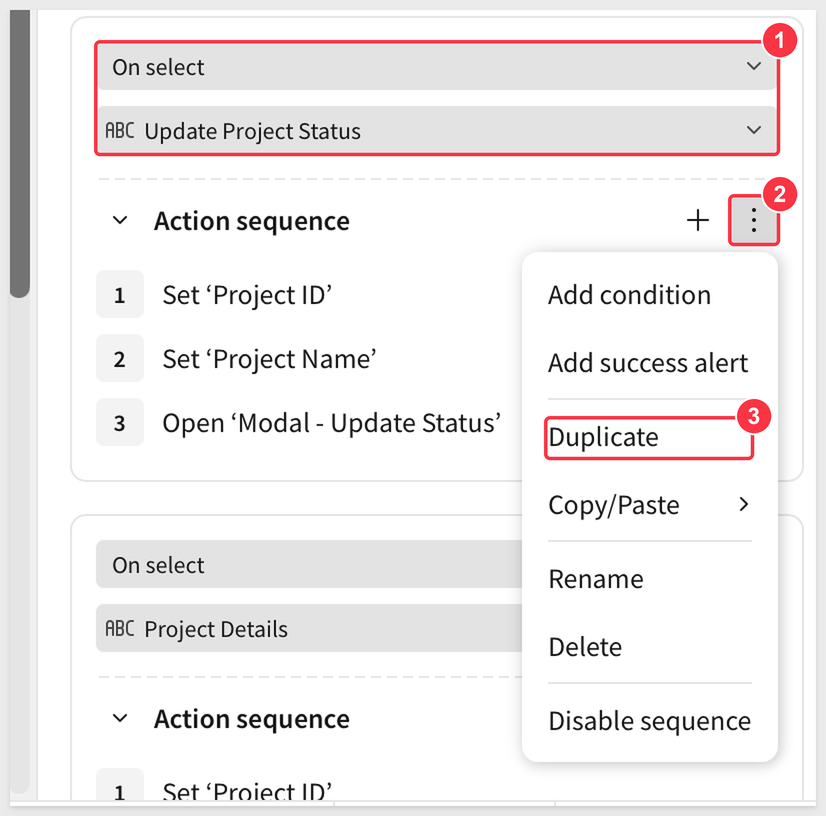
We already have an action that allows the user to update project status, but let's add another to account for the reviewer.
In Actions, find the On select sequence for Update Project Status (1). Open its three-dot menu (2) and select Duplicate (3):
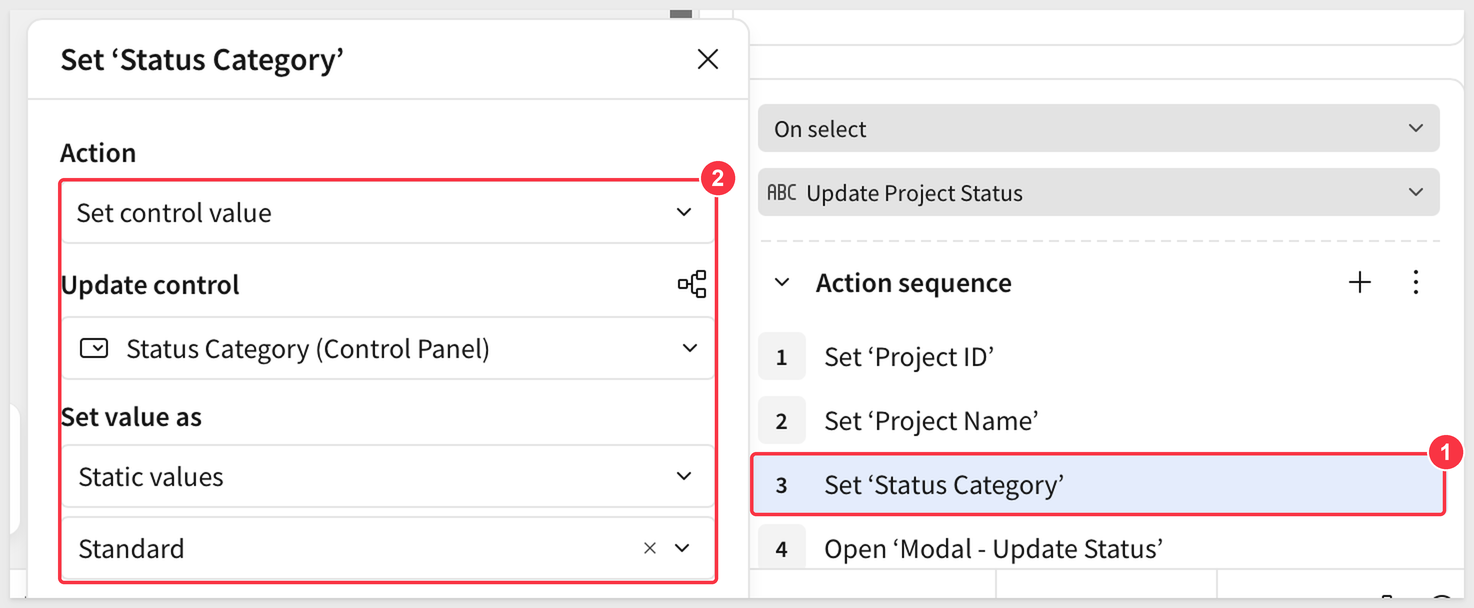
Reconfigure the duplicate by adding a Set control value action (1) before Open modal/drawer. It updates the Status Category control on the Control Panel using Static values set to Standard (2):
Step 7:
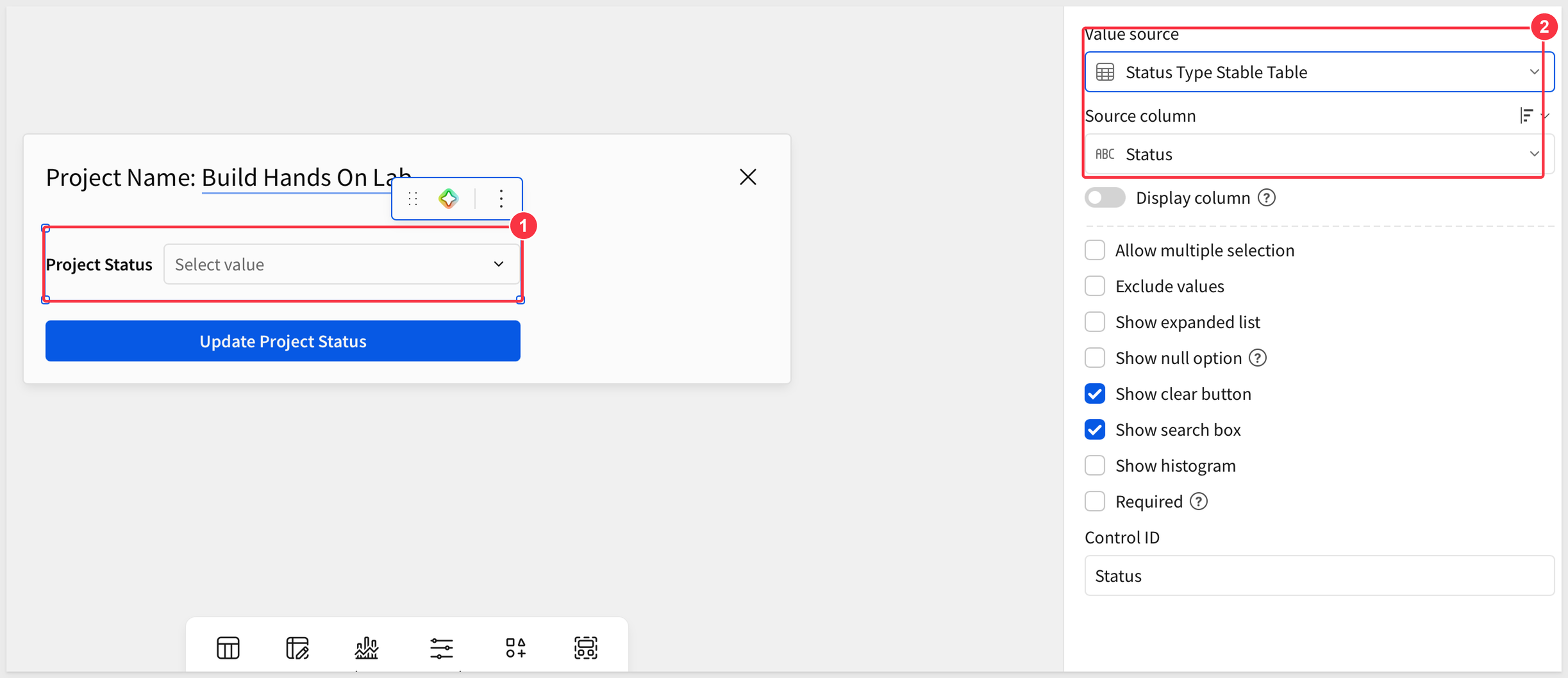
On the Modal - Update Status modal, select the list control titled Project Status (1).
Switch the Value source to the Status Type Stable Table from Control Panel and the Source column to Status (2):
Step 8:
Go back to the Project Tracker page and select the Project Tracker Input Table.
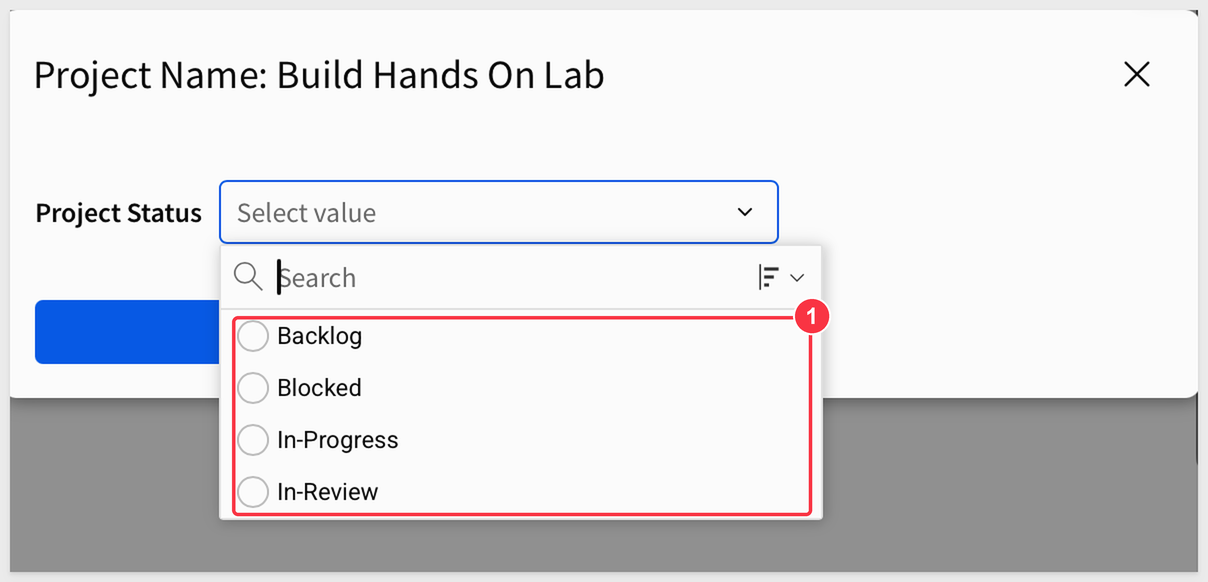
Click a cell with Update Status to test that only 4 options (1) appear on the modal's list control:
Step 9:
On the Project Tracker page, click the Project Reviewer View button in the segmented control.
Now select the Project Tracker Input Table > Actions and duplicate the most recent Update Project Status action.
Scroll to the bottom of the actions list to see the duplicate action.
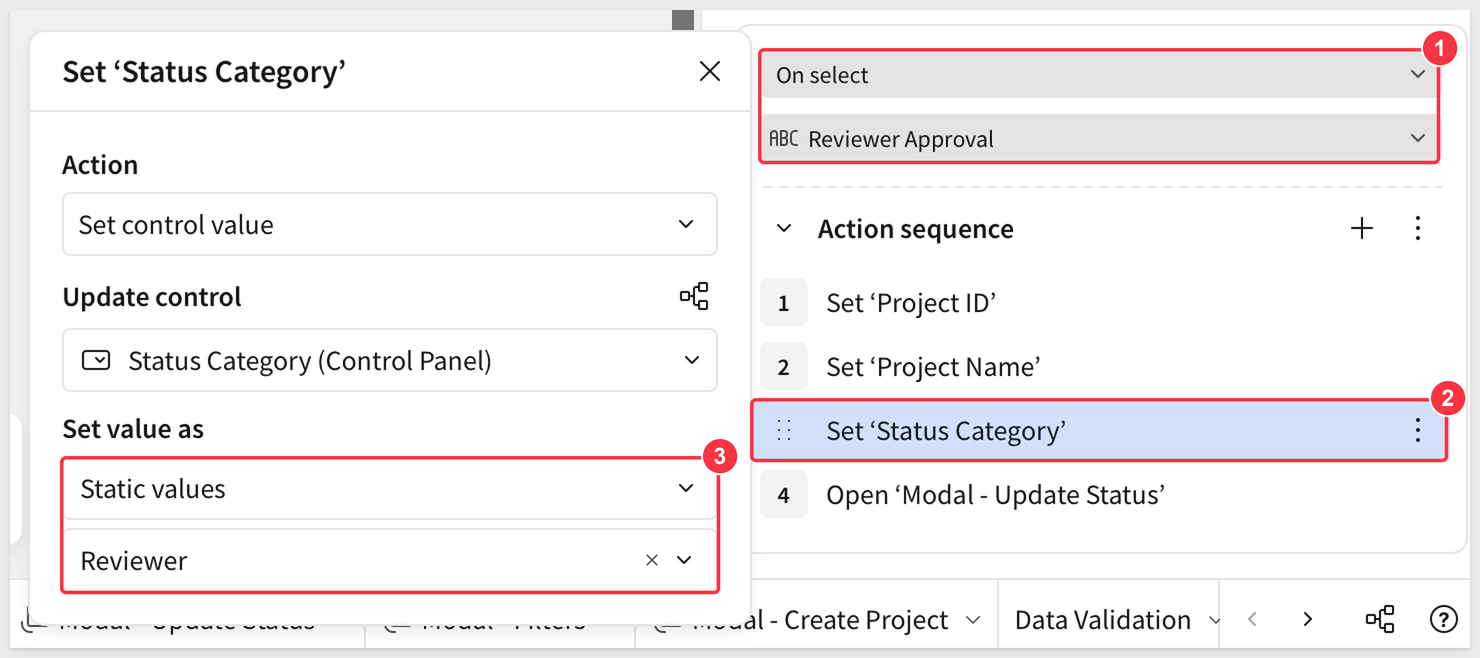
The duplicate runs On select for the Reviewer Approval column (1). Select its Set 'Status Category' action (2) and change the static value to Reviewer (3):
Step 10:
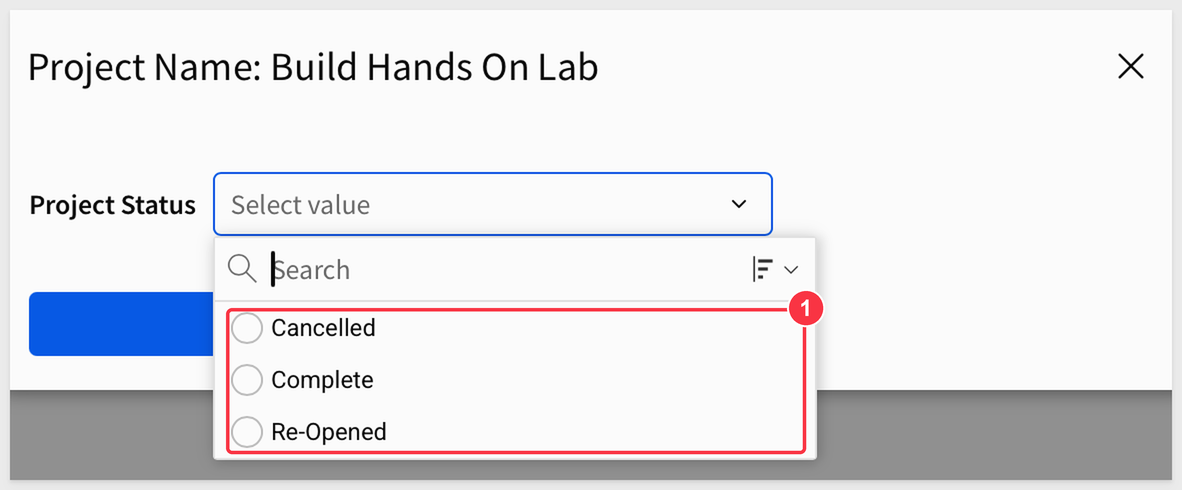
Select Click to Review in any cell and confirm again that the Modal - Update Status only shows the values (1) that correspond to the category Reviewer.
Test the view comparing Project Owner and Project Reviewer Views to test conditional actions and how these scenarios direct access, inputs, and functionality.
Step 11:
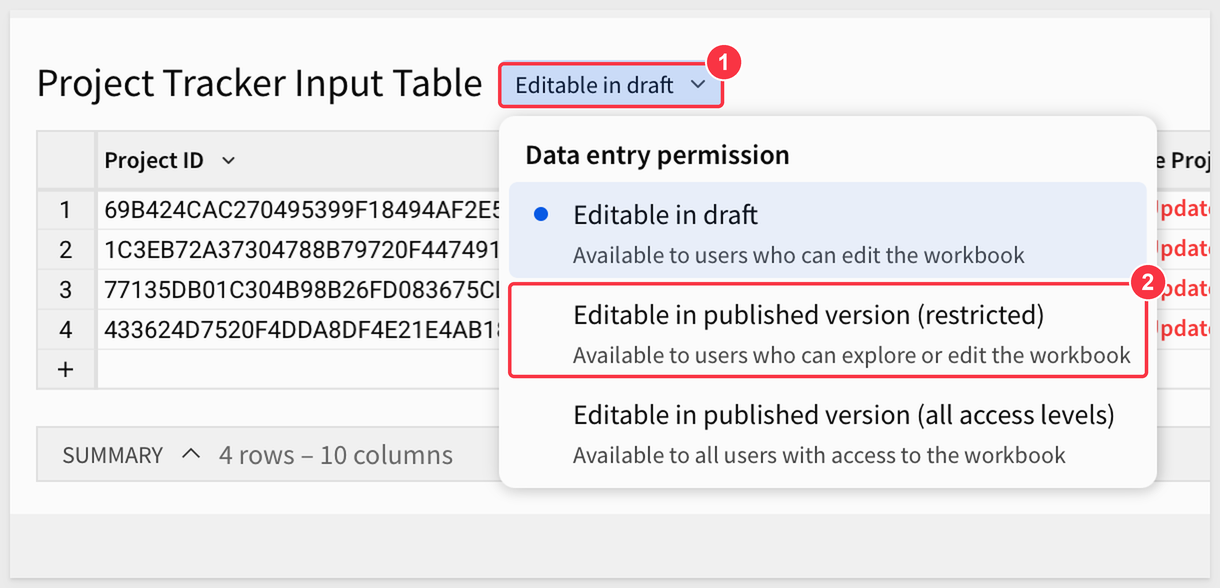
The input tables are set to Editable in draft, so the app cannot accept data entry in the Published version yet.
Open the data entry permission menu (1) on each of the three input tables: Project Tracker Input Table on the Project Tracker page, and Task Tracking Input Table and Status Update Input Table on the Control Panel page. Change the setting to Editable in published version (restricted) (2):
Step 12:
Hide all pages except the Project Tracker page and click Publish.
Open the Publish menu (1) and select Go to published version (2) to test the entire app:
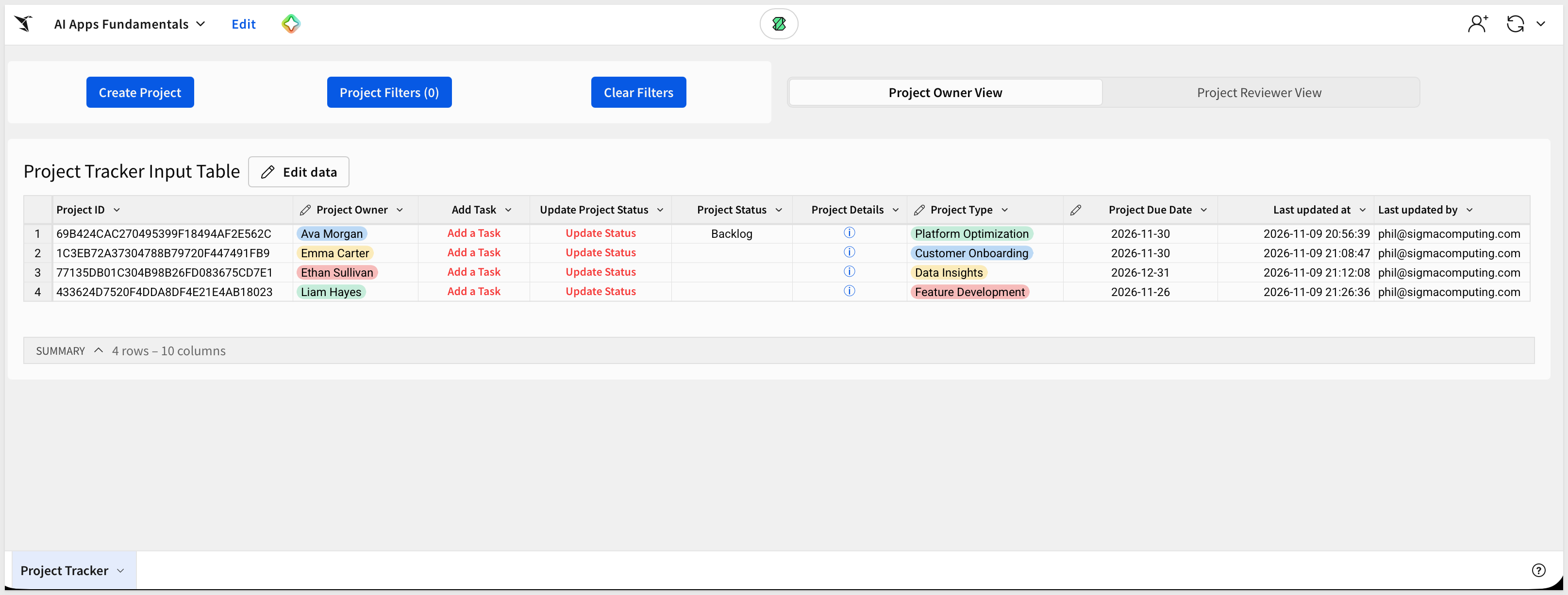
The app should look like this now:
Step 13: Data Lineage
Review the data lineage view to review and confirm all connections and lookups.
Click the edit link next to the workbook's name.
Open the workbook's lineage (1):
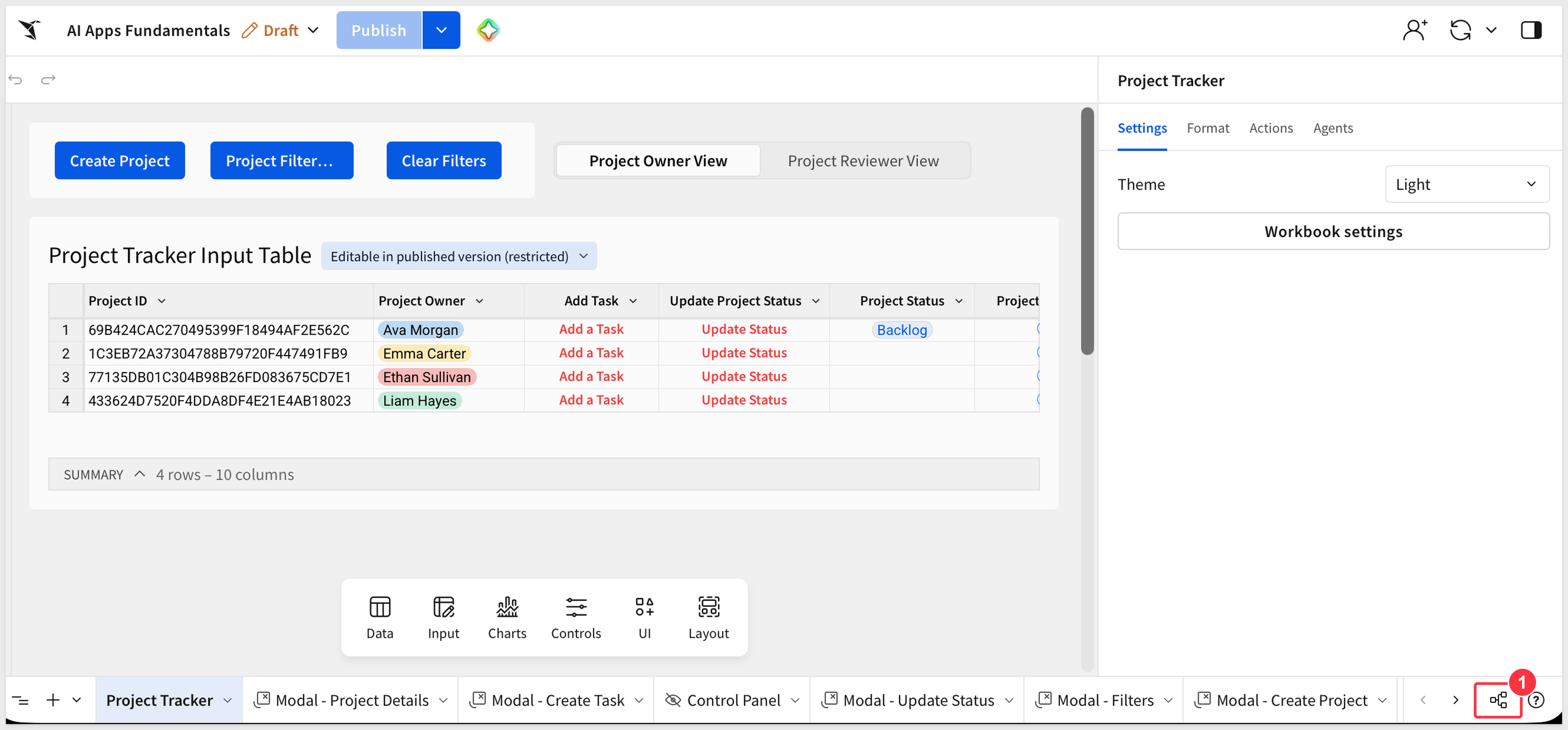
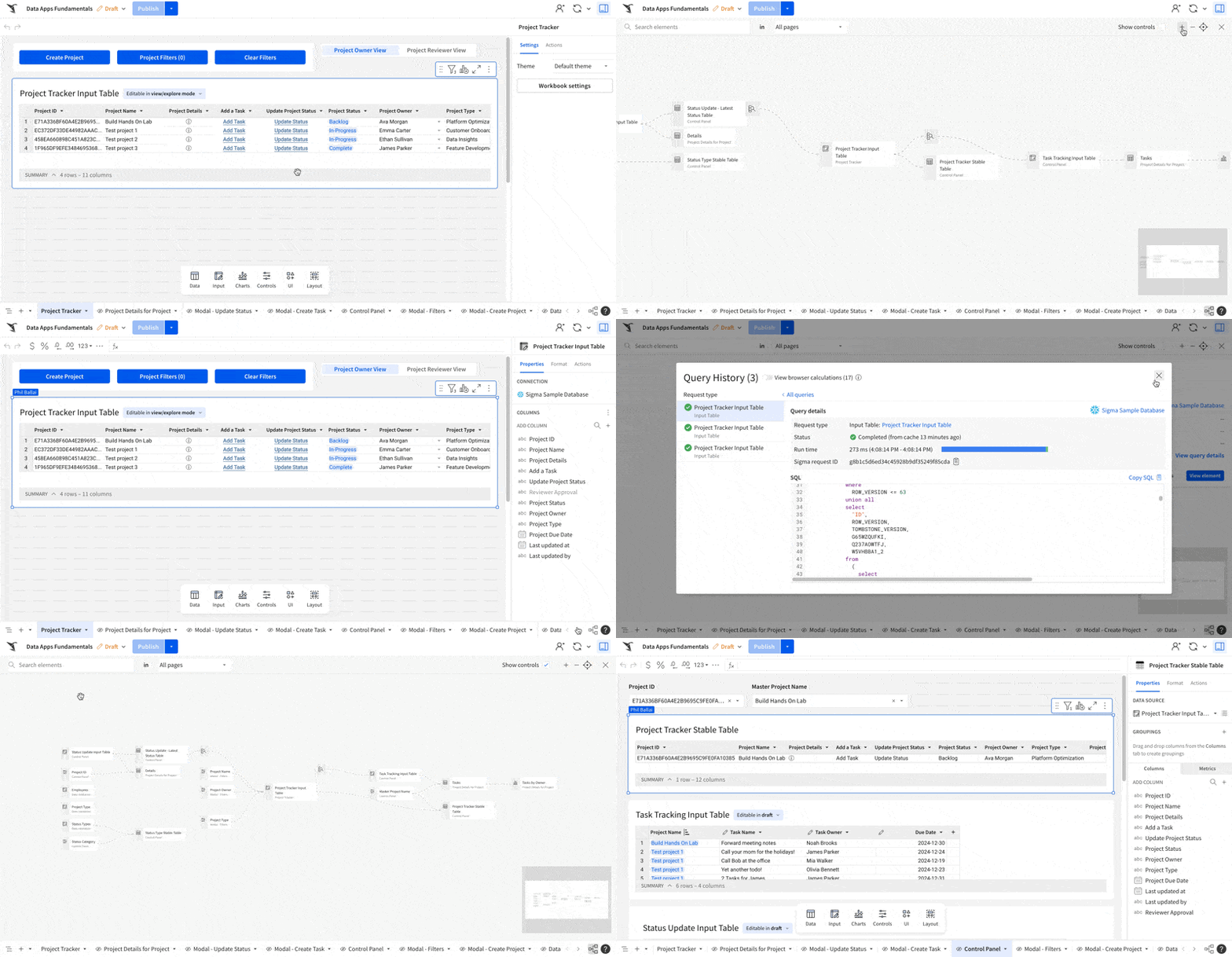
When workbooks become large, working with the lineage is a great way to find what you are after, jump right to the desired element and even see the SQL used to create the data for an element too.
Here is a quick demo:
To learn more about workbook data lineage in Sigma see View workbook data lineage
AI is built into Sigma throughout — not as a separate product or add-on, but as a native capability available where you already work. Whether you're writing formulas, exploring data, or building apps, AI is there to help.
Before we go further, read this section of Fundamentals 01: Overview which provides instructions for configuring AI based on your organizations requirements.
Sigma Assistant
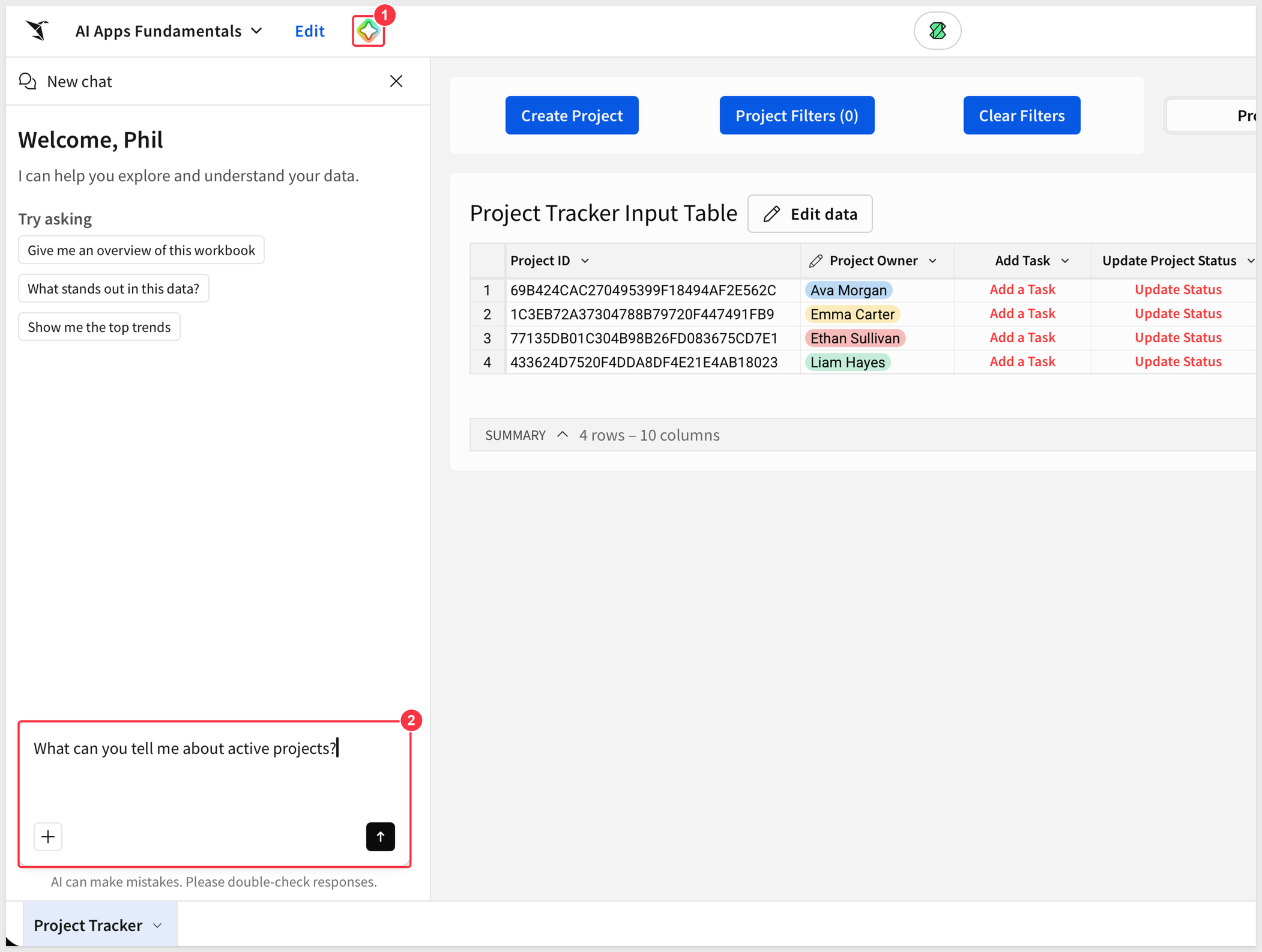
Once configured, we can simply ask Sigma Assistant natural language questions. Select the Sigma Assistant icon (1) in the workbook header and enter a question (2). For example:
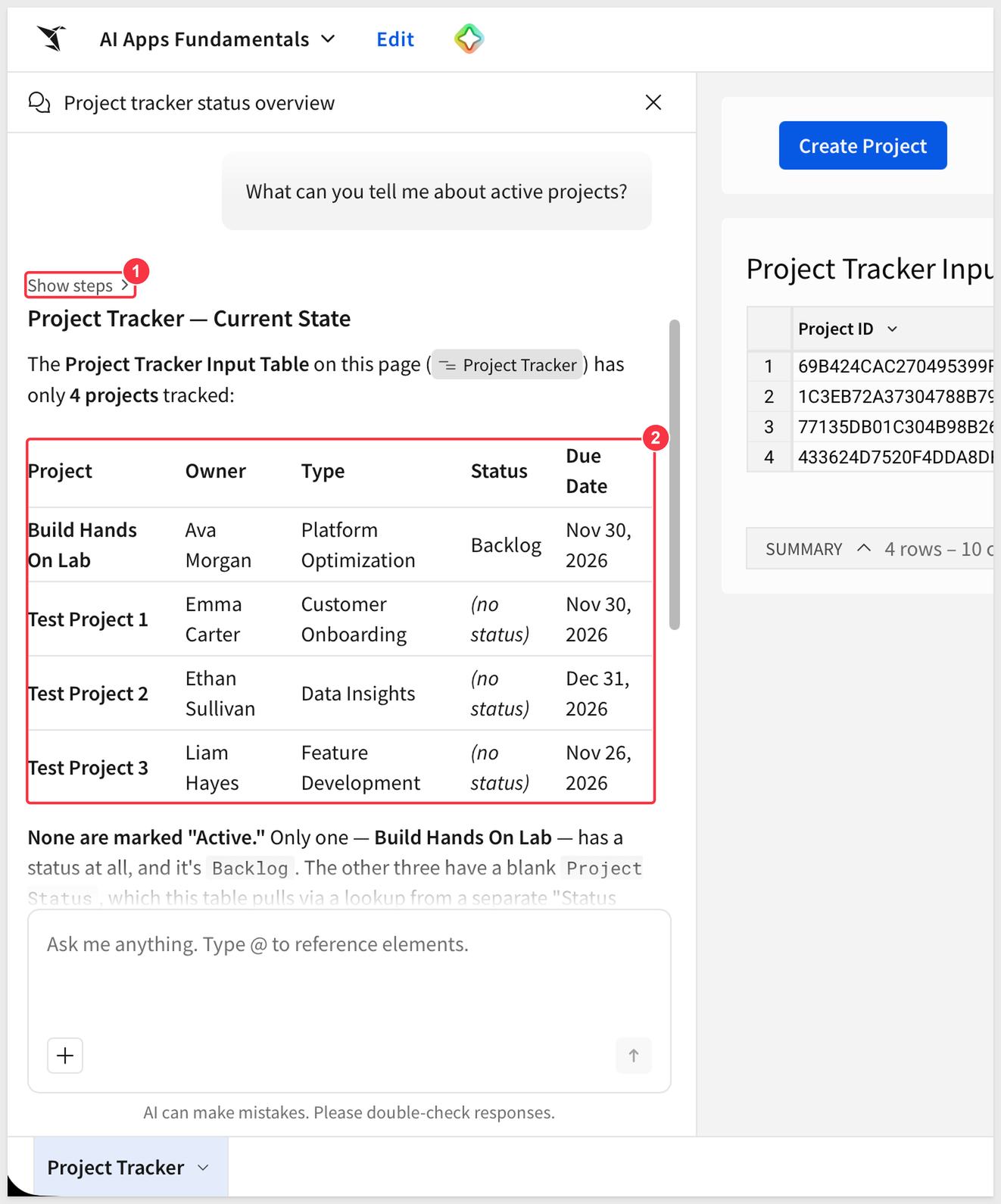
Sigma Assistant will respond, showing the steps it took (1) and providing details along the way (2):
We can do much more with Sigma's AI functionality, but that is enough for now.
For more information, see Get started with AI in Sigma
Also see the other AI related Quickstarts
Step 1:
With the bulk of the app functionality complete, visual design and accessibility is the next step.
Sigma provides many "out-of-the-box" themes; experiment with them and adjust from there as desired too.
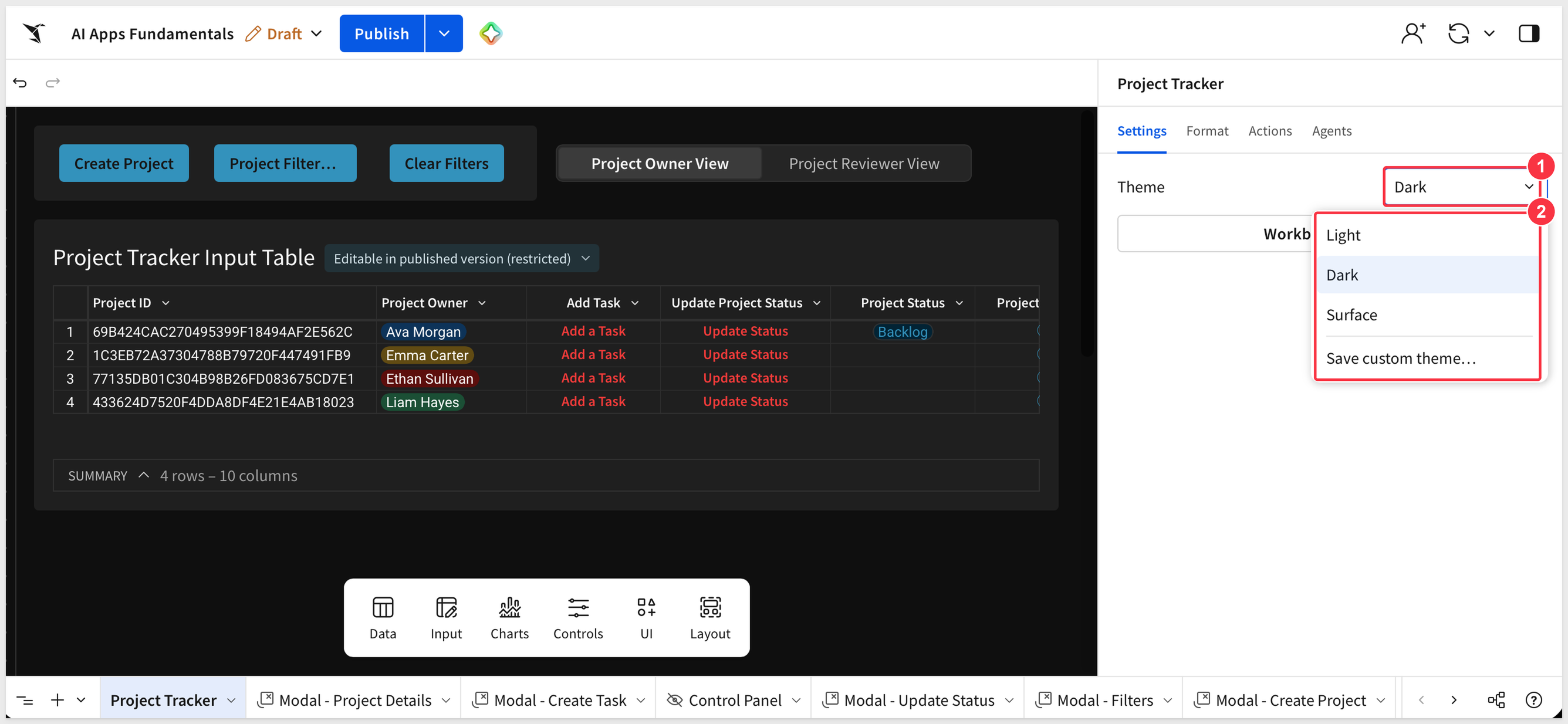
This enables a range of functionality including the ability to toggle between light and dark modes, preset swapping, custom colors that affect elements throughout the workbook (big time saver), fonts, layouts, and additional design settings. With nothing selected, open Settings in the element panel and choose a Theme (1) from the list of options (2):
Step 2: Containers - Containers - Containers
It is a good practice to package elements in containers in a manner that will be easy for users to access and understand.
We have also demonstrated the other cool benefit of using containers; they can be targeted by an action!
Step 3:
With Sigma, your AI apps can support whatever branding may be required.
You can customize to match your own branding and style considerations while maintaining accessibility and visual design best practices.
Images and icons can be added for additional personalization:
Here are some examples of styled AI apps in Sigma:
We built a complete project tracking app in Sigma, with data entry, status tracking, task management, an approval workflow and Sigma Assistant, all without writing code.
The core pattern is simple: input tables hold what people enter, controls and actions carry the logic, and modals present each task. The Control Panel page, with its master controls and stable tables, keeps the pages and modals coordinated as the app grows.
The approval workflow showed how a single segmented control with conditional actions gives different users a different view of the same workbook. The same approach fits any process where roles need to see different columns or choices.
A theme styles the whole app at once, and Sigma Assistant lets anyone ask questions of the same data. Once input tables, lookups and actions are connected, new workflows are mostly a matter of reusing these pieces.
Additional Resource Links
Blog
Community
Help Center
QuickStarts
Be sure to check out all the latest developments at Sigma's First Friday Feature page!